

78
,
: FREEZE:DRYINŒ
_
Integrating
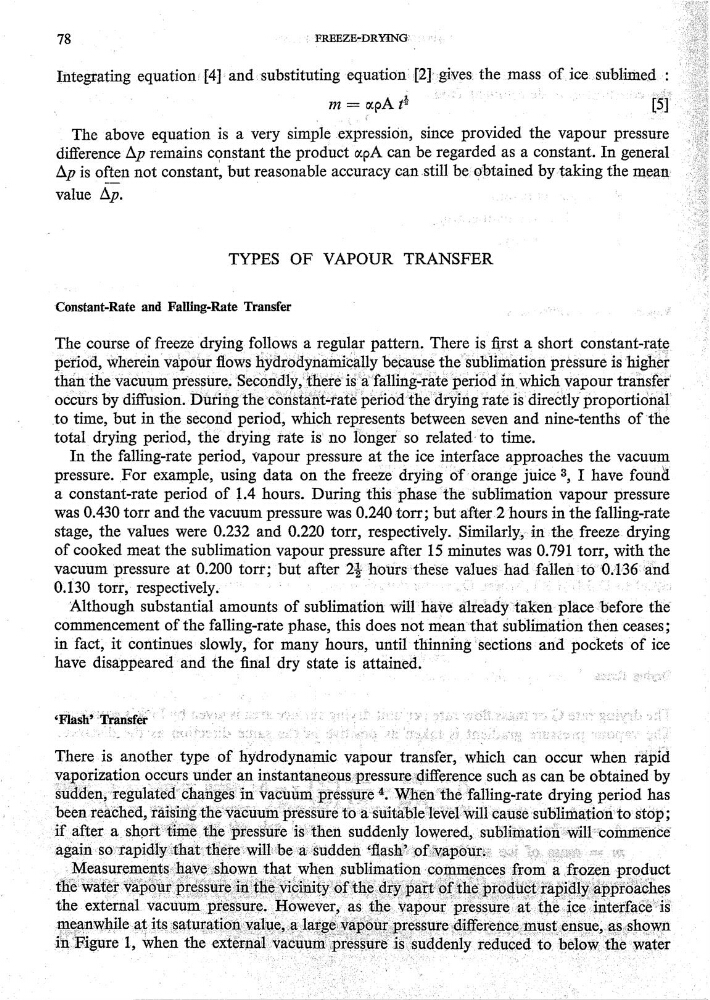
and:substituting equation =[2]:*:gives:the mass °fÏœ sublin‘1ed :
'
"“
'
The above equation is a very simple expression, since provided the vapour pressure
difference Ap remains constant the product ocpA can be regarded as a constant. In general
_
Ap is often not constant, but reasonable accuracy can still be obtained bytaking the mean—
Value Ap.
1
'
,
‘
,
TYPES OF VAPOUR TRANSFER
-
Constant—Rate and Falling—Rate Transfer
'
,
The course
of freeze drying follows a regular pattern. There is rst a short constant—rate
period, Wherein vapour ows hÿdrôdyabàlly because
pressure is higher
pressure,
transfer
_
'
occurs by diffusion. Dungthe *côñ'stätâaüë
proportio‘nal'
.
to time, but in the second period, which represents between seven and nine—tenthS of the
total drying period, the drying rate is no longer so relatedto time.
In the falling-rate period, Vapour pressure at the ice interface approaches the vacuum
pressure. For example, using data on the freeze dryingbf'0range juice 3, I have found
a constant—rate period of 1.4 hours. During this phase the sublimation vapour pressure
was 0.430 torr and the vacuum pressure was 0.240 torr; but after 2 hours in the falling—rate
stage, the values were 0.232 and 0.220 torr, respectively. Similarly,in the freeze drying
of cooked meat the sublimation vapour pressure after 15 minutes was 0.791 torr, With the
vacuum pressure
at 0.200 torr ; but after
hoùrs*thæe values had fallen*to"Of.=‘136'and
0.130 torr, respectively.
‘
‘
‘
“
‘
'
‘
-:
_w
.?
'
Although sub‘stantial amounts of sublimation Will‘h'aŸe' already ":talç‘e placebefore the
'
commencement of the falling—rate phase, this does not mean“that Sublimæion then ceases;
in fact, it continues slowly, for many hours, until thinning "Sections and poCkets of ice
'
have disappeared and the nal dry state is attained.
'
'
…
…
‘Flàsh’ Transfer
,“-'
.
"“.
.=
î,
“
,
Iï
1Ÿ'5;;“._
"
:…
‘.‘ÜÏ
T
'
There is another type of hydrodynamic. vapour transfer, which can occur When rapid
,
_
vaporization occurs under an inStantanœuspressuregdi‘erence such as can be obtained by
sudden,"regulated”,chagësî fin* vacuumpressure 4.“ When
drying period has
been reached, ra13mg
to
sublimation to Stop;
“if after a shortt1me the
suddenly lowered, .subliiaüôiä—ë=Willï*boinmence
"ash‘ïæ:ofÿwapurw
'
-
that….thn .sublîmaü‘0n commences from &
pmduct
the external vacuum pressureHowever, as the vapour pressure
the 1ce
iiiïFigure 1, When the extemalvacuumpressuœ
to, belowÏthe—water
,
: FREEZE:DRYINŒ
_
Integrating
and:substituting equation =[2]:*:gives:the mass °fÏœ sublin‘1ed :
'
"“
'
The above equation is a very simple expression, since provided the vapour pressure
difference Ap remains constant the product ocpA can be regarded as a constant. In general
_
Ap is often not constant, but reasonable accuracy can still be obtained bytaking the mean—
Value Ap.
1
'
,
‘
,
TYPES OF VAPOUR TRANSFER
-
Constant—Rate and Falling—Rate Transfer
'
,
The course
of freeze drying follows a regular pattern. There is rst a short constant—rate
period, Wherein vapour ows hÿdrôdyabàlly because
pressure is higher
pressure,
transfer
_
'
occurs by diffusion. Dungthe *côñ'stätâaüë
proportio‘nal'
.
to time, but in the second period, which represents between seven and nine—tenthS of the
total drying period, the drying rate is no longer so relatedto time.
In the falling-rate period, Vapour pressure at the ice interface approaches the vacuum
pressure. For example, using data on the freeze dryingbf'0range juice 3, I have found
a constant—rate period of 1.4 hours. During this phase the sublimation vapour pressure
was 0.430 torr and the vacuum pressure was 0.240 torr; but after 2 hours in the falling—rate
stage, the values were 0.232 and 0.220 torr, respectively. Similarly,in the freeze drying
of cooked meat the sublimation vapour pressure after 15 minutes was 0.791 torr, With the
vacuum pressure
at 0.200 torr ; but after
hoùrs*thæe values had fallen*to"Of.=‘136'and
0.130 torr, respectively.
‘
‘
‘
“
‘
'
‘
-:
_w
.?
'
Although sub‘stantial amounts of sublimation Will‘h'aŸe' already ":talç‘e placebefore the
'
commencement of the falling—rate phase, this does not mean“that Sublimæion then ceases;
in fact, it continues slowly, for many hours, until thinning "Sections and poCkets of ice
'
have disappeared and the nal dry state is attained.
'
'
…
…
‘Flàsh’ Transfer
,“-'
.
"“.
.=
î,
“
,
Iï
1Ÿ'5;;“._
"
:…
‘.‘ÜÏ
T
'
There is another type of hydrodynamic. vapour transfer, which can occur When rapid
,
_
vaporization occurs under an inStantanœuspressuregdi‘erence such as can be obtained by
sudden,"regulated”,chagësî fin* vacuumpressure 4.“ When
drying period has
been reached, ra13mg
to
sublimation to Stop;
“if after a shortt1me the
suddenly lowered, .subliiaüôiä—ë=Willï*boinmence
"ash‘ïæ:ofÿwapurw
'
-
that….thn .sublîmaü‘0n commences from &
pmduct
the external vacuum pressureHowever, as the vapour pressure
the 1ce
iiiïFigure 1, When the extemalvacuumpressuœ
to, belowÏthe—water