

ICE CRYSTÀLS
'
29
-
Too,
are the temperature and vapour density or solution_concentraüon along
._
_
way from the crystal,
_
_.
_'
,
'
,
Ts, ps are the temperature andvapour density or Solution concentration at the
crystal surface.
’
.
’
-
_
—
For growth,
.
‘
'
'
,
'
'
> Tœ
_.
.
,
For evaporation
'
_'
'
_
=
'
'
“
For growth or evaporatiOn in pure water, or in pure water vapeur, D is effectively
innite, and the growth is'described by equation [3] alone.
.
'
'
'
’
_
,
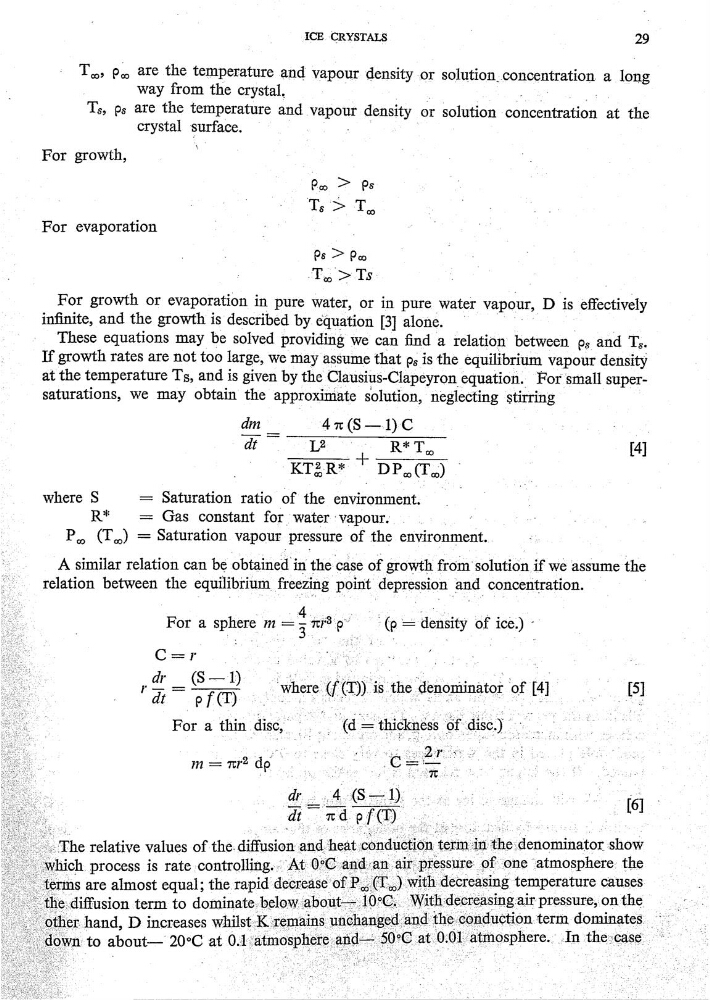
These equations maybe solved providing we can nd a relation between ps and Ts.
If growth rates are not too large, we may assume that {35 is the equilibrium vapour densitÿ
at the temperature Ts, and is given by
equation. For‘ Small supersaturations, we may obtain the approxiniätte solution, neglecting stirring
'
d_ï_
4n(S—l)C
,
—
_
,
dt
,
L2
R*Tœ
“
[4]
.
’KTËOR*
.
DPœ(Too)_
_
'
where S
:
Saturation ratio of the environment.
R*
:
Gas constant forwater vapour; .
_
»
_
-
,
.
_
,.
=
Pœ (Too) = Saturation vapeur pressure of the environment.,
«',—
A similar relation can be obtainedin the case of growth from'soluti0n if we assume the
relation between the
point depression
concetration.
_
'
,
.
-_
_
,
.
For a sphere m =‘
5
71739“
‘(9 ‘=“desrty of ice.) "
_
r — =
————_—
(I)) 18…—th6.deanmatox of [4]
_
_
[5]
m : nr2 dpÏ
C
,
 Ü
,Ï…{
'
'
Îhe relative values of the diusio andheatcondWf—lontel‘ml the ;.dencminator show
Wh10h_process is rate controlling At 0°Candanairpressureofone "atmosphere the
,
terms are almost equal; therapid—
_:decreàismg temperature
causes
…
thed1‘usmnterm to
otherhand, D increases
dommateS»
down to about—' 20°C at
»In theff“?Së: ; f
'
29
-
Too,
are the temperature and vapour density or solution_concentraüon along
._
_
way from the crystal,
_
_.
_'
,
'
,
Ts, ps are the temperature andvapour density or Solution concentration at the
crystal surface.
’
.
’
-
_
—
For growth,
.
‘
'
'
,
'
'
> Tœ
_.
.
,
For evaporation
'
_'
'
_
=
'
'
“
For growth or evaporatiOn in pure water, or in pure water vapeur, D is effectively
innite, and the growth is'described by equation [3] alone.
.
'
'
'
’
_
,
These equations maybe solved providing we can nd a relation between ps and Ts.
If growth rates are not too large, we may assume that {35 is the equilibrium vapour densitÿ
at the temperature Ts, and is given by
equation. For‘ Small supersaturations, we may obtain the approxiniätte solution, neglecting stirring
'
d_ï_
4n(S—l)C
,
—
_
,
dt
,
L2
R*Tœ
“
[4]
.
’KTËOR*
.
DPœ(Too)_
_
'
where S
:
Saturation ratio of the environment.
R*
:
Gas constant forwater vapour; .
_
»
_
-
,
.
_
,.
=
Pœ (Too) = Saturation vapeur pressure of the environment.,
«',—
A similar relation can be obtainedin the case of growth from'soluti0n if we assume the
relation between the
point depression
concetration.
_
'
,
.
-_
_
,
.
For a sphere m =‘
5
71739“
‘(9 ‘=“desrty of ice.) "
_
r — =
————_—
(I)) 18…—th6.deanmatox of [4]
_
_
[5]
m : nr2 dpÏ
C
,
 Ü
,Ï…{
'
'
Îhe relative values of the diusio andheatcondWf—lontel‘ml the ;.dencminator show
Wh10h_process is rate controlling At 0°Candanairpressureofone "atmosphere the
,
terms are almost equal; therapid—
_:decreàismg temperature
causes
…
thed1‘usmnterm to
otherhand, D increases
dommateS»
down to about—' 20°C at
»In theff“?Së: ; f