

22
FREEZB—DRYING
.
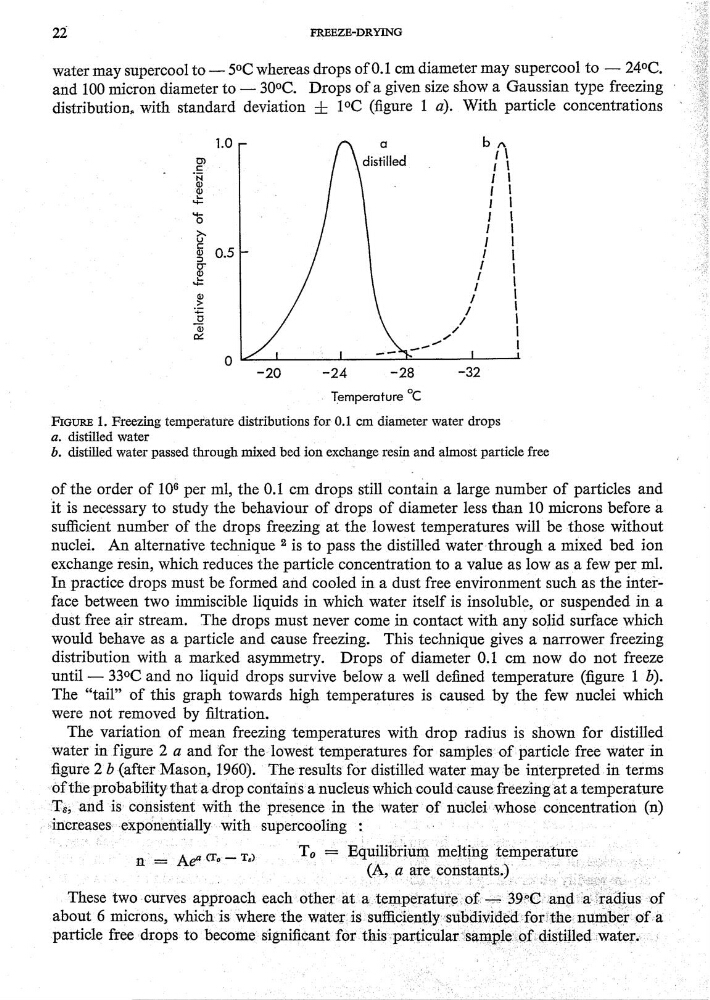
water may supercool to —— 5°C whereas drops of 0.1 cm diameter may supercool to —— 24°C.
and 100 micron diameter to — 30°C. Drops ofa given size show a Gaussian type freezing '
distribution, with standard deviation 3: 10€ (gure 1 a). With particle concentrations
‘
1.0
a
b ,\
‘
_
g
distilled
_
" \
ë
»
Il l
Î
; {
,
°
.
,
.
g
! l
“=:
_
%
0.5
[:
=
…
_
!
l
,
‘
œ
,
l
.a
’
\
,
%
//
‘
‘
…
.
/,
{
0
—20
—24
—28
—32
-
Temperature °C
—
FIGURE 1. Freezing temperature distributions for 0.1 cm diameter water drops
a. distilled water
-
b. distilled water passed through mixed bed ion exchange resin and almost particle free
of the order of 106 per ml, the 0.1 cm drops still contain a large number of particles and
it is necessary to study the behaviour of drops of diameter less than 10 microns before a
-
suicierit number of the drops freezing at the lowest temperatures Will be those without
nuclei.
An alternative technique
2 is to pass the distilled water«through a mixed bed ion
exchange resin, which reduces the particle concentration to a value as low as a few per ml.
In practice drops must be formed and cooled in a dust free environment such as the interface between two immiscible liquids in which water itself is insoluble, or suspended in a
,
duSt free air stream. The drops must never come in contact with any solid surface which
would behave as a particle and cause freezing. This technique gives a narrower freezing
distribution with a marked asymmetry.
Drops of diameter 0.1 cm now do not freeze
until -— 33°C and no liquid drops survive below a well dened temperature (gure 1 I)).
The “tail” of this graph towards high temperatures is caused by the few nuclei which
were not removed by ltration.
'
‘
,
The variation of mean freezing temperatures with drop radins is shown for distilled
water in figure 2 a and for the loweSt temperatures for samples of particle free Water in
gure 2 b (after Mason, 1960). The results for
watermay be interpreted in terms
probability that ‘a»dr0p cOritainSa'nucleus which couldfcause freeZingàt a temperature
‘:T3, “and is consistent with the presence in the water of nuCleiwhose cencentration (n)
increases— «_exponentially with supercoOling :
°
,
‘
‘
-
"
-
=; Àe“ m—
To, =” Equilibùfä1
.…
,
…
'
,
,
_
.,
,
_
(A, a
i. 1
These two curves approach each other
3990 ;andêàäî‘tetdius of
-
about 6 microns, whiCh
where the water is -suîc‘iently:sùbdiVidèdforthe number
particle free drops to become signicant fOr
»
FREEZB—DRYING
.
water may supercool to —— 5°C whereas drops of 0.1 cm diameter may supercool to —— 24°C.
and 100 micron diameter to — 30°C. Drops ofa given size show a Gaussian type freezing '
distribution, with standard deviation 3: 10€ (gure 1 a). With particle concentrations
‘
1.0
a
b ,\
‘
_
g
distilled
_
" \
ë
»
Il l
Î
; {
,
°
.
,
.
g
! l
“=:
_
%
0.5
[:
=
…
_
!
l
,
‘
œ
,
l
.a
’
\
,
%
//
‘
‘
…
.
/,
{
0
—20
—24
—28
—32
-
Temperature °C
—
FIGURE 1. Freezing temperature distributions for 0.1 cm diameter water drops
a. distilled water
-
b. distilled water passed through mixed bed ion exchange resin and almost particle free
of the order of 106 per ml, the 0.1 cm drops still contain a large number of particles and
it is necessary to study the behaviour of drops of diameter less than 10 microns before a
-
suicierit number of the drops freezing at the lowest temperatures Will be those without
nuclei.
An alternative technique
2 is to pass the distilled water«through a mixed bed ion
exchange resin, which reduces the particle concentration to a value as low as a few per ml.
In practice drops must be formed and cooled in a dust free environment such as the interface between two immiscible liquids in which water itself is insoluble, or suspended in a
,
duSt free air stream. The drops must never come in contact with any solid surface which
would behave as a particle and cause freezing. This technique gives a narrower freezing
distribution with a marked asymmetry.
Drops of diameter 0.1 cm now do not freeze
until -— 33°C and no liquid drops survive below a well dened temperature (gure 1 I)).
The “tail” of this graph towards high temperatures is caused by the few nuclei which
were not removed by ltration.
'
‘
,
The variation of mean freezing temperatures with drop radins is shown for distilled
water in figure 2 a and for the loweSt temperatures for samples of particle free Water in
gure 2 b (after Mason, 1960). The results for
watermay be interpreted in terms
probability that ‘a»dr0p cOritainSa'nucleus which couldfcause freeZingàt a temperature
‘:T3, “and is consistent with the presence in the water of nuCleiwhose cencentration (n)
increases— «_exponentially with supercoOling :
°
,
‘
‘
-
"
-
=; Àe“ m—
To, =” Equilibùfä1
.…
,
…
'
,
,
_
.,
,
_
(A, a
i. 1
These two curves approach each other
3990 ;andêàäî‘tetdius of
-
about 6 microns, whiCh
where the water is -suîc‘iently:sùbdiVidèdforthe number
particle free drops to become signicant fOr
»