

148
.
FREEZE—DRYING
freezing, storage
procedures are all together inuencing the food quality
judgement, and we are unable“ to establish the inuence of each of them strictly
According to, our present knowledge We may except that, in principle, the following
*
factors will affect the stability
foods during storage :
1. The nature of the specic commodity (raw materials properties as quality, structure,
composition, variety, etc.).
'
.
2. Handling and pretreatment (method of handling, blanching and packaging, used
packaging material, etc.).
5
‘
-
3. Freezing method (freezing‘C0ditions as temperature, rate offreezing, weight loss, etc.).
'
4. Storage conditions (temperature, humidity, air velocity, duration of storage, etc.).
5. Thawing method and preparation for consumption.
…
2. CHANGES DURING FREEZING
'
According to a good commercial practice the freezing of foodstu‘s is usually done quite
,
rapidly. The average e‘eCtiVe rate of freezing
1 lays practically between 0,1 and 5 cm/h.
(J‘
The main changes o”cŒrring during the relative short freezing time are the freezing out
.
of water, combined with an expansion of about 9 % of its volume. The percentage of
_
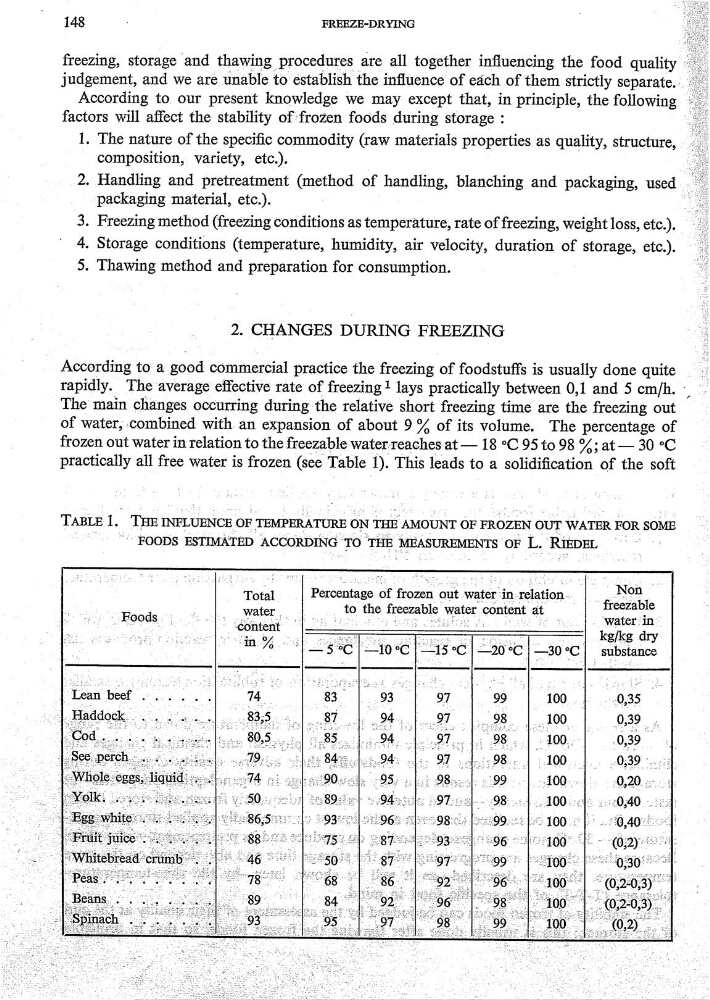
frozen out water in relation to the freezable water reaches at —— 18 °C 95 to 98 %; at —— 30 °C
“
practically all free water is frozen (sééTablel). This leads to a solidication of the soft
'
‘
TABLE 1. THE INFLUENCE OE TEMÈERATÙRE ON THE AMOÙNT OF FROZEN OUT WATER FOR SOME
‘
'
*
'
FOODS EsTMATEO ACCORDING‘TOTÆTŒASURENŒNŒ “OE L.
‘
.
frozen out
N.°
-
_
water
,
to the freezable water cOnt6ta't
7. Foods
.
C,
…
W3æf;1‘,
"
m%
,
,
.
kg/kg dry
_
-
-
-
°C
—10 °C
—15 °C —20
_—,30
substance
_
_
.”
74
Ï93
…o,3s
Seepemh 798494 97 98
100
,
039
Y01k
50…
89
94
97 .…
100 054,40
Eggwhrœ 865
93 96 9899
0,40
Whitebreadcrumb46 5087 9799
100 030
.
FREEZE—DRYING
freezing, storage
procedures are all together inuencing the food quality
judgement, and we are unable“ to establish the inuence of each of them strictly
According to, our present knowledge We may except that, in principle, the following
*
factors will affect the stability
foods during storage :
1. The nature of the specic commodity (raw materials properties as quality, structure,
composition, variety, etc.).
'
.
2. Handling and pretreatment (method of handling, blanching and packaging, used
packaging material, etc.).
5
‘
-
3. Freezing method (freezing‘C0ditions as temperature, rate offreezing, weight loss, etc.).
'
4. Storage conditions (temperature, humidity, air velocity, duration of storage, etc.).
5. Thawing method and preparation for consumption.
…
2. CHANGES DURING FREEZING
'
According to a good commercial practice the freezing of foodstu‘s is usually done quite
,
rapidly. The average e‘eCtiVe rate of freezing
1 lays practically between 0,1 and 5 cm/h.
(J‘
The main changes o”cŒrring during the relative short freezing time are the freezing out
.
of water, combined with an expansion of about 9 % of its volume. The percentage of
_
frozen out water in relation to the freezable water reaches at —— 18 °C 95 to 98 %; at —— 30 °C
“
practically all free water is frozen (sééTablel). This leads to a solidication of the soft
'
‘
TABLE 1. THE INFLUENCE OE TEMÈERATÙRE ON THE AMOÙNT OF FROZEN OUT WATER FOR SOME
‘
'
*
'
FOODS EsTMATEO ACCORDING‘TOTÆTŒASURENŒNŒ “OE L.
‘
.
frozen out
N.°
-
_
water
,
to the freezable water cOnt6ta't
7. Foods
.
C,
…
W3æf;1‘,
"
m%
,
,
.
kg/kg dry
_
-
-
-
°C
—10 °C
—15 °C —20
_—,30
substance
_
_
.”
74
Ï93
…o,3s
Seepemh 798494 97 98
100
,
039
Y01k
50…
89
94
97 .…
100 054,40
Eggwhrœ 865
93 96 9899
0,40
Whitebreadcrumb46 5087 9799
100 030