

THERMAL DEGRADA‘I‘ION OF vmusas
107
APPARATUS FOR DRYING BY SUBLIMATION IN VACUO
To determine the parameters necessary during drying by sublimation in vacuo to assure
the retention of maximum activity of dried suspensions of viruses, we use a manifold—type
molecular still. In order to sublimate ice from suspensions of virus maintained at —— 76 °C
(the lowest temperature used), it was necessary to build a vacuum apparatus consisting
of a three—stage oil diffusion pump, high vacuum stopcocks, O-ring connectors and suitable
condensers. The immersion type condensers were cooled by liquid nitrogen. The samples
to be dried were frozen in specially constructed tubes and attached to the manifolds of the
vacuum apparatus by high vacuum, standard taper, glass joints. As presently constructed,
16 paired aliquants (for a total of 32 individual samples) of a given suspension of virus can
be dried simultaneoulsy While maintained at different temperatures. To maintain the
temperatures desired during the removal of water molecules, the ends of the tubes were
covered by suitable low temperature liquids or sludges. Ionization gauges attached to the
manifolds between the evaporating surfaces (samples) and the condenser surfaces (traps)
"
allowed us to determine the end—point of dehydration.
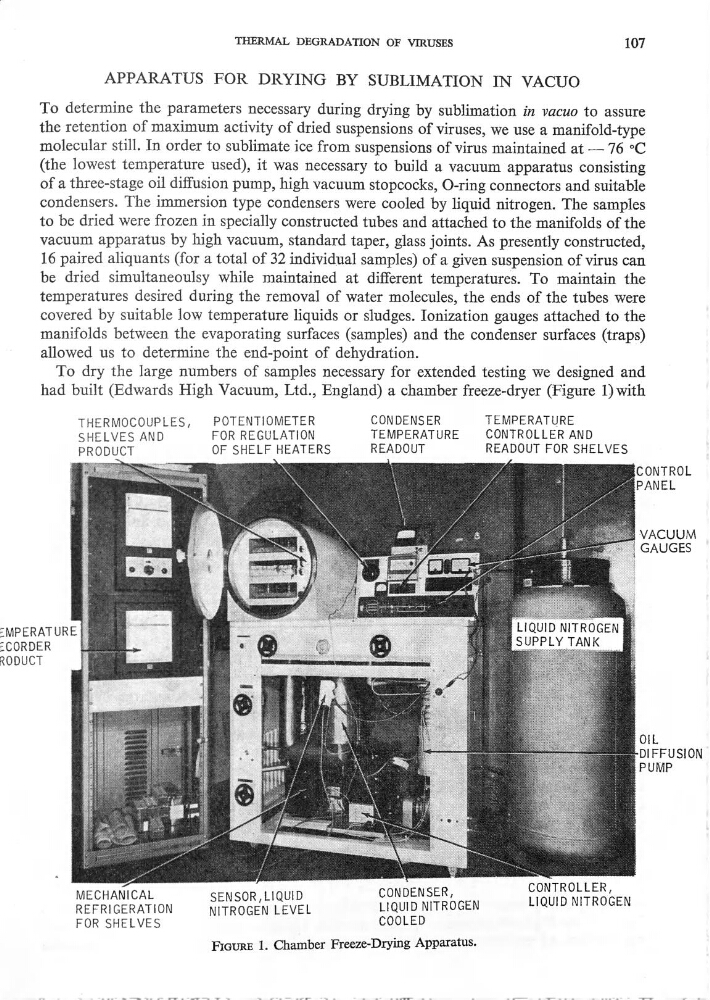
To dry the large numbers of samples necessary for extended testing we designed and
had built {Edwards High Vacuum, Ltd., England) a chamber freeze—dryer (Figure 1) With
THERMOCOUPLES,
POTENTIOMETER
CONDENSER
TEMPERATURE
'
SHELVES AND
FOR REGULATION
TEMPERATURE
CONTROLLER AND
PRODUCT
OF SHELF HEATERS
READOUT
READOUT FOR SHELVES
'
.
_
,
_
_
*
_
ONTROL
_
_
,
‘
'
ANEL
'
VACUUM
_
_
GAUGES
,
-
-
LIQUH)NTTROGEN
;MPERATURE
ECORDER
î
_'
;
.
SUPPLY TANK
'
=
OIL
..:
FFUSION
_
»
'
PUMP
.
CONTROLLER
MECHANICAL
SENSORAJQUID
CONDENSER,
,
‘
REFRIGERATION
NITROGEN LEVEL
LIQUH)NFTROGEN
LIQUH3NVTROGEN
FOR SHELVES
COOLED
_
FIGURE 1. Chamber Fræze-Drymg‘AppaŒ'us-
107
APPARATUS FOR DRYING BY SUBLIMATION IN VACUO
To determine the parameters necessary during drying by sublimation in vacuo to assure
the retention of maximum activity of dried suspensions of viruses, we use a manifold—type
molecular still. In order to sublimate ice from suspensions of virus maintained at —— 76 °C
(the lowest temperature used), it was necessary to build a vacuum apparatus consisting
of a three—stage oil diffusion pump, high vacuum stopcocks, O-ring connectors and suitable
condensers. The immersion type condensers were cooled by liquid nitrogen. The samples
to be dried were frozen in specially constructed tubes and attached to the manifolds of the
vacuum apparatus by high vacuum, standard taper, glass joints. As presently constructed,
16 paired aliquants (for a total of 32 individual samples) of a given suspension of virus can
be dried simultaneoulsy While maintained at different temperatures. To maintain the
temperatures desired during the removal of water molecules, the ends of the tubes were
covered by suitable low temperature liquids or sludges. Ionization gauges attached to the
manifolds between the evaporating surfaces (samples) and the condenser surfaces (traps)
"
allowed us to determine the end—point of dehydration.
To dry the large numbers of samples necessary for extended testing we designed and
had built {Edwards High Vacuum, Ltd., England) a chamber freeze—dryer (Figure 1) With
THERMOCOUPLES,
POTENTIOMETER
CONDENSER
TEMPERATURE
'
SHELVES AND
FOR REGULATION
TEMPERATURE
CONTROLLER AND
PRODUCT
OF SHELF HEATERS
READOUT
READOUT FOR SHELVES
'
.
_
,
_
_
*
_
ONTROL
_
_
,
‘
'
ANEL
'
VACUUM
_
_
GAUGES
,
-
-
LIQUH)NTTROGEN
;MPERATURE
ECORDER
î
_'
;
.
SUPPLY TANK
'
=
OIL
..:
FFUSION
_
»
'
PUMP
.
CONTROLLER
MECHANICAL
SENSORAJQUID
CONDENSER,
,
‘
REFRIGERATION
NITROGEN LEVEL
LIQUH)NFTROGEN
LIQUH3NVTROGEN
FOR SHELVES
COOLED
_
FIGURE 1. Chamber Fræze-Drymg‘AppaŒ'us-