

THERMAL DEGRADATION on vmnsns
105
absence of peripheral structural lipids (solvent resistant ) can be used as a basis,
for d1v1dmg v1ruses 1nto two groups.
.
…
-.
,
_
'
.
Limiting Membrane; the protein coat of the virus particle is called the capsid, the structure
composed of coat
and enclosed
viral nucleic acid is the nucleocapsid. Some viruses
possess an add1tronal covering or envelope about the nucleocapsid, others have none
and are naked.
'
‘
pH Sensitivity; exposure of viral agents to pH 3.0 for 30 minutes dierentiates on acid labile
v1rus group (loss of 1 loglo or more in titer) and an acid stable virus
of full t1ter or a loss of less than 1 log… in activity).
-
,
Heat Sensitivity; susceptibility of viruses to heat, 50 °C for 30 minutes, appears to be
a property characteristic of certain groups of viruses. On this basis Viruses'Can be'separated
into groups that are thermosiable and others that are therMolabile.
_
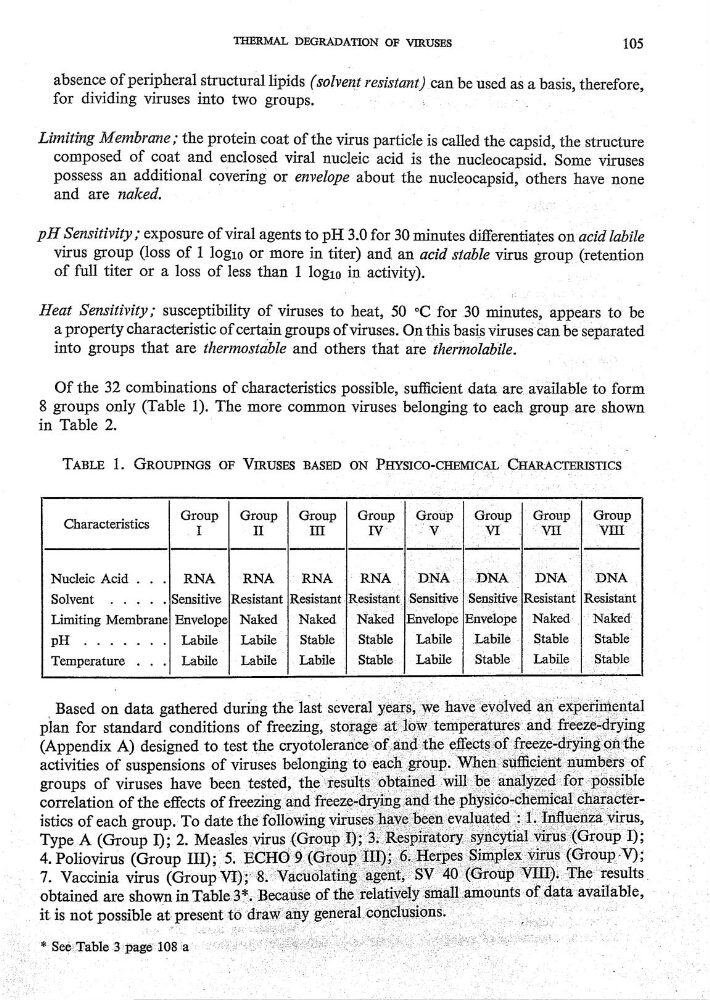
Of the 32 combinations of characteristics possible, suîcient data
available to form
8 groups only (Table 1). The more common viruses belonging to each group…are shown
in Table 2.
.
_
TABLE 1. GROUPINGS OF VIRUSES BASED ON PHYSICO_—CHEMIÇAL CHARACŒMSÏÏCS
Characteristics
Cirî)up Gr&up GËIUP
G{,Ëp
Nucleic Acid
.
.
.
RNA
RNA
RNA
?
DNÂ DNA
DNA
DNA
Solvent
.
.
.
.
.
Sensitive Resistant Resistant Resistant Sensitive -Sensitîve;Resistànt ResiSta‘nt
Limiting Membrane Envelope Naked
Naked
Naked Envelope Envelope Nakedg
pH
.
.
.
.
.
.
.
Labile
Labüe '
Stable
Stable
Labile
.Labilè '
Stable
_
Stable
Temperature . . .
Labile
Labe
Stable
Labile
Stable
_
Labile | Stable
Based on data gathered during thelast
Years»Wehaveevolved an expenmental
plan for standard conditions of
freeze—drymg
.
(Appendix A) designed to test the
,
activities of suspensions of viruses belongirïg to eachgroup Whensuimentnumbersof
-
groups of
have been tested, theultbtmeiwlbnlydfpbl
‘
correlation of the e'ects of Çfreezürg (and“ freeze-drymgandthe physrco-chem1ælcharacær—
istics of each group. To date the f0116wing museshavebeenevaluaædllnuemavnus,
Type A (Group 1); 2. Measlesv1ru8(GmupD3Respat0fysynclalmus(Œ°“P D5
4. Poliovirus (Group III); 5. ECHOMGmupHI)6HerpesSmplexmu8(Gmup "3
,
.
7. Vaccinia virus (GeotepVI)8VacuoletmgagthSV4°<Œ°“PVŒ)ThŒS““S
-
,
obtained are shown
of
—
.
it is not possible
‘
"î_‘_'
f
..
,
* Seéa,Table 3=pagéî 108 a
-
,
105
absence of peripheral structural lipids (solvent resistant ) can be used as a basis,
for d1v1dmg v1ruses 1nto two groups.
.
…
-.
,
_
'
.
Limiting Membrane; the protein coat of the virus particle is called the capsid, the structure
composed of coat
and enclosed
viral nucleic acid is the nucleocapsid. Some viruses
possess an add1tronal covering or envelope about the nucleocapsid, others have none
and are naked.
'
‘
pH Sensitivity; exposure of viral agents to pH 3.0 for 30 minutes dierentiates on acid labile
v1rus group (loss of 1 loglo or more in titer) and an acid stable virus
of full t1ter or a loss of less than 1 log… in activity).
-
,
Heat Sensitivity; susceptibility of viruses to heat, 50 °C for 30 minutes, appears to be
a property characteristic of certain groups of viruses. On this basis Viruses'Can be'separated
into groups that are thermosiable and others that are therMolabile.
_
Of the 32 combinations of characteristics possible, suîcient data
available to form
8 groups only (Table 1). The more common viruses belonging to each group…are shown
in Table 2.
.
_
TABLE 1. GROUPINGS OF VIRUSES BASED ON PHYSICO_—CHEMIÇAL CHARACŒMSÏÏCS
Characteristics
Cirî)up Gr&up GËIUP
G{,Ëp
Nucleic Acid
.
.
.
RNA
RNA
RNA
?
DNÂ DNA
DNA
DNA
Solvent
.
.
.
.
.
Sensitive Resistant Resistant Resistant Sensitive -Sensitîve;Resistànt ResiSta‘nt
Limiting Membrane Envelope Naked
Naked
Naked Envelope Envelope Nakedg
pH
.
.
.
.
.
.
.
Labile
Labüe '
Stable
Stable
Labile
.Labilè '
Stable
_
Stable
Temperature . . .
Labile
Labe
Stable
Labile
Stable
_
Labile | Stable
Based on data gathered during thelast
Years»Wehaveevolved an expenmental
plan for standard conditions of
freeze—drymg
.
(Appendix A) designed to test the
,
activities of suspensions of viruses belongirïg to eachgroup Whensuimentnumbersof
-
groups of
have been tested, theultbtmeiwlbnlydfpbl
‘
correlation of the e'ects of Çfreezürg (and“ freeze-drymgandthe physrco-chem1ælcharacær—
istics of each group. To date the f0116wing museshavebeenevaluaædllnuemavnus,
Type A (Group 1); 2. Measlesv1ru8(GmupD3Respat0fysynclalmus(Œ°“P D5
4. Poliovirus (Group III); 5. ECHOMGmupHI)6HerpesSmplexmu8(Gmup "3
,
.
7. Vaccinia virus (GeotepVI)8VacuoletmgagthSV4°<Œ°“PVŒ)ThŒS““S
-
,
obtained are shown
of
—
.
it is not possible
‘
"î_‘_'
f
..
,
* Seéa,Table 3=pagéî 108 a
-
,