

76
Chapter 4 Finding Your Location with the Global Positioning System
position of the satellite and the precise time at which the signal was transmitted
from the satellite (GPS satellites measure time using extremely accurate atomic
clocks onboard the satellites). The signals are sent on carrier frequencies: L1
(broadcast at 1575.42 MHz) and L2 (broadcast at 1227.60 MHz). There are
also additional carrier frequencies planned for future GPS upgrades, including
an L5 frequency to be used for safety-of-life functions. You need to have a direct
line of sight to the satellites to receive these frequencies (which means that you
have to be in the open-air, not indoors).
Control Segment
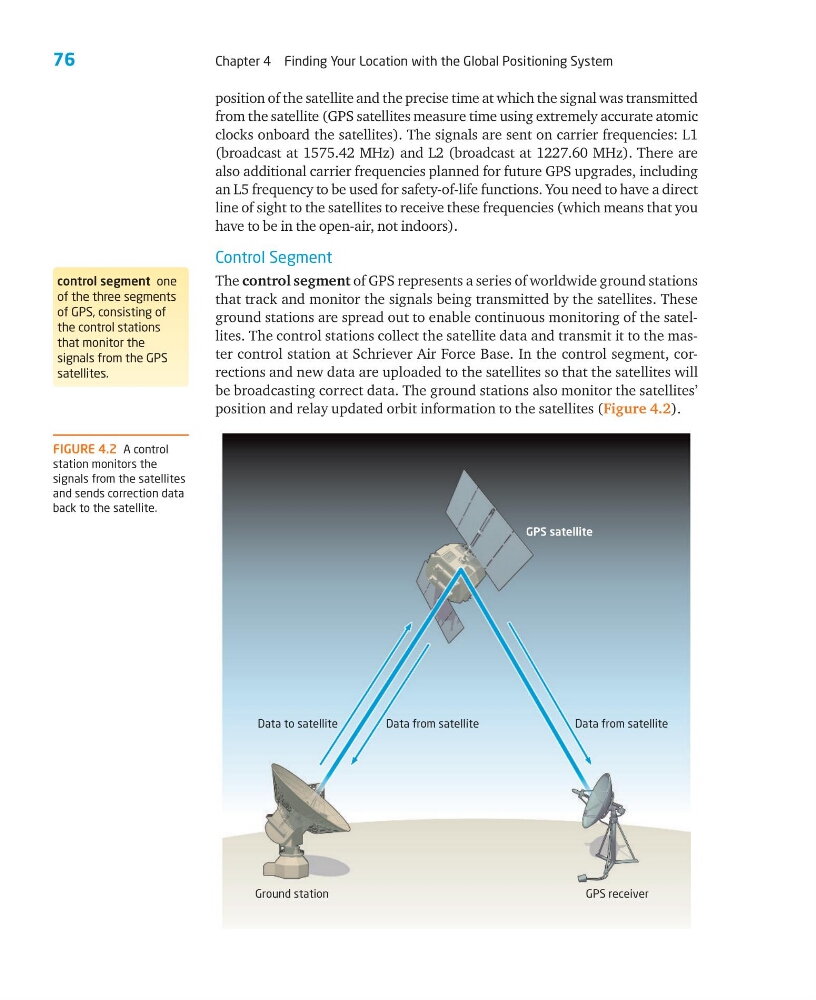
The control segment of GPS represents a series of worldwide ground stations
that track and monitor the signals being transmitted by the satellites. These
ground stations are spread out to enable continuous monitoring of the satellites. The control stations collect the satellite data and transmit it to the master control station at Schriever Air Force Base. In the control segment, corrections and new data are uploaded to the satellites so that the satellites will
be broadcasting correct data. The ground stations also monitor the satellites’
position and relay updated orbit information to the satellites (Figure 4.2).
FIGURE 4.2 A control
station monitors the
signals from the satellites
and sends correction data
back to the satellite.
control segment one
of the three segments
of GPS, consisting of
the control stations
that monitor the
signals from the GPS
satellites.
GPS satellite
Ground station
Data from satellite
Data from satellite
Data to satellite
GPS receiver
Chapter 4 Finding Your Location with the Global Positioning System
position of the satellite and the precise time at which the signal was transmitted
from the satellite (GPS satellites measure time using extremely accurate atomic
clocks onboard the satellites). The signals are sent on carrier frequencies: L1
(broadcast at 1575.42 MHz) and L2 (broadcast at 1227.60 MHz). There are
also additional carrier frequencies planned for future GPS upgrades, including
an L5 frequency to be used for safety-of-life functions. You need to have a direct
line of sight to the satellites to receive these frequencies (which means that you
have to be in the open-air, not indoors).
Control Segment
The control segment of GPS represents a series of worldwide ground stations
that track and monitor the signals being transmitted by the satellites. These
ground stations are spread out to enable continuous monitoring of the satellites. The control stations collect the satellite data and transmit it to the master control station at Schriever Air Force Base. In the control segment, corrections and new data are uploaded to the satellites so that the satellites will
be broadcasting correct data. The ground stations also monitor the satellites’
position and relay updated orbit information to the satellites (Figure 4.2).
FIGURE 4.2 A control
station monitors the
signals from the satellites
and sends correction data
back to the satellite.
control segment one
of the three segments
of GPS, consisting of
the control stations
that monitor the
signals from the GPS
satellites.
GPS satellite
Ground station
Data from satellite
Data from satellite
Data to satellite
GPS receiver