

406
Chapter 14 See the World in 3D
What Is 3D Modeling?
3D modeling (in geospatial terms) refers to the design of spatial data in a
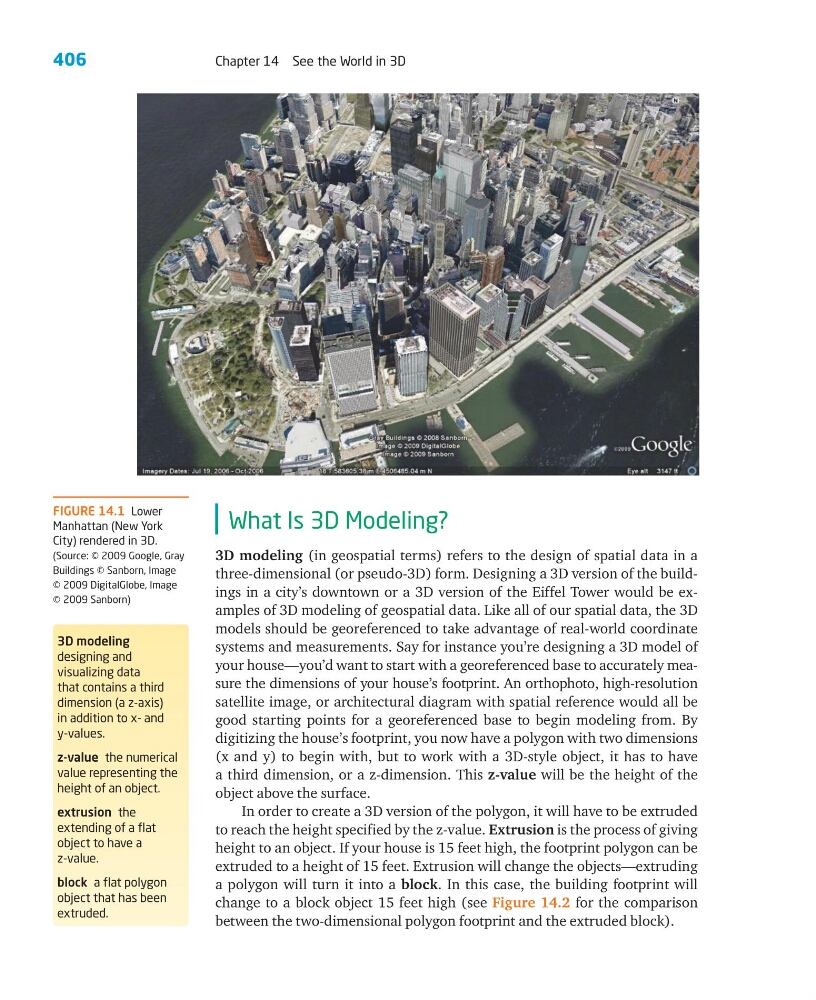
three-dimensional (or pseudo-3D) form. Designing a 3D version of the buildings in a city’s downtown or a 3D version of the Eiffel Tower would be examples of 3D modeling of geospatial data. Like all of our spatial data, the 3D
models should be georeferenced to take advantage of real-world coordinate
systems and measurements. Say for instance you’re designing a 3D model of
your house—you’d want to start with a georeferenced base to accurately measure the dimensions of your house’s footprint. An orthophoto, high-resolution
satellite image, or architectural diagram with spatial reference would all be
good starting points for a georeferenced base to begin modeling from. By
digitizing the house’s footprint, you now have a polygon with two dimensions
(x and y) to begin with, but to work with a 3D-style object, it has to have
a third dimension, or a z-dimension. This z-value will be the height of the
object above the surface.
In order to create a 3D version of the polygon, it will have to be extruded
to reach the height specified by the z-value. Extrusion is the process of giving
height to an object. If your house is 15 feet high, the footprint polygon can be
extruded to a height of 15 feet. Extrusion will change the objects— extruding
a polygon will turn it into a block. In this case, the building footprint will
change to a block object 15 feet high (see Figure 14.2 for the comparison
between the two-dimensional polygon footprint and the extruded block).
FIGURE 14.1 Lower
Manhattan (New York
City) rendered in 3D.
(Source: © 2009 Google, Gray
Buildings © Sanborn, Image
© 2009 DigitalGlobe, Image
© 2009 Sanborn)
3D modeling
designing and
visualizing data
that contains a third
dimension (a z-axis)
in addition to x- and
y-values.
z-value the numerical
value representing the
height of an object.
extrusion the
extending of a flat
object to have a
z-value.
block a flat polygon
object that has been
extruded.
Chapter 14 See the World in 3D
What Is 3D Modeling?
3D modeling (in geospatial terms) refers to the design of spatial data in a
three-dimensional (or pseudo-3D) form. Designing a 3D version of the buildings in a city’s downtown or a 3D version of the Eiffel Tower would be examples of 3D modeling of geospatial data. Like all of our spatial data, the 3D
models should be georeferenced to take advantage of real-world coordinate
systems and measurements. Say for instance you’re designing a 3D model of
your house—you’d want to start with a georeferenced base to accurately measure the dimensions of your house’s footprint. An orthophoto, high-resolution
satellite image, or architectural diagram with spatial reference would all be
good starting points for a georeferenced base to begin modeling from. By
digitizing the house’s footprint, you now have a polygon with two dimensions
(x and y) to begin with, but to work with a 3D-style object, it has to have
a third dimension, or a z-dimension. This z-value will be the height of the
object above the surface.
In order to create a 3D version of the polygon, it will have to be extruded
to reach the height specified by the z-value. Extrusion is the process of giving
height to an object. If your house is 15 feet high, the footprint polygon can be
extruded to a height of 15 feet. Extrusion will change the objects— extruding
a polygon will turn it into a block. In this case, the building footprint will
change to a block object 15 feet high (see Figure 14.2 for the comparison
between the two-dimensional polygon footprint and the extruded block).
FIGURE 14.1 Lower
Manhattan (New York
City) rendered in 3D.
(Source: © 2009 Google, Gray
Buildings © Sanborn, Image
© 2009 DigitalGlobe, Image
© 2009 Sanborn)
3D modeling
designing and
visualizing data
that contains a third
dimension (a z-axis)
in addition to x- and
y-values.
z-value the numerical
value representing the
height of an object.
extrusion the
extending of a flat
object to have a
z-value.
block a flat polygon
object that has been
extruded.