

300
Chapter 10 How Remote Sensing Works
What Is the Role of the Atmosphere
in Remote Sensing?
Earth’s atmosphere acts like a shield around the planet and the energy from
the Sun has to pass through this medium before it reaches Earth’s surface.
As a result, a considerable portion of the Sun’s electromagnetic energy never actually makes it to the ground. Consequently, if it never makes it to the
ground, it’s never going to be reflected back up to the remote sensing device
(and is not part of the whole remote sensing process). Earth’s atmosphere
contains a variety of gases (including carbon dioxide and ozone) that serve to
absorb numerous types of electromagnetic wavelengths. For instance, ozone
absorbs wavelengths of energy that correspond to ultraviolet light, the “UV
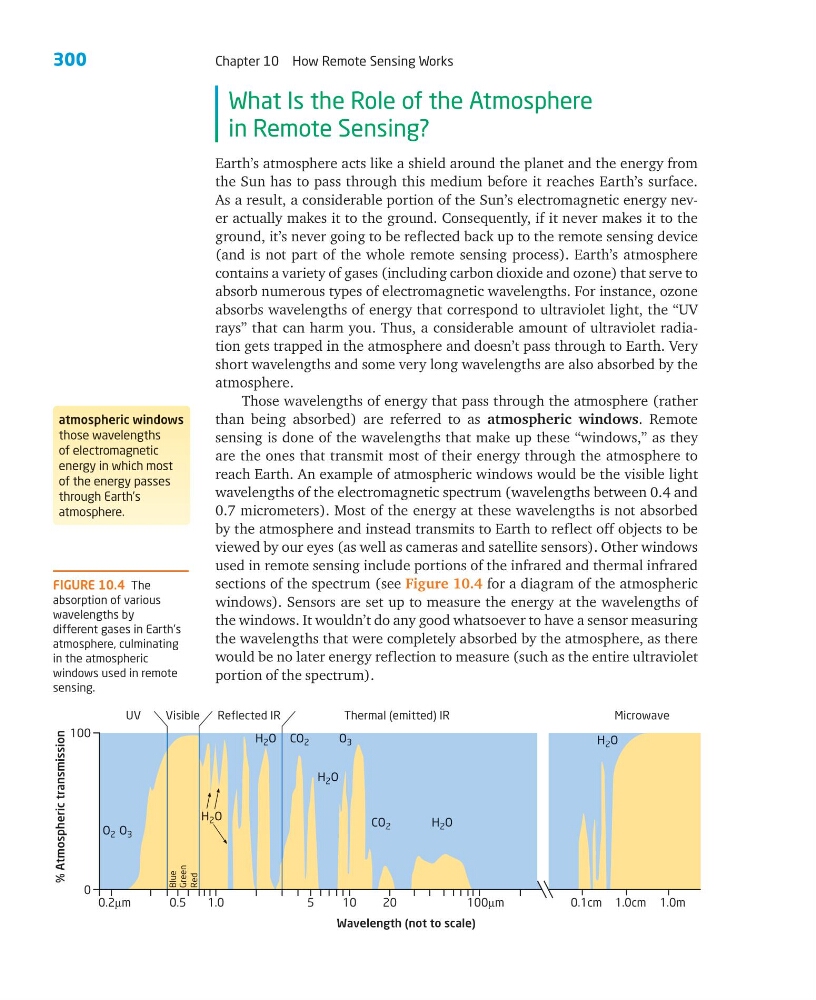
rays” that can harm you. Thus, a considerable amount of ultraviolet radiation gets trapped in the atmosphere and doesn’t pass through to Earth. Very
short wavelengths and some very long wavelengths are also absorbed by the
atmosphere.
Those wavelengths of energy that pass through the atmosphere (rather
than being absorbed) are referred to as atmospheric windows. Remote
sensing is done of the wavelengths that make up these “windows,” as they
are the ones that transmit most of their energy through the atmosphere to
reach Earth. An example of atmospheric windows would be the visible light
wavelengths of the electromagnetic spectrum (wavelengths between 0.4 and
0.7 micrometers). Most of the energy at these wavelengths is not absorbed
by the atmosphere and instead transmits to Earth to reflect off objects to be
viewed by our eyes (as well as cameras and satellite sensors). Other windows
used in remote sensing include portions of the infrared and thermal infrared
sections of the spectrum (see Figure 10.4 for a diagram of the atmospheric
windows). Sensors are set up to measure the energy at the wavelengths of
the windows. It wouldn’t do any good whatsoever to have a sensor measuring
the wavelengths that were completely absorbed by the atmosphere, as there
would be no later energy reflection to measure (such as the entire ultraviolet
portion of the spectrum).
atmospheric windows
those wavelengths
of electromagnetic
energy in which most
of the energy passes
through Earth’s
atmosphere.
FIGURE 10.4 The
absorption of various
wavelengths by
different gases in Earth’s
atmosphere, culminating
in the atmospheric
windows used in remote
sensing.
0.2µm
O 2 O 3
H 2 O
H 2 O
H 2 O
H 2 O
CO 2
CO 2
H 2 O
O 3
1.0
5
10
20
100µm
0.1cm 1.0cm 1.0m
0.5
Blue
Green
Red
0
100
UV
Visible
Reflected IR
Thermal (emitted) IR
Microwave
% Atmospheric transmission
Wavelength (not to scale)
Chapter 10 How Remote Sensing Works
What Is the Role of the Atmosphere
in Remote Sensing?
Earth’s atmosphere acts like a shield around the planet and the energy from
the Sun has to pass through this medium before it reaches Earth’s surface.
As a result, a considerable portion of the Sun’s electromagnetic energy never actually makes it to the ground. Consequently, if it never makes it to the
ground, it’s never going to be reflected back up to the remote sensing device
(and is not part of the whole remote sensing process). Earth’s atmosphere
contains a variety of gases (including carbon dioxide and ozone) that serve to
absorb numerous types of electromagnetic wavelengths. For instance, ozone
absorbs wavelengths of energy that correspond to ultraviolet light, the “UV
rays” that can harm you. Thus, a considerable amount of ultraviolet radiation gets trapped in the atmosphere and doesn’t pass through to Earth. Very
short wavelengths and some very long wavelengths are also absorbed by the
atmosphere.
Those wavelengths of energy that pass through the atmosphere (rather
than being absorbed) are referred to as atmospheric windows. Remote
sensing is done of the wavelengths that make up these “windows,” as they
are the ones that transmit most of their energy through the atmosphere to
reach Earth. An example of atmospheric windows would be the visible light
wavelengths of the electromagnetic spectrum (wavelengths between 0.4 and
0.7 micrometers). Most of the energy at these wavelengths is not absorbed
by the atmosphere and instead transmits to Earth to reflect off objects to be
viewed by our eyes (as well as cameras and satellite sensors). Other windows
used in remote sensing include portions of the infrared and thermal infrared
sections of the spectrum (see Figure 10.4 for a diagram of the atmospheric
windows). Sensors are set up to measure the energy at the wavelengths of
the windows. It wouldn’t do any good whatsoever to have a sensor measuring
the wavelengths that were completely absorbed by the atmosphere, as there
would be no later energy reflection to measure (such as the entire ultraviolet
portion of the spectrum).
atmospheric windows
those wavelengths
of electromagnetic
energy in which most
of the energy passes
through Earth’s
atmosphere.
FIGURE 10.4 The
absorption of various
wavelengths by
different gases in Earth’s
atmosphere, culminating
in the atmospheric
windows used in remote
sensing.
0.2µm
O 2 O 3
H 2 O
H 2 O
H 2 O
H 2 O
CO 2
CO 2
H 2 O
O 3
1.0
5
10
20
100µm
0.1cm 1.0cm 1.0m
0.5
Blue
Green
Red
0
100
UV
Visible
Reflected IR
Thermal (emitted) IR
Microwave
% Atmospheric transmission
Wavelength (not to scale)