

287
this information to calculate the height of any object in the photo casting a
shadow we can measure. Say you measure the shadow cast by a second building in the photo on the boardwalk and find it to be 0.14 inches in length. Using the 1:4000 photo scale, this shadow in the real-world would be 560 inches
long, or 46.67 feet in length. The only thing that’s unknown now is the actual
height of the building. Using the equation:
3.45 ϭ
h
46.67 ft
and solving for h, we can find that the height of the new building is about
161 feet. This type of measurement can be applied to other objects casting
shadows, allowing one to quickly determine the heights of multiple objects in
a single photo. Again, be cautious on how you employ these techniques—for
finding heights because of shadows, the object must be straight up and down
while casting a full shadow on level ground.
Chapter Wrapup
Aerial photography has a wide variety of uses and is an integral part of geospatial technology. Aerial photos are used for interpretation, photogrammetry, and additional data sources for other aspects of geospatial technology,
such as GIS. Despite its myriad of uses and applications, aerial photography
is just one part of remote sensing. The next chapter will delve into how the
whole remote sensing process actually works.
This chapter’s lab will put you to work with several remotely sensed images and applying elements of visual image interpretation to items in the
images.
Important note: The references for this chapter are part of the online companion for this book and can be found at http://www.whfreeman.com/
shellito1e.
S u n ’s r a y s
Length of shadow
Height of object
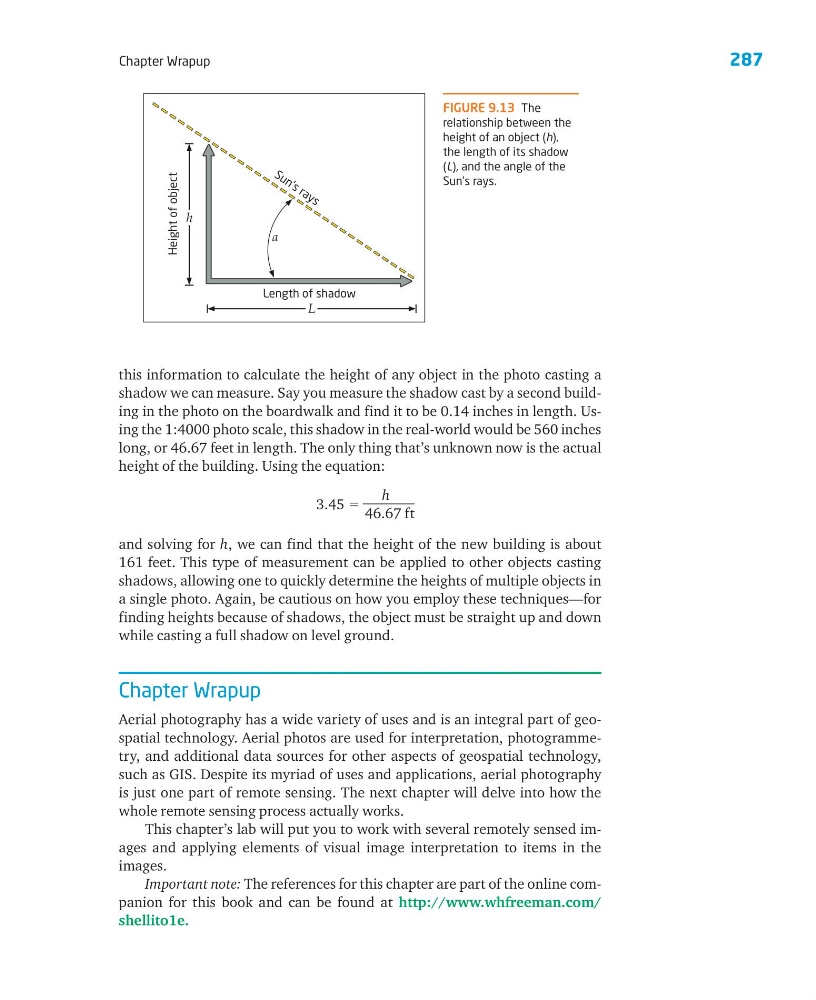
FIGURE 9.13 The
relationship between the
height of an object (h),
the length of its shadow
(L), and the angle of the
Sun’s rays.
Chapter Wrapup
this information to calculate the height of any object in the photo casting a
shadow we can measure. Say you measure the shadow cast by a second building in the photo on the boardwalk and find it to be 0.14 inches in length. Using the 1:4000 photo scale, this shadow in the real-world would be 560 inches
long, or 46.67 feet in length. The only thing that’s unknown now is the actual
height of the building. Using the equation:
3.45 ϭ
h
46.67 ft
and solving for h, we can find that the height of the new building is about
161 feet. This type of measurement can be applied to other objects casting
shadows, allowing one to quickly determine the heights of multiple objects in
a single photo. Again, be cautious on how you employ these techniques—for
finding heights because of shadows, the object must be straight up and down
while casting a full shadow on level ground.
Chapter Wrapup
Aerial photography has a wide variety of uses and is an integral part of geospatial technology. Aerial photos are used for interpretation, photogrammetry, and additional data sources for other aspects of geospatial technology,
such as GIS. Despite its myriad of uses and applications, aerial photography
is just one part of remote sensing. The next chapter will delve into how the
whole remote sensing process actually works.
This chapter’s lab will put you to work with several remotely sensed images and applying elements of visual image interpretation to items in the
images.
Important note: The references for this chapter are part of the online companion for this book and can be found at http://www.whfreeman.com/
shellito1e.
S u n ’s r a y s
Length of shadow
Height of object
FIGURE 9.13 The
relationship between the
height of an object (h),
the length of its shadow
(L), and the angle of the
Sun’s rays.
Chapter Wrapup