

111
How Is Non-Spatial Data Handled by GIS?
A raster attribute table is handled differently than one for vector objects
since a raster dataset is composed of multiple grid cells (for instance, a 30-meter
resolution grid of a single county could take millions of cells to model). Rather
than having separate records for each grid cell, raster data will often be set up
in a table with each record featuring the value for a raster cell and an attribute showing the count of how many cells comprise the dataset. For instance, a
county-land-use dataset may contain millions of cells, but only consist of seven
values. Thus, the raster would have seven records (one for each value) and another field whose value would be a summation of how many cells have that
value. New attributes would be defined by the raster values (for instance, the
type of land use that value represents).
Besides creating new fields and populating them with attributes by hand,
a join is another way GIS allows non-spatial data to be connected to spatial
locations. This operation works by linking the information for records in one
table to its corresponding records in another table. This is managed by both
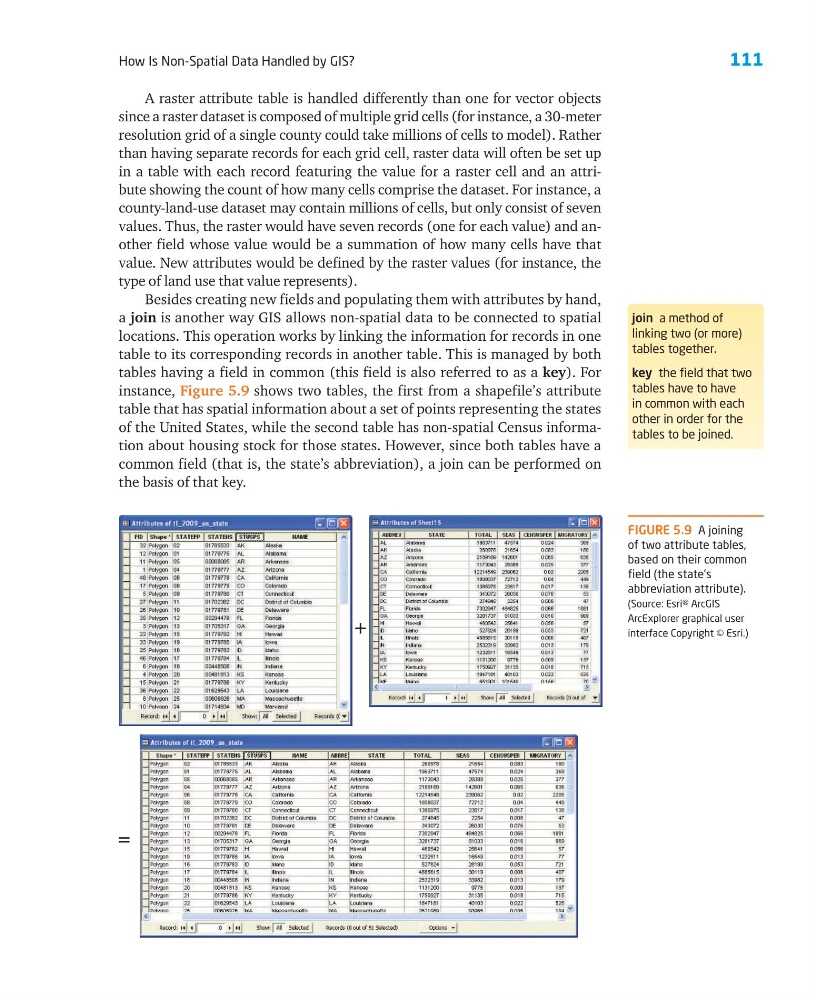
tables having a field in common (this field is also referred to as a key). For
instance, Figure 5.9 shows two tables, the first from a shapefile’s attribute
table that has spatial information about a set of points representing the states
of the United States, while the second table has non-spatial Census information about housing stock for those states. However, since both tables have a
common field (that is, the state’s abbreviation), a join can be performed on
the basis of that key.
join a method of
linking two (or more)
tables together.
key the field that two
tables have to have
in common with each
other in order for the
tables to be joined.
FIGURE 5.9 A joining
of two attribute tables,
based on their common
field (the state’s
abbreviation attribute).
(Source: Esri® ArcGIS
ArcExplorer graphical user
interface Copyright © Esri.)
؉
؍
How Is Non-Spatial Data Handled by GIS?
A raster attribute table is handled differently than one for vector objects
since a raster dataset is composed of multiple grid cells (for instance, a 30-meter
resolution grid of a single county could take millions of cells to model). Rather
than having separate records for each grid cell, raster data will often be set up
in a table with each record featuring the value for a raster cell and an attribute showing the count of how many cells comprise the dataset. For instance, a
county-land-use dataset may contain millions of cells, but only consist of seven
values. Thus, the raster would have seven records (one for each value) and another field whose value would be a summation of how many cells have that
value. New attributes would be defined by the raster values (for instance, the
type of land use that value represents).
Besides creating new fields and populating them with attributes by hand,
a join is another way GIS allows non-spatial data to be connected to spatial
locations. This operation works by linking the information for records in one
table to its corresponding records in another table. This is managed by both
tables having a field in common (this field is also referred to as a key). For
instance, Figure 5.9 shows two tables, the first from a shapefile’s attribute
table that has spatial information about a set of points representing the states
of the United States, while the second table has non-spatial Census information about housing stock for those states. However, since both tables have a
common field (that is, the state’s abbreviation), a join can be performed on
the basis of that key.
join a method of
linking two (or more)
tables together.
key the field that two
tables have to have
in common with each
other in order for the
tables to be joined.
FIGURE 5.9 A joining
of two attribute tables,
based on their common
field (the state’s
abbreviation attribute).
(Source: Esri® ArcGIS
ArcExplorer graphical user
interface Copyright © Esri.)
؉
؍