

82
Chapter 4 Finding Your Location with the Global Positioning System
to indicate what relative error could be introduced because of the arrangement of
the satellites being used (basically, the lower the value the better).
Also keep in mind that the signals are being broadcast from space and
have to pass through Earth’s atmosphere before reaching the receiver.
Though some of these atmospheric effects can be modeled and attempted to
be accounted for, atmospheric problems can still introduce errors in accuracy
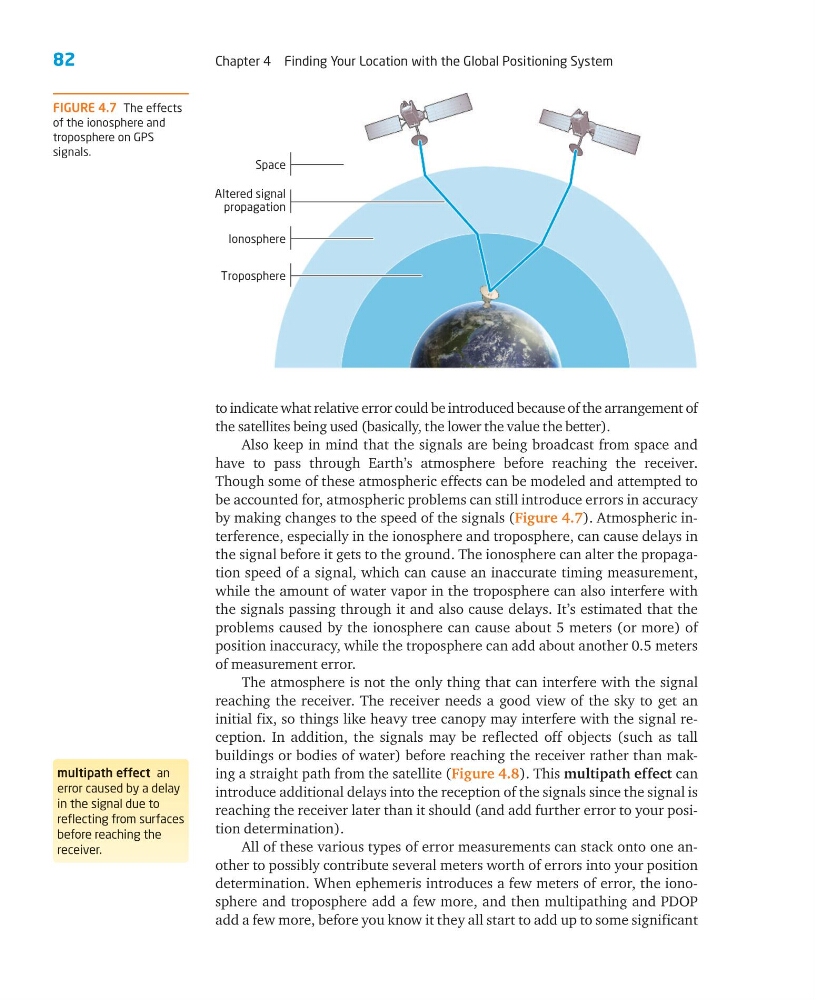
by making changes to the speed of the signals (Figure 4.7). Atmospheric interference, especially in the ionosphere and troposphere, can cause delays in
the signal before it gets to the ground. The ionosphere can alter the propagation speed of a signal, which can cause an inaccurate timing measurement,
while the amount of water vapor in the troposphere can also interfere with
the signals passing through it and also cause delays. It’s estimated that the
problems caused by the ionosphere can cause about 5 meters (or more) of
position inaccuracy, while the troposphere can add about another 0.5 meters
of measurement error.
The atmosphere is not the only thing that can interfere with the signal
reaching the receiver. The receiver needs a good view of the sky to get an
initial fix, so things like heavy tree canopy may interfere with the signal reception. In addition, the signals may be reflected off objects (such as tall
buildings or bodies of water) before reaching the receiver rather than making a straight path from the satellite (Figure 4.8). This multipath effect can
introduce additional delays into the reception of the signals since the signal is
reaching the receiver later than it should (and add further error to your position determination).
All of these various types of error measurements can stack onto one another to possibly contribute several meters worth of errors into your position
determination. When ephemeris introduces a few meters of error, the ionosphere and troposphere add a few more, and then multipathing and PDOP
add a few more, before you know it they all start to add up to some significant
multipath effect an
error caused by a delay
in the signal due to
reflecting from surfaces
before reaching the
receiver.
FIGURE 4.7 The effects
of the ionosphere and
troposphere on GPS
signals.
Space
Troposphere
Altered signal
propagation
Ionosphere
Chapter 4 Finding Your Location with the Global Positioning System
to indicate what relative error could be introduced because of the arrangement of
the satellites being used (basically, the lower the value the better).
Also keep in mind that the signals are being broadcast from space and
have to pass through Earth’s atmosphere before reaching the receiver.
Though some of these atmospheric effects can be modeled and attempted to
be accounted for, atmospheric problems can still introduce errors in accuracy
by making changes to the speed of the signals (Figure 4.7). Atmospheric interference, especially in the ionosphere and troposphere, can cause delays in
the signal before it gets to the ground. The ionosphere can alter the propagation speed of a signal, which can cause an inaccurate timing measurement,
while the amount of water vapor in the troposphere can also interfere with
the signals passing through it and also cause delays. It’s estimated that the
problems caused by the ionosphere can cause about 5 meters (or more) of
position inaccuracy, while the troposphere can add about another 0.5 meters
of measurement error.
The atmosphere is not the only thing that can interfere with the signal
reaching the receiver. The receiver needs a good view of the sky to get an
initial fix, so things like heavy tree canopy may interfere with the signal reception. In addition, the signals may be reflected off objects (such as tall
buildings or bodies of water) before reaching the receiver rather than making a straight path from the satellite (Figure 4.8). This multipath effect can
introduce additional delays into the reception of the signals since the signal is
reaching the receiver later than it should (and add further error to your position determination).
All of these various types of error measurements can stack onto one another to possibly contribute several meters worth of errors into your position
determination. When ephemeris introduces a few meters of error, the ionosphere and troposphere add a few more, and then multipathing and PDOP
add a few more, before you know it they all start to add up to some significant
multipath effect an
error caused by a delay
in the signal due to
reflecting from surfaces
before reaching the
receiver.
FIGURE 4.7 The effects
of the ionosphere and
troposphere on GPS
signals.
Space
Troposphere
Altered signal
propagation
Ionosphere