

80
Chapter 4 Finding Your Location with the Global Positioning System
The same concept applies to finding your location using GPS, but rather than locating yourself relative to three other points on a map, your GPS
receiver is finding its position relative to three satellites. Also, since a position
on a three-dimensional (3D) Earth is being found with reference to positions
surrounding it, a spherical distance is calculated rather than a flat circular
distance. This process is referred to as trilateration in three dimensions (or
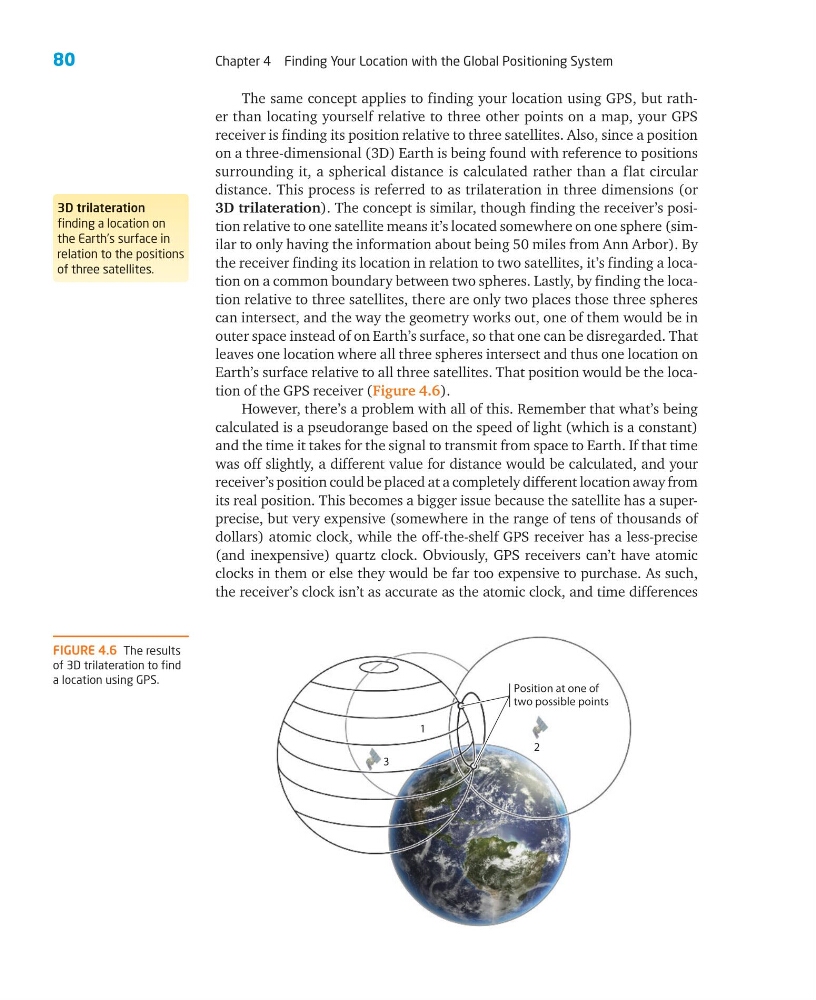
3D trilateration). The concept is similar, though finding the receiver’s position relative to one satellite means it’s located somewhere on one sphere (similar to only having the information about being 50 miles from Ann Arbor). By
the receiver finding its location in relation to two satellites, it’s finding a location on a common boundary between two spheres. Lastly, by finding the location relative to three satellites, there are only two places those three spheres
can intersect, and the way the geometry works out, one of them would be in
outer space instead of on Earth’s surface, so that one can be disregarded. That
leaves one location where all three spheres intersect and thus one location on
Earth’s surface relative to all three satellites. That position would be the location of the GPS receiver (Figure 4.6).
However, there’s a problem with all of this. Remember that what’s being
calculated is a pseudorange based on the speed of light (which is a constant)
and the time it takes for the signal to transmit from space to Earth. If that time
was off slightly, a different value for distance would be calculated, and your
receiver’s position could be placed at a completely different location away from
its real position. This becomes a bigger issue because the satellite has a superprecise, but very expensive (somewhere in the range of tens of thousands of
dollars) atomic clock, while the off-the-shelf GPS receiver has a less-precise
(and inexpensive) quartz clock. Obviously, GPS receivers can’t have atomic
clocks in them or else they would be far too expensive to purchase. As such,
the receiver’s clock isn’t as accurate as the atomic clock, and time differences
3D trilateration
finding a location on
the Earth’s surface in
relation to the positions
of three satellites.
FIGURE 4.6 The results
of 3D trilateration to find
a location using GPS.
1
2
3
Position at one of
two possible points
Chapter 4 Finding Your Location with the Global Positioning System
The same concept applies to finding your location using GPS, but rather than locating yourself relative to three other points on a map, your GPS
receiver is finding its position relative to three satellites. Also, since a position
on a three-dimensional (3D) Earth is being found with reference to positions
surrounding it, a spherical distance is calculated rather than a flat circular
distance. This process is referred to as trilateration in three dimensions (or
3D trilateration). The concept is similar, though finding the receiver’s position relative to one satellite means it’s located somewhere on one sphere (similar to only having the information about being 50 miles from Ann Arbor). By
the receiver finding its location in relation to two satellites, it’s finding a location on a common boundary between two spheres. Lastly, by finding the location relative to three satellites, there are only two places those three spheres
can intersect, and the way the geometry works out, one of them would be in
outer space instead of on Earth’s surface, so that one can be disregarded. That
leaves one location where all three spheres intersect and thus one location on
Earth’s surface relative to all three satellites. That position would be the location of the GPS receiver (Figure 4.6).
However, there’s a problem with all of this. Remember that what’s being
calculated is a pseudorange based on the speed of light (which is a constant)
and the time it takes for the signal to transmit from space to Earth. If that time
was off slightly, a different value for distance would be calculated, and your
receiver’s position could be placed at a completely different location away from
its real position. This becomes a bigger issue because the satellite has a superprecise, but very expensive (somewhere in the range of tens of thousands of
dollars) atomic clock, while the off-the-shelf GPS receiver has a less-precise
(and inexpensive) quartz clock. Obviously, GPS receivers can’t have atomic
clocks in them or else they would be far too expensive to purchase. As such,
the receiver’s clock isn’t as accurate as the atomic clock, and time differences
3D trilateration
finding a location on
the Earth’s surface in
relation to the positions
of three satellites.
FIGURE 4.6 The results
of 3D trilateration to find
a location using GPS.
1
2
3
Position at one of
two possible points