

Télédétection et ressources en eau/Remote sensing and water resources
321
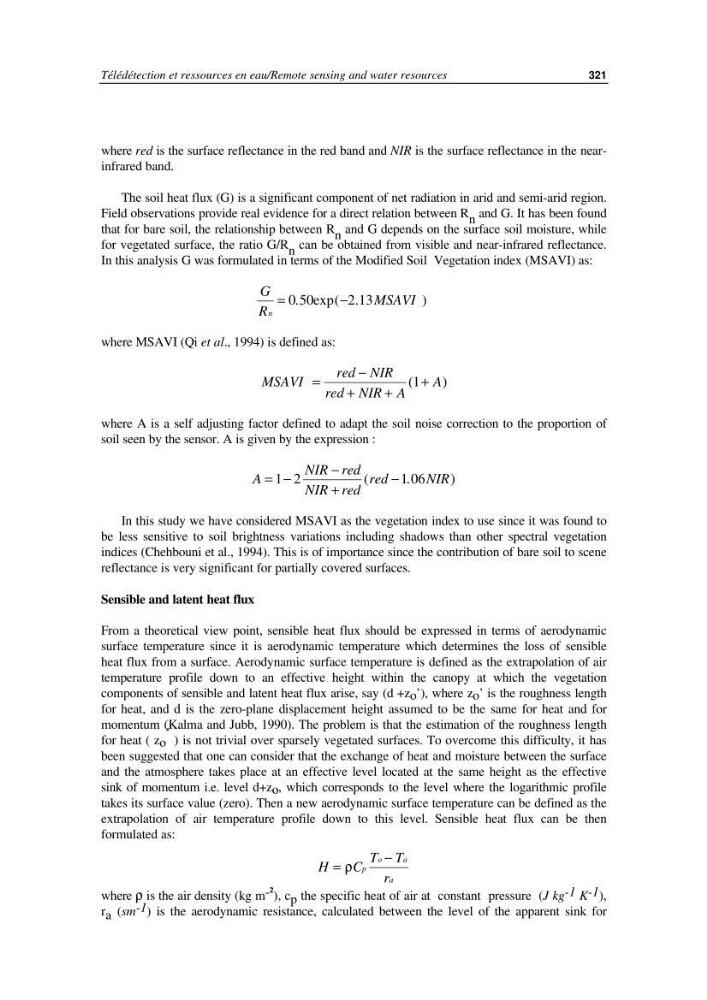
where red is the surface reflectance in the red band and NIR is the surface reflectance in the nearinfrared band.
The soil heat flux (G) is a significant component of net radiation in arid and semi-arid region.
Field observations provide real evidence for a direct relation between R n and G. It has been found
that for bare soil, the relationship between R n and G depends on the surface soil moisture, while
for vegetated surface, the ratio G/R n can be obtained from visible and near-infrared reflectance.
In this analysis G was formulated in terms of the Modified Soil Vegetation index (MSAVI) as:
G
R
MSAVI
n
=
−
0 50
2 13
. exp( .
)
where MSAVI (Qi et al., 1994) is defined as:
MSAVI
red NIR
red NIR A
A
=
−
+
+
+
(
)
1
where A is a self adjusting factor defined to adapt the soil noise correction to the proportion of
soil seen by the sensor. A is given by the expression :
A
NIR red
NIR red
red
NIR
= −
−
+
−
1 2
1 06
(
.
)
In this study we have considered MSAVI as the vegetation index to use since it was found to
be less sensitive to soil brightness variations including shadows than other spectral vegetation
indices (Chehbouni et al., 1994). This is of importance since the contribution of bare soil to scene
reflectance is very significant for partially covered surfaces.
Sensible and latent heat flux
From a theoretical view point, sensible heat flux should be expressed in terms of aerodynamic
surface temperature since it is aerodynamic temperature which determines the loss of sensible
heat flux from a surface. Aerodynamic surface temperature is defined as the extrapolation of air
temperature profile down to an effective height within the canopy at which the vegetation
components of sensible and latent heat flux arise, say (d +z o ’), where z o ’ is the roughness length
for heat, and d is the zero-plane displacement height assumed to be the same for heat and for
momentum (Kalma and Jubb, 1990). The problem is that the estimation of the roughness length
for heat ( z o
’ ) is not trivial over sparsely vegetated surfaces. To overcome this difficulty, it has
been suggested that one can consider that the exchange of heat and moisture between the surface
and the atmosphere takes place at an effective level located at the same height as the effective
sink of momentum i.e. level d+z o , which corresponds to the level where the logarithmic profile
takes its surface value (zero). Then a new aerodynamic surface temperature can be defined as the
extrapolation of air temperature profile down to this level. Sensible heat flux can be then
formulated as:
H
C
T T
r
p
o
a
a
=
−
ρ
where ρ is the air density (kg m -² ), c p the specific heat of air at constant pressure (J kg -1 K -1 ),
r a (sm -1 ) is the aerodynamic resistance, calculated between the level of the apparent sink for
321
where red is the surface reflectance in the red band and NIR is the surface reflectance in the nearinfrared band.
The soil heat flux (G) is a significant component of net radiation in arid and semi-arid region.
Field observations provide real evidence for a direct relation between R n and G. It has been found
that for bare soil, the relationship between R n and G depends on the surface soil moisture, while
for vegetated surface, the ratio G/R n can be obtained from visible and near-infrared reflectance.
In this analysis G was formulated in terms of the Modified Soil Vegetation index (MSAVI) as:
G
R
MSAVI
n
=
−
0 50
2 13
. exp( .
)
where MSAVI (Qi et al., 1994) is defined as:
MSAVI
red NIR
red NIR A
A
=
−
+
+
+
(
)
1
where A is a self adjusting factor defined to adapt the soil noise correction to the proportion of
soil seen by the sensor. A is given by the expression :
A
NIR red
NIR red
red
NIR
= −
−
+
−
1 2
1 06
(
.
)
In this study we have considered MSAVI as the vegetation index to use since it was found to
be less sensitive to soil brightness variations including shadows than other spectral vegetation
indices (Chehbouni et al., 1994). This is of importance since the contribution of bare soil to scene
reflectance is very significant for partially covered surfaces.
Sensible and latent heat flux
From a theoretical view point, sensible heat flux should be expressed in terms of aerodynamic
surface temperature since it is aerodynamic temperature which determines the loss of sensible
heat flux from a surface. Aerodynamic surface temperature is defined as the extrapolation of air
temperature profile down to an effective height within the canopy at which the vegetation
components of sensible and latent heat flux arise, say (d +z o ’), where z o ’ is the roughness length
for heat, and d is the zero-plane displacement height assumed to be the same for heat and for
momentum (Kalma and Jubb, 1990). The problem is that the estimation of the roughness length
for heat ( z o
’ ) is not trivial over sparsely vegetated surfaces. To overcome this difficulty, it has
been suggested that one can consider that the exchange of heat and moisture between the surface
and the atmosphere takes place at an effective level located at the same height as the effective
sink of momentum i.e. level d+z o , which corresponds to the level where the logarithmic profile
takes its surface value (zero). Then a new aerodynamic surface temperature can be defined as the
extrapolation of air temperature profile down to this level. Sensible heat flux can be then
formulated as:
H
C
T T
r
p
o
a
a
=
−
ρ
where ρ is the air density (kg m -² ), c p the specific heat of air at constant pressure (J kg -1 K -1 ),
r a (sm -1 ) is the aerodynamic resistance, calculated between the level of the apparent sink for