

Télédétection et ressources en eau/Remote sensing and water resources
15
Summary of the workshop
INTRODUCTION
The objective of the workshop was to assess the current status of application of spatial
information to the management of water resources in arid and semi-arid developing countries.
The presentations included in this publication do not pretend to exhaustively cover all issues
relating the use of spatial information systems to the management of water resources in
developing countries. However, the richness and the variety of papers prove the interest in
hydrological applications related to analysis of spatial information that exists in these countries.
The presentations and the discussions of this workshop were centred mostly upon the
utilization of spatial data obtained from satellite platforms (low resolution NOAA, high
resolution SPOT and LANDSAT), aerial photography and digital elevation models (DEM).
Geographic information systems (GIS) were also covered in many presentations, either for
specific applications or for the analysis of data obtained from remote sensing. GIS are used for
the management of spatial information, but also as information and decision-making tools
through simple (data combination, data aggregation, intersection of overlays) or complex
operations (hydrological modelling).
A classification by objective effectively summarizes the two main themes of the workshop:
• objectives related to global or local knowledge of the earth surface for an improved
management of water resources, which may also be described as an attempt to describe in
order to manage better, particularly in the short term.
• objectives related to modelling, comprehension and analysis of hydrologic events, which
consists in describing for understanding and forecasting: quantifying, classifying and
validating.
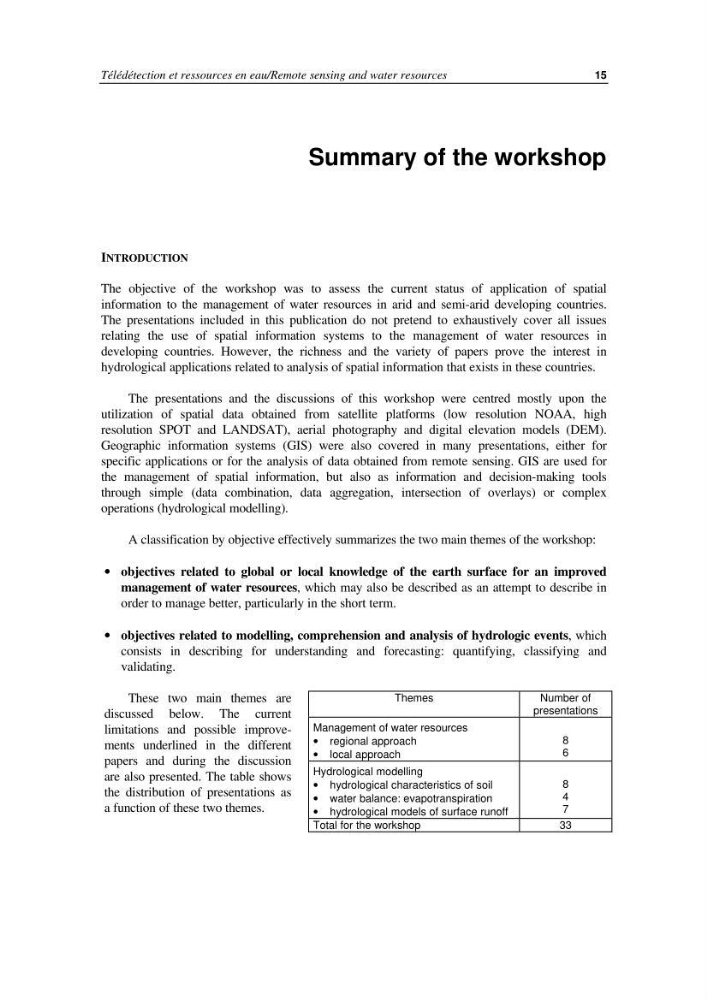
These two main themes are
discussed below. The current
limitations and possible improvements underlined in the different
papers and during the discussion
are also presented. The table shows
the distribution of presentations as
a function of these two themes.
Themes
Number of
presentations
Management of water resources
• regional approach
• local approach
8
6
Hydrological modelling
• hydrological characteristics of soil
• water balance: evapotranspiration
• hydrological models of surface runoff
8
4
7
Total for the workshop
33
15
Summary of the workshop
INTRODUCTION
The objective of the workshop was to assess the current status of application of spatial
information to the management of water resources in arid and semi-arid developing countries.
The presentations included in this publication do not pretend to exhaustively cover all issues
relating the use of spatial information systems to the management of water resources in
developing countries. However, the richness and the variety of papers prove the interest in
hydrological applications related to analysis of spatial information that exists in these countries.
The presentations and the discussions of this workshop were centred mostly upon the
utilization of spatial data obtained from satellite platforms (low resolution NOAA, high
resolution SPOT and LANDSAT), aerial photography and digital elevation models (DEM).
Geographic information systems (GIS) were also covered in many presentations, either for
specific applications or for the analysis of data obtained from remote sensing. GIS are used for
the management of spatial information, but also as information and decision-making tools
through simple (data combination, data aggregation, intersection of overlays) or complex
operations (hydrological modelling).
A classification by objective effectively summarizes the two main themes of the workshop:
• objectives related to global or local knowledge of the earth surface for an improved
management of water resources, which may also be described as an attempt to describe in
order to manage better, particularly in the short term.
• objectives related to modelling, comprehension and analysis of hydrologic events, which
consists in describing for understanding and forecasting: quantifying, classifying and
validating.
These two main themes are
discussed below. The current
limitations and possible improvements underlined in the different
papers and during the discussion
are also presented. The table shows
the distribution of presentations as
a function of these two themes.
Themes
Number of
presentations
Management of water resources
• regional approach
• local approach
8
6
Hydrological modelling
• hydrological characteristics of soil
• water balance: evapotranspiration
• hydrological models of surface runoff
8
4
7
Total for the workshop
33