

Télédétection et ressources en eau/Remote sensing and water resources
185
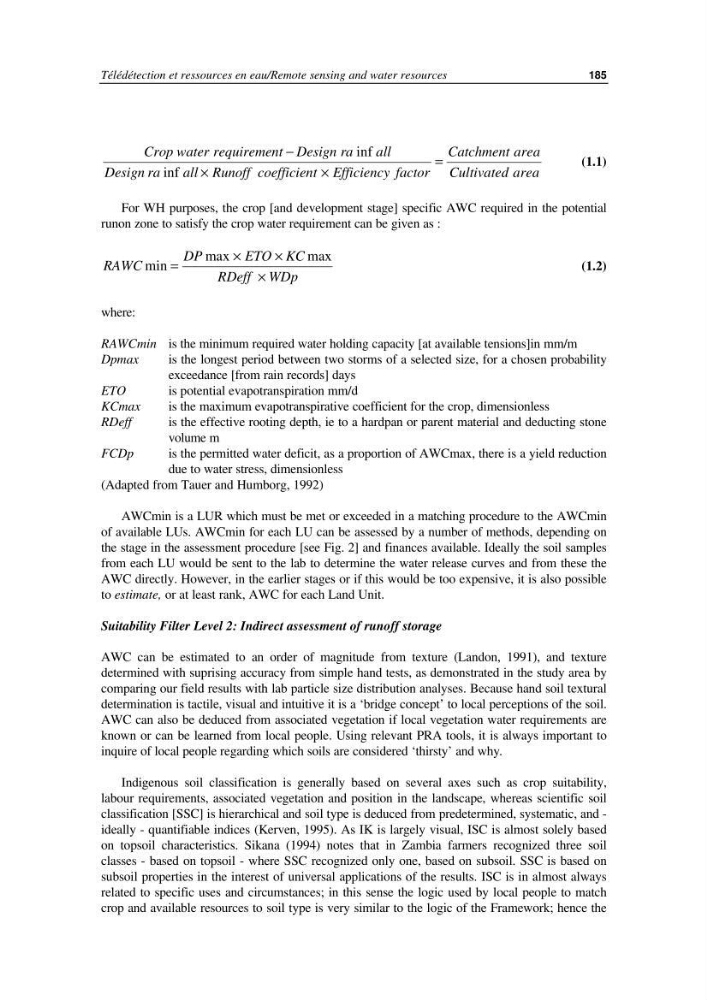
Crop water requirement Design ra
all
Design ra
all Runoff coefficient Efficiency factor
Catchment area
Cultivated area
−
×
×
=
inf
inf
(1.1)
For WH purposes, the crop [and development stage] specific AWC required in the potential
runon zone to satisfy the crop water requirement can be given as :
RAWC
DP
ETO KC
RDeff WDp
min
max
max
=
×
×
×
(1.2)
where:
RAWCmin is the minimum required water holding capacity [at available tensions]in mm/m
Dpmax
is the longest period between two storms of a selected size, for a chosen probability
exceedance [from rain records] days
ETO
is potential evapotranspiration mm/d
KCmax
is the maximum evapotranspirative coefficient for the crop, dimensionless
RDeff
is the effective rooting depth, ie to a hardpan or parent material and deducting stone
volume m
FCDp
is the permitted water deficit, as a proportion of AWCmax, there is a yield reduction
due to water stress, dimensionless
(Adapted from Tauer and Humborg, 1992)
AWCmin is a LUR which must be met or exceeded in a matching procedure to the AWCmin
of available LUs. AWCmin for each LU can be assessed by a number of methods, depending on
the stage in the assessment procedure [see Fig. 2] and finances available. Ideally the soil samples
from each LU would be sent to the lab to determine the water release curves and from these the
AWC directly. However, in the earlier stages or if this would be too expensive, it is also possible
to estimate, or at least rank, AWC for each Land Unit.
Suitability Filter Level 2: Indirect assessment of runoff storage
AWC can be estimated to an order of magnitude from texture (Landon, 1991), and texture
determined with suprising accuracy from simple hand tests, as demonstrated in the study area by
comparing our field results with lab particle size distribution analyses. Because hand soil textural
determination is tactile, visual and intuitive it is a ‘bridge concept’ to local perceptions of the soil.
AWC can also be deduced from associated vegetation if local vegetation water requirements are
known or can be learned from local people. Using relevant PRA tools, it is always important to
inquire of local people regarding which soils are considered ‘thirsty’ and why.
Indigenous soil classification is generally based on several axes such as crop suitability,
labour requirements, associated vegetation and position in the landscape, whereas scientific soil
classification [SSC] is hierarchical and soil type is deduced from predetermined, systematic, and -
ideally - quantifiable indices (Kerven, 1995). As IK is largely visual, ISC is almost solely based
on topsoil characteristics. Sikana (1994) notes that in Zambia farmers recognized three soil
classes - based on topsoil - where SSC recognized only one, based on subsoil. SSC is based on
subsoil properties in the interest of universal applications of the results. ISC is in almost always
related to specific uses and circumstances; in this sense the logic used by local people to match
crop and available resources to soil type is very similar to the logic of the Framework; hence the
185
Crop water requirement Design ra
all
Design ra
all Runoff coefficient Efficiency factor
Catchment area
Cultivated area
−
×
×
=
inf
inf
(1.1)
For WH purposes, the crop [and development stage] specific AWC required in the potential
runon zone to satisfy the crop water requirement can be given as :
RAWC
DP
ETO KC
RDeff WDp
min
max
max
=
×
×
×
(1.2)
where:
RAWCmin is the minimum required water holding capacity [at available tensions]in mm/m
Dpmax
is the longest period between two storms of a selected size, for a chosen probability
exceedance [from rain records] days
ETO
is potential evapotranspiration mm/d
KCmax
is the maximum evapotranspirative coefficient for the crop, dimensionless
RDeff
is the effective rooting depth, ie to a hardpan or parent material and deducting stone
volume m
FCDp
is the permitted water deficit, as a proportion of AWCmax, there is a yield reduction
due to water stress, dimensionless
(Adapted from Tauer and Humborg, 1992)
AWCmin is a LUR which must be met or exceeded in a matching procedure to the AWCmin
of available LUs. AWCmin for each LU can be assessed by a number of methods, depending on
the stage in the assessment procedure [see Fig. 2] and finances available. Ideally the soil samples
from each LU would be sent to the lab to determine the water release curves and from these the
AWC directly. However, in the earlier stages or if this would be too expensive, it is also possible
to estimate, or at least rank, AWC for each Land Unit.
Suitability Filter Level 2: Indirect assessment of runoff storage
AWC can be estimated to an order of magnitude from texture (Landon, 1991), and texture
determined with suprising accuracy from simple hand tests, as demonstrated in the study area by
comparing our field results with lab particle size distribution analyses. Because hand soil textural
determination is tactile, visual and intuitive it is a ‘bridge concept’ to local perceptions of the soil.
AWC can also be deduced from associated vegetation if local vegetation water requirements are
known or can be learned from local people. Using relevant PRA tools, it is always important to
inquire of local people regarding which soils are considered ‘thirsty’ and why.
Indigenous soil classification is generally based on several axes such as crop suitability,
labour requirements, associated vegetation and position in the landscape, whereas scientific soil
classification [SSC] is hierarchical and soil type is deduced from predetermined, systematic, and -
ideally - quantifiable indices (Kerven, 1995). As IK is largely visual, ISC is almost solely based
on topsoil characteristics. Sikana (1994) notes that in Zambia farmers recognized three soil
classes - based on topsoil - where SSC recognized only one, based on subsoil. SSC is based on
subsoil properties in the interest of universal applications of the results. ISC is in almost always
related to specific uses and circumstances; in this sense the logic used by local people to match
crop and available resources to soil type is very similar to the logic of the Framework; hence the