

It should be emphasized that, even if solar elevation angle and azimuth do not vary
during routine data collection on the field, they should be taken into consideration
when data acquired at other times are used, especially when used on satellite data for
calibration and/or validation. Atmospheric corrections for BRDF are necessary for
highly elevated sensors that view very wide (e.g., 100-km) areas on the ground FoV
from a given altitude, as the direction-dependent effects are more expressed, rather
than for small FoV sensors or field spectral measurements.
Other illumination factors such as skylight and background radiance from the
surroundings, compared to direct solar illumination and skylight, are typically small
and insignificant sources of error, except if a large background object or something
close enough to the target covers a large portion of the solid angle viewed by the
target. Clouds, shades, and wind attenuate the solar irradiance and the target’s
reflectance (Chang et al., 2005). Therefore, clouds should be avoided as much as
possible, while the wind affects the spectral signature of the target as it moves the
canopy and changes its shadow. It is nevertheless minimized by the fast scanning time
(100 ms for a complete 350–2500-nm spectrum) of the spectroradiometers nowadays
(ASD, 2009). In addition, replicate measurements are essential to find the average
reflectance value for a specific target in the field in order to minimize both the wind
background radiance synergetic effect and instrumentation factors described previously (Hemmer and Westphal, 2000).
15.2.1.3 Measurement Errors Measurement errors are typically present in every
field work and should be accounted for in the spectral characterization procedure. The
Wavelength (nm)
Reflectance
0.00
0.10
0.20
0.30
0.40
0.50
0.60
350 500 650 800 950 1100 1250 1400 1550 1700 1850 2000 2150 2300 2450
Sensitivity drift“step”
Atmospheric
noise
Corrected
spectrum
VIS
NIR
SWIR1
SWIR2
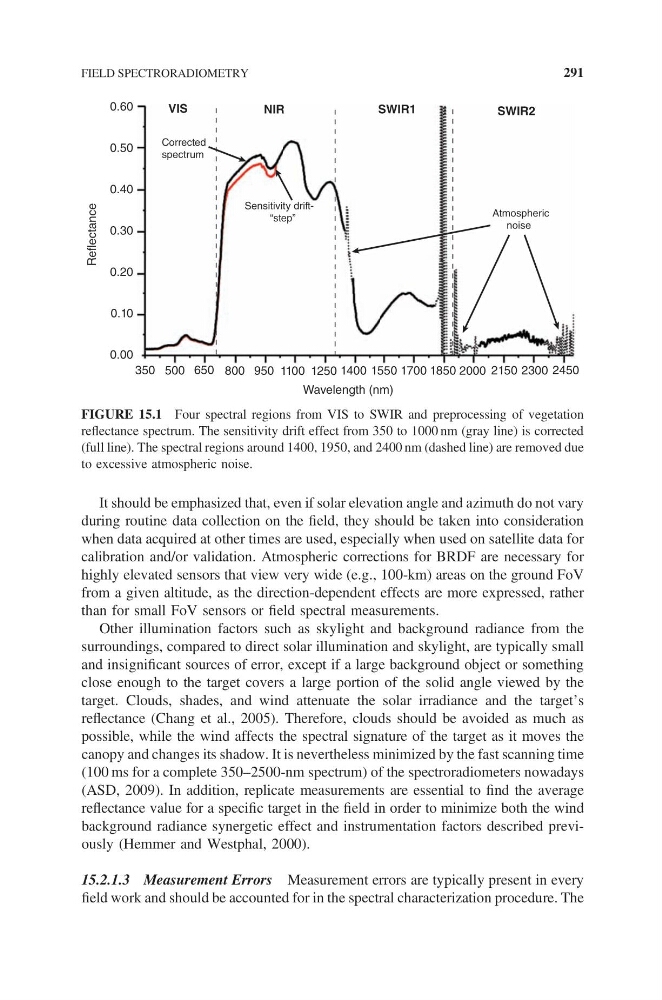
FIGURE 15.1 Four spectral regions from VIS to SWIR and preprocessing of vegetation
reflectance spectrum. The sensitivity drift effect from 350 to 1000 nm (gray line) is corrected
(full line). The spectral regions around 1400, 1950, and 2400 nm (dashed line) are removed due
to excessive atmospheric noise.
FIELD SPECTRORADIOMETRY
291
during routine data collection on the field, they should be taken into consideration
when data acquired at other times are used, especially when used on satellite data for
calibration and/or validation. Atmospheric corrections for BRDF are necessary for
highly elevated sensors that view very wide (e.g., 100-km) areas on the ground FoV
from a given altitude, as the direction-dependent effects are more expressed, rather
than for small FoV sensors or field spectral measurements.
Other illumination factors such as skylight and background radiance from the
surroundings, compared to direct solar illumination and skylight, are typically small
and insignificant sources of error, except if a large background object or something
close enough to the target covers a large portion of the solid angle viewed by the
target. Clouds, shades, and wind attenuate the solar irradiance and the target’s
reflectance (Chang et al., 2005). Therefore, clouds should be avoided as much as
possible, while the wind affects the spectral signature of the target as it moves the
canopy and changes its shadow. It is nevertheless minimized by the fast scanning time
(100 ms for a complete 350–2500-nm spectrum) of the spectroradiometers nowadays
(ASD, 2009). In addition, replicate measurements are essential to find the average
reflectance value for a specific target in the field in order to minimize both the wind
background radiance synergetic effect and instrumentation factors described previously (Hemmer and Westphal, 2000).
15.2.1.3 Measurement Errors Measurement errors are typically present in every
field work and should be accounted for in the spectral characterization procedure. The
Wavelength (nm)
Reflectance
0.00
0.10
0.20
0.30
0.40
0.50
0.60
350 500 650 800 950 1100 1250 1400 1550 1700 1850 2000 2150 2300 2450
Sensitivity drift“step”
Atmospheric
noise
Corrected
spectrum
VIS
NIR
SWIR1
SWIR2
FIGURE 15.1 Four spectral regions from VIS to SWIR and preprocessing of vegetation
reflectance spectrum. The sensitivity drift effect from 350 to 1000 nm (gray line) is corrected
(full line). The spectral regions around 1400, 1950, and 2400 nm (dashed line) are removed due
to excessive atmospheric noise.
FIELD SPECTRORADIOMETRY
291