

10.4 OPTIMUM SCALES IN OBIA
Many studies pointed out the importance of scale in OBIA as it directly affects the
overall size of resultant image objects and consequently the performance of the
subsequent analyses, such as classification, feature extraction, and change detection
(Addink et al., 2007; Ke et al., 2010). However, the selection of an optimum scale is
often challenging. Based on the review of the 76 papers on OBIA published since
2008, there are three basic methods commonly adopted to select optimum scale in
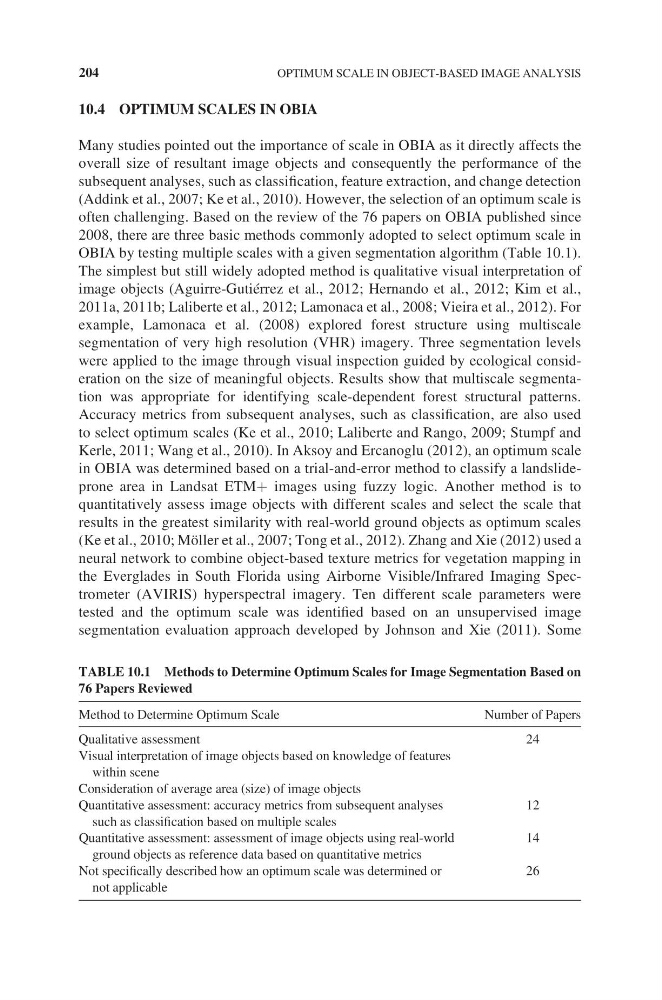
OBIA by testing multiple scales with a given segmentation algorithm (Table 10.1).
The simplest but still widely adopted method is qualitative visual interpretation of
image objects (Aguirre-Gutiérrez et al., 2012; Hernando et al., 2012; Kim et al.,
2011a, 2011b; Laliberte et al., 2012; Lamonaca et al., 2008; Vieira et al., 2012). For
example, Lamonaca et al. (2008) explored forest structure using multiscale
segmentation of very high resolution (VHR) imagery. Three segmentation levels
were applied to the image through visual inspection guided by ecological consideration on the size of meaningful objects. Results show that multiscale segmentation was appropriate for identifying scale-dependent forest structural patterns.
Accuracy metrics from subsequent analyses, such as classification, are also used
to select optimum scales (Ke et al., 2010; Laliberte and Rango, 2009; Stumpf and
Kerle, 2011; Wang et al., 2010). In Aksoy and Ercanoglu (2012), an optimum scale
in OBIA was determined based on a trial-and-error method to classify a landslideprone area in Landsat ETM+ images using fuzzy logic. Another method is to
quantitatively assess image objects with different scales and select the scale that
results in the greatest similarity with real-world ground objects as optimum scales
(Ke et al., 2010; Möller et al., 2007; Tong et al., 2012). Zhang and Xie (2012) used a
neural network to combine object-based texture metrics for vegetation mapping in
the Everglades in South Florida using Airborne Visible/Infrared Imaging Spectrometer (AVIRIS) hyperspectral imagery. Ten different scale parameters were
tested and the optimum scale was identified based on an unsupervised image
segmentation evaluation approach developed by Johnson and Xie (2011). Some
TABLE 10.1 Methods to Determine Optimum Scales for Image Segmentation Based on
76 Papers Reviewed
Method to Determine Optimum Scale
Number of Papers
Qualitative assessment
Visual interpretation of image objects based on knowledge of features
within scene
Consideration of average area (size) of image objects
24
Quantitative assessment: accuracy metrics from subsequent analyses
such as classification based on multiple scales
12
Quantitative assessment: assessment of image objects using real-world
ground objects as reference data based on quantitative metrics
14
Not specifically described how an optimum scale was determined or
not applicable
26
204
OPTIMUM SCALE IN OBJECT-BASED IMAGE ANALYSIS
Many studies pointed out the importance of scale in OBIA as it directly affects the
overall size of resultant image objects and consequently the performance of the
subsequent analyses, such as classification, feature extraction, and change detection
(Addink et al., 2007; Ke et al., 2010). However, the selection of an optimum scale is
often challenging. Based on the review of the 76 papers on OBIA published since
2008, there are three basic methods commonly adopted to select optimum scale in
OBIA by testing multiple scales with a given segmentation algorithm (Table 10.1).
The simplest but still widely adopted method is qualitative visual interpretation of
image objects (Aguirre-Gutiérrez et al., 2012; Hernando et al., 2012; Kim et al.,
2011a, 2011b; Laliberte et al., 2012; Lamonaca et al., 2008; Vieira et al., 2012). For
example, Lamonaca et al. (2008) explored forest structure using multiscale
segmentation of very high resolution (VHR) imagery. Three segmentation levels
were applied to the image through visual inspection guided by ecological consideration on the size of meaningful objects. Results show that multiscale segmentation was appropriate for identifying scale-dependent forest structural patterns.
Accuracy metrics from subsequent analyses, such as classification, are also used
to select optimum scales (Ke et al., 2010; Laliberte and Rango, 2009; Stumpf and
Kerle, 2011; Wang et al., 2010). In Aksoy and Ercanoglu (2012), an optimum scale
in OBIA was determined based on a trial-and-error method to classify a landslideprone area in Landsat ETM+ images using fuzzy logic. Another method is to
quantitatively assess image objects with different scales and select the scale that
results in the greatest similarity with real-world ground objects as optimum scales
(Ke et al., 2010; Möller et al., 2007; Tong et al., 2012). Zhang and Xie (2012) used a
neural network to combine object-based texture metrics for vegetation mapping in
the Everglades in South Florida using Airborne Visible/Infrared Imaging Spectrometer (AVIRIS) hyperspectral imagery. Ten different scale parameters were
tested and the optimum scale was identified based on an unsupervised image
segmentation evaluation approach developed by Johnson and Xie (2011). Some
TABLE 10.1 Methods to Determine Optimum Scales for Image Segmentation Based on
76 Papers Reviewed
Method to Determine Optimum Scale
Number of Papers
Qualitative assessment
Visual interpretation of image objects based on knowledge of features
within scene
Consideration of average area (size) of image objects
24
Quantitative assessment: accuracy metrics from subsequent analyses
such as classification based on multiple scales
12
Quantitative assessment: assessment of image objects using real-world
ground objects as reference data based on quantitative metrics
14
Not specifically described how an optimum scale was determined or
not applicable
26
204
OPTIMUM SCALE IN OBJECT-BASED IMAGE ANALYSIS