

After examining and validating line support regions and testing that they are aligned
properly, a selection of meaningful rectangles is provided as the final result. In Figure
9.1d the application of LSD on a very high resolution aerial scanner image is
demonstrated. LSD has been designed to be automated and includes an internal
filtering and simplification procedure with constant scale of 0.8.
For the multiscale segmentation procedure, an improved version of the initial
MSEG algorithm (Tzotsos and Argialas, 2006) was implemented. The initial MSEG
is a region-based multiscale segmentation algorithm recently developed for objectoriented image analysis. Briefly, starting from a pixel representation it creates
objects through continuous pairwise object fusions executed in iterations (passes).
For each pass, every object is evaluated in relation with its neighboring objects
toward the optimal pair of objects adequate for fusion. In every pass, an image object
can be merged only once, aiming at a balanced object growth. The MSEG algorithm
defines a cost function for each object merge and then implements various
optimization techniques to minimize this cost. The cost function is implemented
using the measure of homogeneity (color and shape) in the same way as with other
approaches (Baatz and Schape, 2000). The threshold of the allowed merging cost for
the segmentation procedure is called a scale parameter, since it implicitly dictates
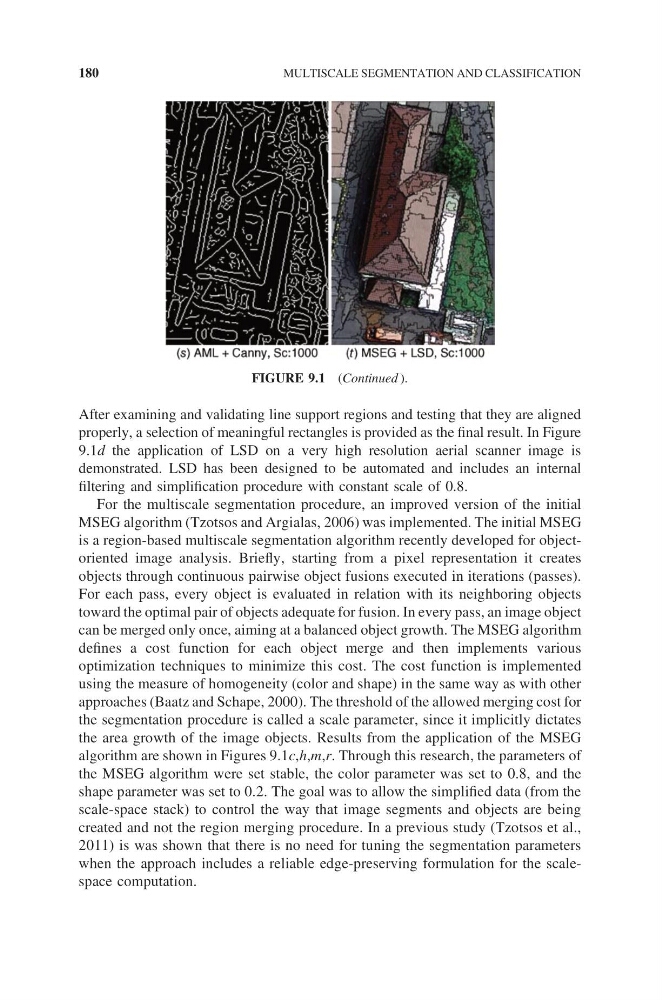
the area growth of the image objects. Results from the application of the MSEG
algorithm are shown in Figures 9.1c,h,m,r. Through this research, the parameters of
the MSEG algorithm were set stable, the color parameter was set to 0.8, and the
shape parameter was set to 0.2. The goal was to allow the simplified data (from the
scale-space stack) to control the way that image segments and objects are being
created and not the region merging procedure. In a previous study (Tzotsos et al.,
2011) is was shown that there is no need for tuning the segmentation parameters
when the approach includes a reliable edge-preserving formulation for the scalespace computation.
FIGURE 9.1 (Continued ).
180
MULTISCALE SEGMENTATION AND CLASSIFICATION
properly, a selection of meaningful rectangles is provided as the final result. In Figure
9.1d the application of LSD on a very high resolution aerial scanner image is
demonstrated. LSD has been designed to be automated and includes an internal
filtering and simplification procedure with constant scale of 0.8.
For the multiscale segmentation procedure, an improved version of the initial
MSEG algorithm (Tzotsos and Argialas, 2006) was implemented. The initial MSEG
is a region-based multiscale segmentation algorithm recently developed for objectoriented image analysis. Briefly, starting from a pixel representation it creates
objects through continuous pairwise object fusions executed in iterations (passes).
For each pass, every object is evaluated in relation with its neighboring objects
toward the optimal pair of objects adequate for fusion. In every pass, an image object
can be merged only once, aiming at a balanced object growth. The MSEG algorithm
defines a cost function for each object merge and then implements various
optimization techniques to minimize this cost. The cost function is implemented
using the measure of homogeneity (color and shape) in the same way as with other
approaches (Baatz and Schape, 2000). The threshold of the allowed merging cost for
the segmentation procedure is called a scale parameter, since it implicitly dictates
the area growth of the image objects. Results from the application of the MSEG
algorithm are shown in Figures 9.1c,h,m,r. Through this research, the parameters of
the MSEG algorithm were set stable, the color parameter was set to 0.8, and the
shape parameter was set to 0.2. The goal was to allow the simplified data (from the
scale-space stack) to control the way that image segments and objects are being
created and not the region merging procedure. In a previous study (Tzotsos et al.,
2011) is was shown that there is no need for tuning the segmentation parameters
when the approach includes a reliable edge-preserving formulation for the scalespace computation.
FIGURE 9.1 (Continued ).
180
MULTISCALE SEGMENTATION AND CLASSIFICATION