

relationships are completely different. Thus the questions that can be posed and the
information resulting from each type of hierarchy will be very different. This is one
critical reason why it is important to understand how patterns and processes are/are
not (hierarchically) connected through scale.
As Cousins (1993) notes, recognizing the existence of these different types of
hierarchies (nested and unseated) and the warnings against mixing them have not been
fully understood or heeded across a broad range of disciplines. Similarly, Wu (1999,
p. 4) states that “levels in the traditional hierarchy of ecological organization
(i.e., individual-population-community-ecosystem
4
-landscape-biome-biosphere) are
definitional and do not necessarily meet scalar criteria.” Rowe (2001) also remarks
that “the biological hierarchy of cell-organ-organism-ecosystem has been
imprudently extrapolated to include psychological and social/cultural phenomena”.
8.1.3 Multiscale Analysis
Over the last four decades, a number of computational techniques have been
developed that incorporate concepts and theory from computer vision and machine
learning to generate multiscale representations (Jähne, 1999) and detect important
features in images (Starck et al., 1998; Dey et al., 2010). These include edge detectors
(Canny, 1986), mathematical morphology (Haralick et al., 1987), watersheds
(Beucher and Lantuéjoul, 1979), image texture analysis (Hay et al., 1996), spectral
unmixing (Settle and Drake, 1993), neural nets (Foody, 1999), Bayesian networks
(Robert, 2001), fuzzy logic (Wang, 1990), and multiscale techniques such as fractals
(Mandelbrot, 1967), quadtrees (Klinger, 1972), pyramids (Klinger and Dyer, 1976),
and wavelets (Daubechies, 1988). However, the results of these techniques often fall
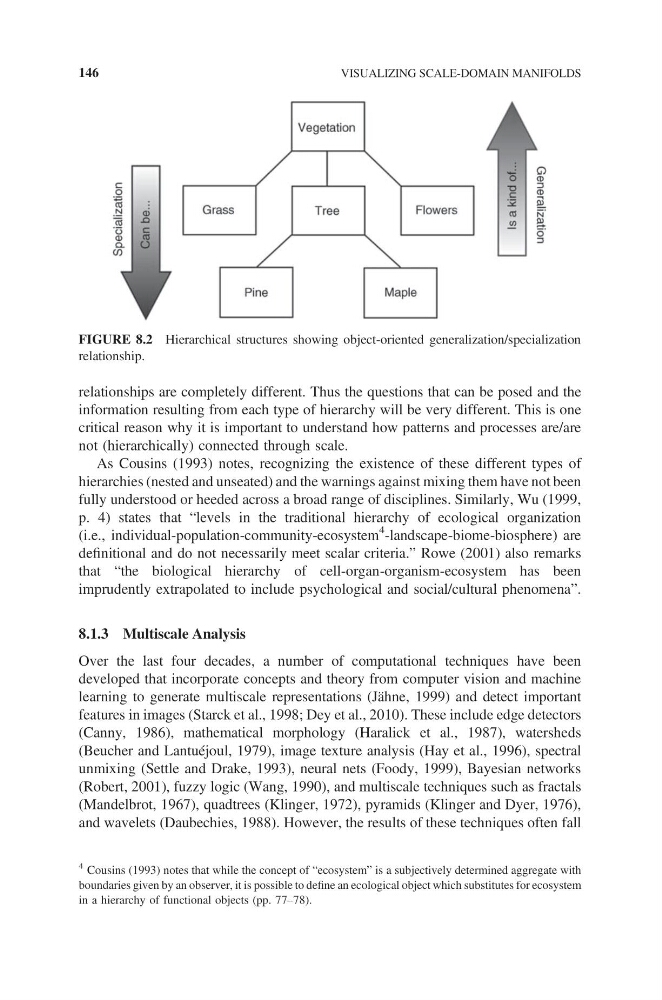
FIGURE 8.2 Hierarchical structures showing object-oriented generalization/specialization
relationship.
4 Cousins (1993) notes that while the concept of “ecosystem” is a subjectively determined aggregate with
boundaries given by an observer, it is possible to define an ecological object which substitutes for ecosystem
in a hierarchy of functional objects (pp. 77–78).
146
VISUALIZING SCALE-DOMAIN MANIFOLDS
information resulting from each type of hierarchy will be very different. This is one
critical reason why it is important to understand how patterns and processes are/are
not (hierarchically) connected through scale.
As Cousins (1993) notes, recognizing the existence of these different types of
hierarchies (nested and unseated) and the warnings against mixing them have not been
fully understood or heeded across a broad range of disciplines. Similarly, Wu (1999,
p. 4) states that “levels in the traditional hierarchy of ecological organization
(i.e., individual-population-community-ecosystem
4
-landscape-biome-biosphere) are
definitional and do not necessarily meet scalar criteria.” Rowe (2001) also remarks
that “the biological hierarchy of cell-organ-organism-ecosystem has been
imprudently extrapolated to include psychological and social/cultural phenomena”.
8.1.3 Multiscale Analysis
Over the last four decades, a number of computational techniques have been
developed that incorporate concepts and theory from computer vision and machine
learning to generate multiscale representations (Jähne, 1999) and detect important
features in images (Starck et al., 1998; Dey et al., 2010). These include edge detectors
(Canny, 1986), mathematical morphology (Haralick et al., 1987), watersheds
(Beucher and Lantuéjoul, 1979), image texture analysis (Hay et al., 1996), spectral
unmixing (Settle and Drake, 1993), neural nets (Foody, 1999), Bayesian networks
(Robert, 2001), fuzzy logic (Wang, 1990), and multiscale techniques such as fractals
(Mandelbrot, 1967), quadtrees (Klinger, 1972), pyramids (Klinger and Dyer, 1976),
and wavelets (Daubechies, 1988). However, the results of these techniques often fall
FIGURE 8.2 Hierarchical structures showing object-oriented generalization/specialization
relationship.
4 Cousins (1993) notes that while the concept of “ecosystem” is a subjectively determined aggregate with
boundaries given by an observer, it is possible to define an ecological object which substitutes for ecosystem
in a hierarchy of functional objects (pp. 77–78).
146
VISUALIZING SCALE-DOMAIN MANIFOLDS