

of Tamarix defoliation on riparian ET, the sum of evaporation and plant transpiration
from the surface to the atmosphere. The prospect of water salvage was a prime
motivation for introducing the beetles (e.g., Pattison et al., 2011).
As the beetles spread, three key questions amendable to remote sensing methods
are (Nagler et al., 2012):
1. How do leaf beetles affect the phenology of Tamarix leaf development over
multiple years of infestation (i.e., does it kill the shrubs or is damage only
temporary)?
2. What magnitude of water salvage can be expected in infested river systems?
3. How far are beetles likely to spread in the southwestern United States?
We determined the effects of beetles on the phenology and ET of Tamarix stands
at beetle release sites on six river systems in four western states (Hultine et al.,
2009, 2010; Nagler et al., 2012) and have recently extended the findings to the
Virgin River in southern Nevada as the beetles move south into new Tamarix
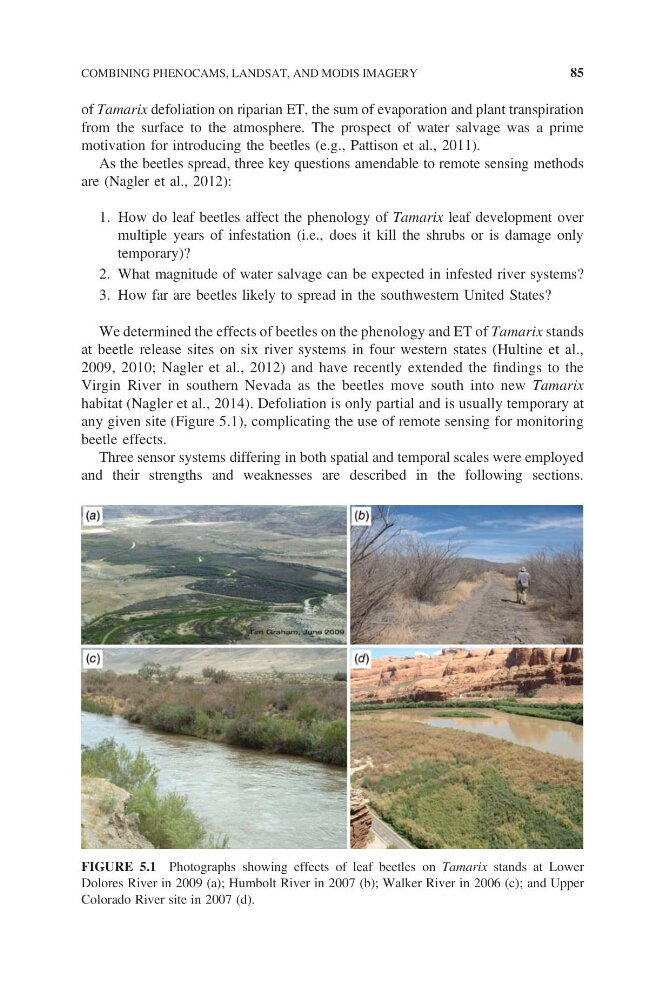
habitat (Nagler et al., 2014). Defoliation is only partial and is usually temporary at
any given site (Figure 5.1), complicating the use of remote sensing for monitoring
beetle effects.
Three sensor systems differing in both spatial and temporal scales were employed
and their strengths and weaknesses are described in the following sections.
FIGURE 5.1 Photographs showing effects of leaf beetles on Tamarix stands at Lower
Dolores River in 2009 (a); Humbolt River in 2007 (b); Walker River in 2006 (c); and Upper
Colorado River site in 2007 (d).
COMBINING PHENOCAMS, LANDSAT, AND MODIS IMAGERY
85
from the surface to the atmosphere. The prospect of water salvage was a prime
motivation for introducing the beetles (e.g., Pattison et al., 2011).
As the beetles spread, three key questions amendable to remote sensing methods
are (Nagler et al., 2012):
1. How do leaf beetles affect the phenology of Tamarix leaf development over
multiple years of infestation (i.e., does it kill the shrubs or is damage only
temporary)?
2. What magnitude of water salvage can be expected in infested river systems?
3. How far are beetles likely to spread in the southwestern United States?
We determined the effects of beetles on the phenology and ET of Tamarix stands
at beetle release sites on six river systems in four western states (Hultine et al.,
2009, 2010; Nagler et al., 2012) and have recently extended the findings to the
Virgin River in southern Nevada as the beetles move south into new Tamarix
habitat (Nagler et al., 2014). Defoliation is only partial and is usually temporary at
any given site (Figure 5.1), complicating the use of remote sensing for monitoring
beetle effects.
Three sensor systems differing in both spatial and temporal scales were employed
and their strengths and weaknesses are described in the following sections.
FIGURE 5.1 Photographs showing effects of leaf beetles on Tamarix stands at Lower
Dolores River in 2009 (a); Humbolt River in 2007 (b); Walker River in 2006 (c); and Upper
Colorado River site in 2007 (d).
COMBINING PHENOCAMS, LANDSAT, AND MODIS IMAGERY
85