

The distribution of diversity: challenges and applications
53
by attempting to develop a universal standard for
species recognition (Isaac et al ., 2004 ). However, we
should expect the debates over species concepts and
their application to the task of naming new species and
revising existing ones to continue into the distant
future.
animals (Angulo & Reichle, 2008 ), fungi (Leslie &
Bowden, 2008 ), plants (Knapp, 2008 ) and other
eukaryotes (Williams & Reid, 2009 ). Some reconciliation has been suggested by separating conceptual from
operational objectives in diagnosing species (Mayden,
1997 ; Sites & Marshall, 2004 ; de Queiroz, 2007 ), or
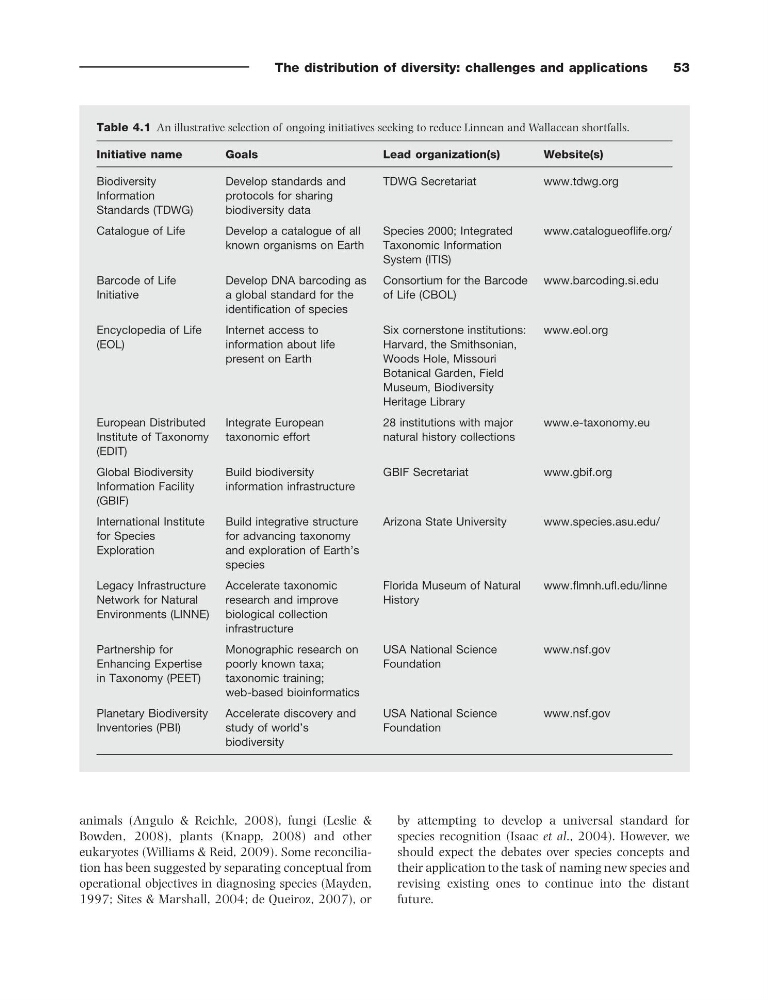
Table 4.1 An illustrative selection of ongoing initiatives seeking to reduce Linnean and Wallacean shortfalls.
Initiative name
Goals
Lead organization(s)
Website(s)
Biodiversity
Information
Standards (TDWG)
Develop standards and
protocols for sharing
biodiversity data
TDWG Secretariat
www.tdwg.org
Catalogue of Life
Develop a catalogue of all
known organisms on Earth
Species 2000; Integrated
Taxonomic Information
System (ITIS)
www.catalogueofl ife.org/
Barcode of Life
Initiative
Develop DNA barcoding as
a global standard for the
identifi cation of species
Consortium for the Barcode
of Life (CBOL)
www.barcoding.si.edu
Encyclopedia of Life
(EOL)
Internet access to
information about life
present on Earth
Six cornerstone institutions:
Harvard, the Smithsonian,
Woods Hole, Missouri
Botanical Garden, Field
Museum, Biodiversity
Heritage Library
www.eol.org
European Distributed
Institute of Taxonomy
(EDIT)
Integrate European
taxonomic effort
28 institutions with major
natural history collections
www.e - taxonomy.eu
Global Biodiversity
Information Facility
(GBIF)
Build biodiversity
information infrastructure
GBIF Secretariat
www.gbif.org
International Institute
for Species
Exploration
Build integrative structure
for advancing taxonomy
and exploration of Earth ’ s
species
Arizona State University
www.species.asu.edu/
Legacy Infrastructure
Network for Natural
Environments (LINNE)
Accelerate taxonomic
research and improve
biological collection
infrastructure
Florida Museum of Natural
History
www.fl mnh.ufl .edu/linne
Partnership for
Enhancing Expertise
in Taxonomy (PEET)
Monographic research on
poorly known taxa;
taxonomic training;
web - based bioinformatics
USA National Science
Foundation
www.nsf.gov
Planetary Biodiversity
Inventories (PBI)
Accelerate discovery and
study of world ’ s
biodiversity
USA National Science
Foundation
www.nsf.gov
53
by attempting to develop a universal standard for
species recognition (Isaac et al ., 2004 ). However, we
should expect the debates over species concepts and
their application to the task of naming new species and
revising existing ones to continue into the distant
future.
animals (Angulo & Reichle, 2008 ), fungi (Leslie &
Bowden, 2008 ), plants (Knapp, 2008 ) and other
eukaryotes (Williams & Reid, 2009 ). Some reconciliation has been suggested by separating conceptual from
operational objectives in diagnosing species (Mayden,
1997 ; Sites & Marshall, 2004 ; de Queiroz, 2007 ), or
Table 4.1 An illustrative selection of ongoing initiatives seeking to reduce Linnean and Wallacean shortfalls.
Initiative name
Goals
Lead organization(s)
Website(s)
Biodiversity
Information
Standards (TDWG)
Develop standards and
protocols for sharing
biodiversity data
TDWG Secretariat
www.tdwg.org
Catalogue of Life
Develop a catalogue of all
known organisms on Earth
Species 2000; Integrated
Taxonomic Information
System (ITIS)
www.catalogueofl ife.org/
Barcode of Life
Initiative
Develop DNA barcoding as
a global standard for the
identifi cation of species
Consortium for the Barcode
of Life (CBOL)
www.barcoding.si.edu
Encyclopedia of Life
(EOL)
Internet access to
information about life
present on Earth
Six cornerstone institutions:
Harvard, the Smithsonian,
Woods Hole, Missouri
Botanical Garden, Field
Museum, Biodiversity
Heritage Library
www.eol.org
European Distributed
Institute of Taxonomy
(EDIT)
Integrate European
taxonomic effort
28 institutions with major
natural history collections
www.e - taxonomy.eu
Global Biodiversity
Information Facility
(GBIF)
Build biodiversity
information infrastructure
GBIF Secretariat
www.gbif.org
International Institute
for Species
Exploration
Build integrative structure
for advancing taxonomy
and exploration of Earth ’ s
species
Arizona State University
www.species.asu.edu/
Legacy Infrastructure
Network for Natural
Environments (LINNE)
Accelerate taxonomic
research and improve
biological collection
infrastructure
Florida Museum of Natural
History
www.fl mnh.ufl .edu/linne
Partnership for
Enhancing Expertise
in Taxonomy (PEET)
Monographic research on
poorly known taxa;
taxonomic training;
web - based bioinformatics
USA National Science
Foundation
www.nsf.gov
Planetary Biodiversity
Inventories (PBI)
Accelerate discovery and
study of world ’ s
biodiversity
USA National Science
Foundation
www.nsf.gov