

The distribution of diversity: challenges and applications
51
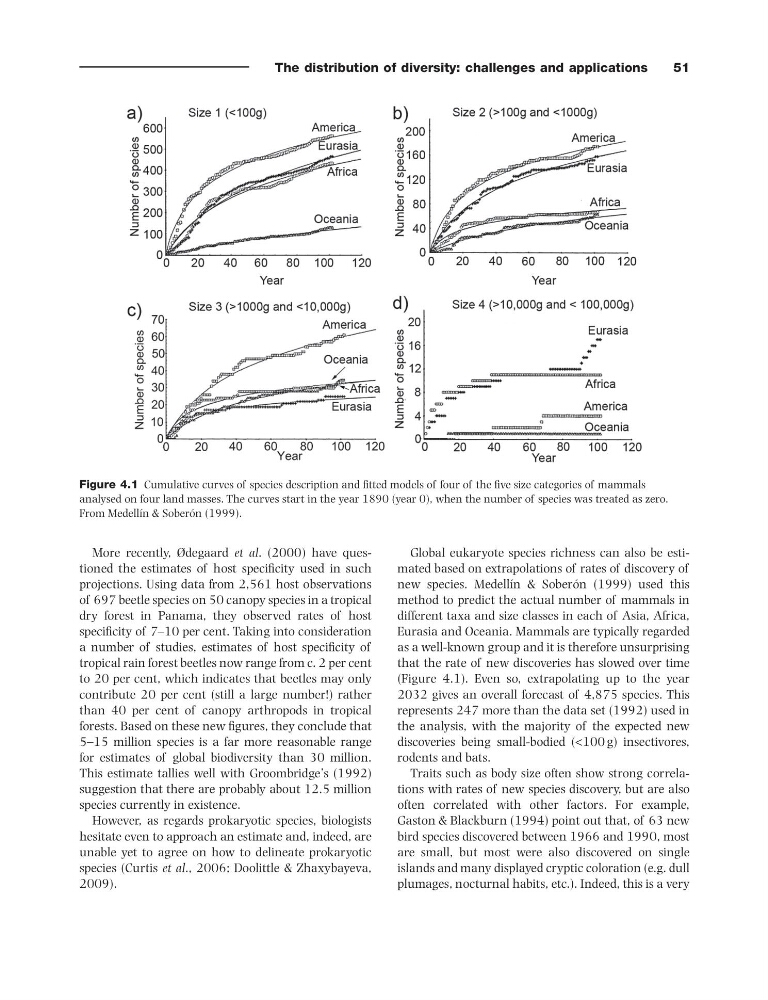
Global eukaryote species richness can also be estimated based on extrapolations of rates of discovery of
new species. Medell í n & Sober ó n (1999) used this
method to predict the actual number of mammals in
different taxa and size classes in each of Asia, Africa,
Eurasia and Oceania. Mammals are typically regarded
as a well - known group and it is therefore unsurprising
that the rate of new discoveries has slowed over time
(Figure 4.1 ). Even so, extrapolating up to the year
2032 gives an overall forecast of 4,875 species. This
represents 247 more than the data set (1992) used in
the analysis, with the majority of the expected new
discoveries being small - bodied ( < 100 g) insectivores,
rodents and bats.
Traits such as body size often show strong correlations with rates of new species discovery, but are also
often correlated with other factors. For example,
Gaston & Blackburn (1994) point out that, of 63 new
bird species discovered between 1966 and 1990, most
are small, but most were also discovered on single
islands and many displayed cryptic coloration (e.g. dull
plumages, nocturnal habits, etc.). Indeed, this is a very
More recently, Ø degaard et al . (2000) have questioned the estimates of host specifi city used in such
projections. Using data from 2,561 host observations
of 697 beetle species on 50 canopy species in a tropical
dry forest in Panama, they observed rates of host
specifi city of 7 – 10 per cent. Taking into consideration
a number of studies, estimates of host specifi city of
tropical rain forest beetles now range from c. 2 per cent
to 20 per cent, which indicates that beetles may only
contribute 20 per cent (still a large number!) rather
than 40 per cent of canopy arthropods in tropical
forests. Based on these new fi gures, they conclude that
5 – 15 million species is a far more reasonable range
for estimates of global biodiversity than 30 million.
This estimate tallies well with Groombridge ’ s (1992)
suggestion that there are probably about 12.5 million
species currently in existence.
However, as regards prokaryotic species, biologists
hesitate even to approach an estimate and, indeed, are
unable yet to agree on how to delineate prokaryotic
species (Curtis et al ., 2006 ; Doolittle & Zhaxybayeva,
2009 ).
Figure 4.1 Cumulative curves of species description and fi tted models of four of the fi ve size categories of mammals
analysed on four land masses. The curves start in the year 1890 (year 0), when the number of species was treated as zero.
From Medell í n & Sober ó n (1999) .
51
Global eukaryote species richness can also be estimated based on extrapolations of rates of discovery of
new species. Medell í n & Sober ó n (1999) used this
method to predict the actual number of mammals in
different taxa and size classes in each of Asia, Africa,
Eurasia and Oceania. Mammals are typically regarded
as a well - known group and it is therefore unsurprising
that the rate of new discoveries has slowed over time
(Figure 4.1 ). Even so, extrapolating up to the year
2032 gives an overall forecast of 4,875 species. This
represents 247 more than the data set (1992) used in
the analysis, with the majority of the expected new
discoveries being small - bodied ( < 100 g) insectivores,
rodents and bats.
Traits such as body size often show strong correlations with rates of new species discovery, but are also
often correlated with other factors. For example,
Gaston & Blackburn (1994) point out that, of 63 new
bird species discovered between 1966 and 1990, most
are small, but most were also discovered on single
islands and many displayed cryptic coloration (e.g. dull
plumages, nocturnal habits, etc.). Indeed, this is a very
More recently, Ø degaard et al . (2000) have questioned the estimates of host specifi city used in such
projections. Using data from 2,561 host observations
of 697 beetle species on 50 canopy species in a tropical
dry forest in Panama, they observed rates of host
specifi city of 7 – 10 per cent. Taking into consideration
a number of studies, estimates of host specifi city of
tropical rain forest beetles now range from c. 2 per cent
to 20 per cent, which indicates that beetles may only
contribute 20 per cent (still a large number!) rather
than 40 per cent of canopy arthropods in tropical
forests. Based on these new fi gures, they conclude that
5 – 15 million species is a far more reasonable range
for estimates of global biodiversity than 30 million.
This estimate tallies well with Groombridge ’ s (1992)
suggestion that there are probably about 12.5 million
species currently in existence.
However, as regards prokaryotic species, biologists
hesitate even to approach an estimate and, indeed, are
unable yet to agree on how to delineate prokaryotic
species (Curtis et al ., 2006 ; Doolittle & Zhaxybayeva,
2009 ).
Figure 4.1 Cumulative curves of species description and fi tted models of four of the fi ve size categories of mammals
analysed on four land masses. The curves start in the year 1890 (year 0), when the number of species was treated as zero.
From Medell í n & Sober ó n (1999) .