

40
Baselines, patterns and process
However, the palaeoecological record provides multiple
illustrations from the past, indicating that species, to
a large degree, respond individualistically to climate
change. This applies particularly to periods of rapid
and dramatic climate change, which are notable in the
records for the emergence of communities with no
modern analogue (e.g. Bush et al ., 2004 ; Williams &
Jackson, 2007 ).
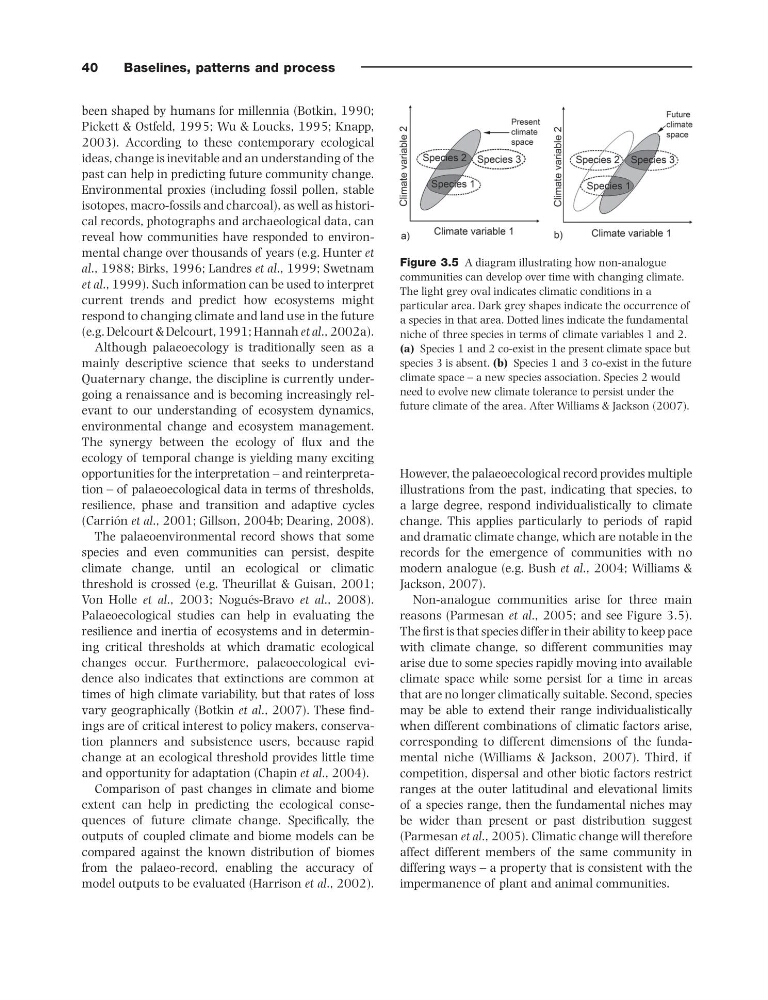
Non - analogue communities arise for three main
reasons (Parmesan et al ., 2005 ; and see Figure 3.5 ).
The fi rst is that species differ in their ability to keep pace
with climate change, so different communities may
arise due to some species rapidly moving into available
climate space while some persist for a time in areas
that are no longer climatically suitable. Second, species
may be able to extend their range individualistically
when different combinations of climatic factors arise,
corresponding to different dimensions of the fundamental niche (Williams & Jackson, 2007 ). Third, if
competition, dispersal and other biotic factors restrict
ranges at the outer latitudinal and elevational limits
of a species range, then the fundamental niches may
be wider than present or past distribution suggest
(Parmesan et al ., 2005 ). Climatic change will therefore
affect different members of the same community in
differing ways – a property that is consistent with the
impermanence of plant and animal communities.
been shaped by humans for millennia (Botkin, 1990 ;
Pickett & Ostfeld, 1995 ; Wu & Loucks, 1995 ; Knapp,
2003 ). According to these contemporary ecological
ideas, change is inevitable and an understanding of the
past can help in predicting future community change.
Environmental proxies (including fossil pollen, stable
isotopes, macro - fossils and charcoal), as well as historical records, photographs and archaeological data, can
reveal how communities have responded to environmental change over thousands of years (e.g. Hunter et
al ., 1988 ; Birks, 1996 ; Landres et al ., 1999 ; Swetnam
et al ., 1999 ). Such information can be used to interpret
current trends and predict how ecosystems might
respond to changing climate and land use in the future
(e.g. Delcourt & Delcourt, 1991 ; Hannah et al ., 2002a ).
Although palaeoecology is traditionally seen as a
mainly descriptive science that seeks to understand
Quaternary change, the discipline is currently undergoing a renaissance and is becoming increasingly relevant to our understanding of ecosystem dynamics,
environmental change and ecosystem management.
The synergy between the ecology of fl ux and the
ecology of temporal change is yielding many exciting
opportunities for the interpretation – and reinterpretation – of palaeoecological data in terms of thresholds,
resilience, phase and transition and adaptive cycles
(Carri ó n et al ., 2001 ; Gillson, 2004b ; Dearing, 2008 ).
The palaeoenvironmental record shows that some
species and even communities can persist, despite
climate change, until an ecological or climatic
threshold is crossed (e.g. Theurillat & Guisan, 2001 ;
Von Holle et al ., 2003 ; Nogu é s - Bravo et al ., 2008 ).
Palaeoecological studies can help in evaluating the
resilience and inertia of ecosystems and in determining critical thresholds at which dramatic ecological
changes occur. Furthermore, palaeoecological evidence also indicates that extinctions are common at
times of high climate variability, but that rates of loss
vary geographically (Botkin et al ., 2007 ). These fi ndings are of critical interest to policy makers, conservation planners and subsistence users, because rapid
change at an ecological threshold provides little time
and opportunity for adaptation (Chapin et al ., 2004 ).
Comparison of past changes in climate and biome
extent can help in predicting the ecological consequences of future climate change. Specifi cally, the
outputs of coupled climate and biome models can be
compared against the known distribution of biomes
from the palaeo - record, enabling the accuracy of
model outputs to be evaluated (Harrison et al ., 2002 ).
Figure 3.5 A diagram illustrating how non - analogue
communities can develop over time with changing climate.
The light grey oval indicates climatic conditions in a
particular area. Dark grey shapes indicate the occurrence of
a species in that area. Dotted lines indicate the fundamental
niche of three species in terms of climate variables 1 and 2.
(a) Species 1 and 2 co - exist in the present climate space but
species 3 is absent. (b) Species 1 and 3 co - exist in the future
climate space – a new species association. Species 2 would
need to evolve new climate tolerance to persist under the
future climate of the area. After Williams & Jackson (2007) .
Baselines, patterns and process
However, the palaeoecological record provides multiple
illustrations from the past, indicating that species, to
a large degree, respond individualistically to climate
change. This applies particularly to periods of rapid
and dramatic climate change, which are notable in the
records for the emergence of communities with no
modern analogue (e.g. Bush et al ., 2004 ; Williams &
Jackson, 2007 ).
Non - analogue communities arise for three main
reasons (Parmesan et al ., 2005 ; and see Figure 3.5 ).
The fi rst is that species differ in their ability to keep pace
with climate change, so different communities may
arise due to some species rapidly moving into available
climate space while some persist for a time in areas
that are no longer climatically suitable. Second, species
may be able to extend their range individualistically
when different combinations of climatic factors arise,
corresponding to different dimensions of the fundamental niche (Williams & Jackson, 2007 ). Third, if
competition, dispersal and other biotic factors restrict
ranges at the outer latitudinal and elevational limits
of a species range, then the fundamental niches may
be wider than present or past distribution suggest
(Parmesan et al ., 2005 ). Climatic change will therefore
affect different members of the same community in
differing ways – a property that is consistent with the
impermanence of plant and animal communities.
been shaped by humans for millennia (Botkin, 1990 ;
Pickett & Ostfeld, 1995 ; Wu & Loucks, 1995 ; Knapp,
2003 ). According to these contemporary ecological
ideas, change is inevitable and an understanding of the
past can help in predicting future community change.
Environmental proxies (including fossil pollen, stable
isotopes, macro - fossils and charcoal), as well as historical records, photographs and archaeological data, can
reveal how communities have responded to environmental change over thousands of years (e.g. Hunter et
al ., 1988 ; Birks, 1996 ; Landres et al ., 1999 ; Swetnam
et al ., 1999 ). Such information can be used to interpret
current trends and predict how ecosystems might
respond to changing climate and land use in the future
(e.g. Delcourt & Delcourt, 1991 ; Hannah et al ., 2002a ).
Although palaeoecology is traditionally seen as a
mainly descriptive science that seeks to understand
Quaternary change, the discipline is currently undergoing a renaissance and is becoming increasingly relevant to our understanding of ecosystem dynamics,
environmental change and ecosystem management.
The synergy between the ecology of fl ux and the
ecology of temporal change is yielding many exciting
opportunities for the interpretation – and reinterpretation – of palaeoecological data in terms of thresholds,
resilience, phase and transition and adaptive cycles
(Carri ó n et al ., 2001 ; Gillson, 2004b ; Dearing, 2008 ).
The palaeoenvironmental record shows that some
species and even communities can persist, despite
climate change, until an ecological or climatic
threshold is crossed (e.g. Theurillat & Guisan, 2001 ;
Von Holle et al ., 2003 ; Nogu é s - Bravo et al ., 2008 ).
Palaeoecological studies can help in evaluating the
resilience and inertia of ecosystems and in determining critical thresholds at which dramatic ecological
changes occur. Furthermore, palaeoecological evidence also indicates that extinctions are common at
times of high climate variability, but that rates of loss
vary geographically (Botkin et al ., 2007 ). These fi ndings are of critical interest to policy makers, conservation planners and subsistence users, because rapid
change at an ecological threshold provides little time
and opportunity for adaptation (Chapin et al ., 2004 ).
Comparison of past changes in climate and biome
extent can help in predicting the ecological consequences of future climate change. Specifi cally, the
outputs of coupled climate and biome models can be
compared against the known distribution of biomes
from the palaeo - record, enabling the accuracy of
model outputs to be evaluated (Harrison et al ., 2002 ).
Figure 3.5 A diagram illustrating how non - analogue
communities can develop over time with changing climate.
The light grey oval indicates climatic conditions in a
particular area. Dark grey shapes indicate the occurrence of
a species in that area. Dotted lines indicate the fundamental
niche of three species in terms of climate variables 1 and 2.
(a) Species 1 and 2 co - exist in the present climate space but
species 3 is absent. (b) Species 1 and 3 co - exist in the future
climate space – a new species association. Species 2 would
need to evolve new climate tolerance to persist under the
future climate of the area. After Williams & Jackson (2007) .