

Roots, relevance, aims and values
33
and vegetation composition. This, in turn, alters the
supply and quality of resources available to animals.
Populations respond to this variability through
increases and decreases in their rate of population
growth as well as changes in distribution.
Population size also changes in response to demographic stochasticity, biotic interactions, disease and
disturbance events. Feedbacks occur between these
many interacting biological and environmental variables; for example, the frequency and intensity of fi re
will depend on seasonal rainfall, which infl uences
standing biomass and likelihood of ignition (Sousa,
1984 ).
For these reasons, ecological equilibria are thought
to be transient (temporally unstable) and scale - specifi c
(spatially constrained) (cf. Whittaker et al ., 2001 ;
homeostatic systems that respond to disturbance by
returning to a pre - determined state, through a predictable series of changes. In the climatic climax, for
example, vegetation types can be predicted according
to climatic factors such as rainfall and temperature –
a view later modifi ed to incorporate fi ner scale patterns
as a function of soil type and geology (Clements, 1916 ;
Tansley, 1939 ; Whittaker, 1953 ). Following disturbance, ecosystems would progress through several
stages to a defi ned end point, the climax community.
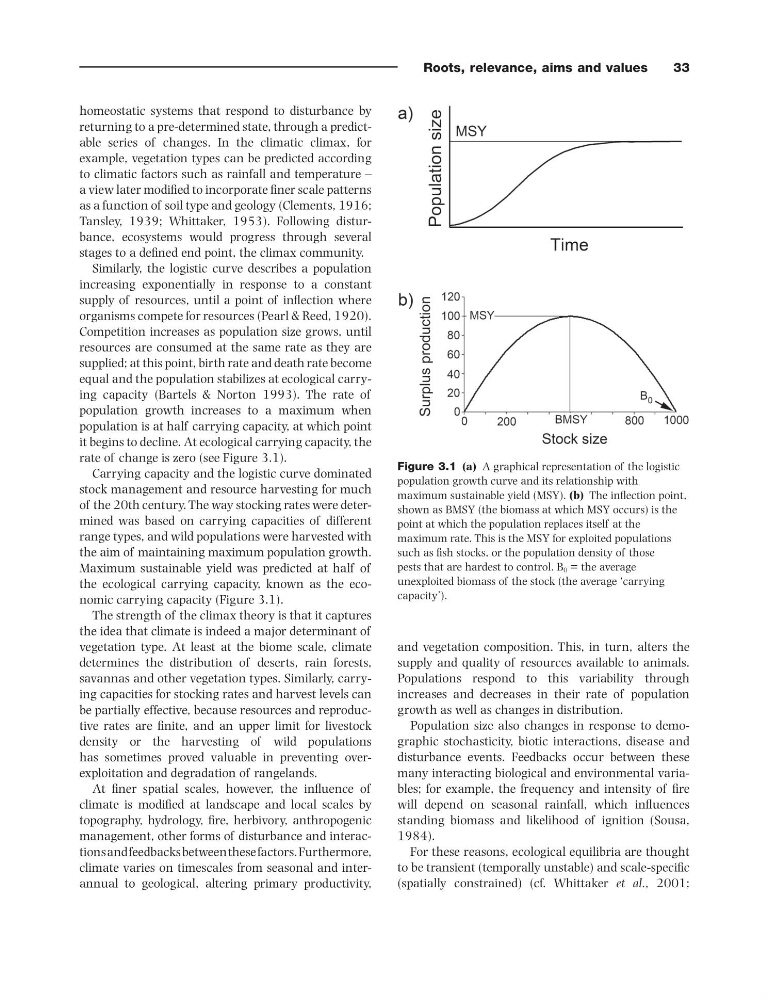
Similarly, the logistic curve describes a population
increasing exponentially in response to a constant
supply of resources, until a point of infl ection where
organisms compete for resources (Pearl & Reed, 1920 ).
Competition increases as population size grows, until
resources are consumed at the same rate as they are
supplied; at this point, birth rate and death rate become
equal and the population stabilizes at ecological carrying capacity (Bartels & Norton 1993 ). The rate of
population growth increases to a maximum when
population is at half carrying capacity, at which point
it begins to decline. At ecological carrying capacity, the
rate of change is zero (see Figure 3.1 ).
Carrying capacity and the logistic curve dominated
stock management and resource harvesting for much
of the 20th century. The way stocking rates were determined was based on carrying capacities of different
range types, and wild populations were harvested with
the aim of maintaining maximum population growth.
Maximum sustainable yield was predicted at half of
the ecological carrying capacity, known as the economic carrying capacity (Figure 3.1 ).
The strength of the climax theory is that it captures
the idea that climate is indeed a major determinant of
vegetation type. At least at the biome scale, climate
determines the distribution of deserts, rain forests,
savannas and other vegetation types. Similarly, carrying capacities for stocking rates and harvest levels can
be partially effective, because resources and reproductive rates are fi nite, and an upper limit for livestock
density or the harvesting of wild populations
has sometimes proved valuable in preventing over -
exploitation and degradation of rangelands.
At fi ner spatial scales, however, the infl uence of
climate is modifi ed at landscape and local scales by
topography, hydrology, fi re, herbivory, anthropogenic
management, other forms of disturbance and interactions and feedbacks between these factors. Furthermore,
climate varies on timescales from seasonal and interannual to geological, altering primary productivity,
Figure 3.1 (a) A graphical representation of the logistic
population growth curve and its relationship with
maximum sustainable yield (MSY). (b) The infl ection point,
shown as BMSY (the biomass at which MSY occurs) is the
point at which the population replaces itself at the
maximum rate. This is the MSY for exploited populations
such as fi sh stocks, or the population density of those
pests that are hardest to control. B 0 = the average
unexploited biomass of the stock (the average ‘ carrying
capacity ’ ).
33
and vegetation composition. This, in turn, alters the
supply and quality of resources available to animals.
Populations respond to this variability through
increases and decreases in their rate of population
growth as well as changes in distribution.
Population size also changes in response to demographic stochasticity, biotic interactions, disease and
disturbance events. Feedbacks occur between these
many interacting biological and environmental variables; for example, the frequency and intensity of fi re
will depend on seasonal rainfall, which infl uences
standing biomass and likelihood of ignition (Sousa,
1984 ).
For these reasons, ecological equilibria are thought
to be transient (temporally unstable) and scale - specifi c
(spatially constrained) (cf. Whittaker et al ., 2001 ;
homeostatic systems that respond to disturbance by
returning to a pre - determined state, through a predictable series of changes. In the climatic climax, for
example, vegetation types can be predicted according
to climatic factors such as rainfall and temperature –
a view later modifi ed to incorporate fi ner scale patterns
as a function of soil type and geology (Clements, 1916 ;
Tansley, 1939 ; Whittaker, 1953 ). Following disturbance, ecosystems would progress through several
stages to a defi ned end point, the climax community.
Similarly, the logistic curve describes a population
increasing exponentially in response to a constant
supply of resources, until a point of infl ection where
organisms compete for resources (Pearl & Reed, 1920 ).
Competition increases as population size grows, until
resources are consumed at the same rate as they are
supplied; at this point, birth rate and death rate become
equal and the population stabilizes at ecological carrying capacity (Bartels & Norton 1993 ). The rate of
population growth increases to a maximum when
population is at half carrying capacity, at which point
it begins to decline. At ecological carrying capacity, the
rate of change is zero (see Figure 3.1 ).
Carrying capacity and the logistic curve dominated
stock management and resource harvesting for much
of the 20th century. The way stocking rates were determined was based on carrying capacities of different
range types, and wild populations were harvested with
the aim of maintaining maximum population growth.
Maximum sustainable yield was predicted at half of
the ecological carrying capacity, known as the economic carrying capacity (Figure 3.1 ).
The strength of the climax theory is that it captures
the idea that climate is indeed a major determinant of
vegetation type. At least at the biome scale, climate
determines the distribution of deserts, rain forests,
savannas and other vegetation types. Similarly, carrying capacities for stocking rates and harvest levels can
be partially effective, because resources and reproductive rates are fi nite, and an upper limit for livestock
density or the harvesting of wild populations
has sometimes proved valuable in preventing over -
exploitation and degradation of rangelands.
At fi ner spatial scales, however, the infl uence of
climate is modifi ed at landscape and local scales by
topography, hydrology, fi re, herbivory, anthropogenic
management, other forms of disturbance and interactions and feedbacks between these factors. Furthermore,
climate varies on timescales from seasonal and interannual to geological, altering primary productivity,
Figure 3.1 (a) A graphical representation of the logistic
population growth curve and its relationship with
maximum sustainable yield (MSY). (b) The infl ection point,
shown as BMSY (the biomass at which MSY occurs) is the
point at which the population replaces itself at the
maximum rate. This is the MSY for exploited populations
such as fi sh stocks, or the population density of those
pests that are hardest to control. B 0 = the average
unexploited biomass of the stock (the average ‘ carrying
capacity ’ ).