

248
Prospects and challenges
1 Barriers to scientifi c development:
• Filling biogeographical shortfalls
• Improving the accuracy and specifi city of
forecasts
2 Barriers to application:
• Turning theory into practice
• Education and communication
• Social values and lifestyles
In the following sub - sections, we will address each of
these challenges, the prospects for overcoming them
and how doing so may impact on the discipline and contribute to the long - term conservation of biodiversity.
10.2.1 Filling the Wallacean and
Linnean s hortfalls
As we have repeatedly stressed within this book, data
on species identities and distributions are central to
research and practice in conservation biogeography. It
is therefore essential that these data are of appropriate
quality, i.e. that they are fi t for purpose.
For example, global conservation prioritization
frameworks (Chapter 5 ) such as Conservation
new biogeographical knowledge enters the public
domain on issues such as extinction rates, range shifts,
species invasions and habitat transformation, public
attitudes may shift, putting pressure on policymakers
and presenting both challenges and opportunities to
conservation organizations. However, it is important to
remember that the relationship between knowledge,
attitudes and behaviours is complex and multi - faceted,
and that the act of providing new information may not,
in itself, be suffi cient to infl uence attitudes and actions.
Explaining, contextualizing and framing biogeographical information for diverse constituencies is therefore
arguably as important as generating the data.
10.2 THE CHALLENGES
Conservation biogeographers face a range of different
challenges over the next few decades if they are to
make a signifi cant and lasting impact on the conservation of global diversity (Richardson & Whittaker,
2010 ). The fi ve challenges identifi ed below refl ect two
different categories of barriers to the development of
the discipline:
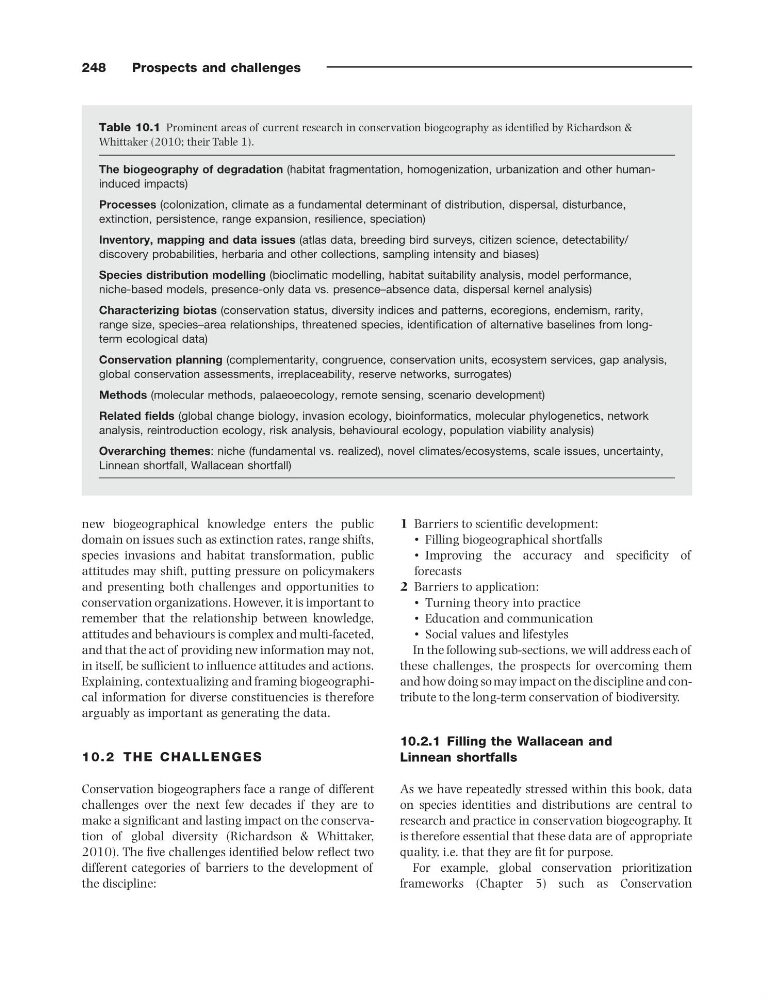
Table 10.1 Prominent areas of current research in conservation biogeography as identifi ed by Richardson &
Whittaker ( 2010 ; their Table 1).
The biogeography of degradation (habitat fragmentation, homogenization, urbanization and other human -
induced impacts)
Processes (colonization, climate as a fundamental determinant of distribution, dispersal, disturbance,
extinction, persistence, range expansion, resilience, speciation)
Inventory, mapping and data issues (atlas data, breeding bird surveys, citizen science, detectability/
discovery probabilities, herbaria and other collections, sampling intensity and biases)
Species distribution modelling (bioclimatic modelling, habitat suitability analysis, model performance,
niche - based models, presence - only data vs. presence – absence data, dispersal kernel analysis)
Characterizing biotas (conservation status, diversity indices and patterns, ecoregions, endemism, rarity,
range size, species – area relationships, threatened species, identifi cation of alternative baselines from long -
term ecological data)
Conservation planning (complementarity, congruence, conservation units, ecosystem services, gap analysis,
global conservation assessments, irreplaceability, reserve networks, surrogates)
Methods (molecular methods, palaeoecology, remote sensing, scenario development)
Related fi elds (global change biology, invasion ecology, bioinformatics, molecular phylogenetics, network
analysis, reintroduction ecology, risk analysis, behavioural ecology, population viability analysis)
Overarching themes : niche (fundamental vs. realized), novel climates/ecosystems, scale issues, uncertainty,
Linnean shortfall, Wallacean shortfall)
Prospects and challenges
1 Barriers to scientifi c development:
• Filling biogeographical shortfalls
• Improving the accuracy and specifi city of
forecasts
2 Barriers to application:
• Turning theory into practice
• Education and communication
• Social values and lifestyles
In the following sub - sections, we will address each of
these challenges, the prospects for overcoming them
and how doing so may impact on the discipline and contribute to the long - term conservation of biodiversity.
10.2.1 Filling the Wallacean and
Linnean s hortfalls
As we have repeatedly stressed within this book, data
on species identities and distributions are central to
research and practice in conservation biogeography. It
is therefore essential that these data are of appropriate
quality, i.e. that they are fi t for purpose.
For example, global conservation prioritization
frameworks (Chapter 5 ) such as Conservation
new biogeographical knowledge enters the public
domain on issues such as extinction rates, range shifts,
species invasions and habitat transformation, public
attitudes may shift, putting pressure on policymakers
and presenting both challenges and opportunities to
conservation organizations. However, it is important to
remember that the relationship between knowledge,
attitudes and behaviours is complex and multi - faceted,
and that the act of providing new information may not,
in itself, be suffi cient to infl uence attitudes and actions.
Explaining, contextualizing and framing biogeographical information for diverse constituencies is therefore
arguably as important as generating the data.
10.2 THE CHALLENGES
Conservation biogeographers face a range of different
challenges over the next few decades if they are to
make a signifi cant and lasting impact on the conservation of global diversity (Richardson & Whittaker,
2010 ). The fi ve challenges identifi ed below refl ect two
different categories of barriers to the development of
the discipline:
Table 10.1 Prominent areas of current research in conservation biogeography as identifi ed by Richardson &
Whittaker ( 2010 ; their Table 1).
The biogeography of degradation (habitat fragmentation, homogenization, urbanization and other human -
induced impacts)
Processes (colonization, climate as a fundamental determinant of distribution, dispersal, disturbance,
extinction, persistence, range expansion, resilience, speciation)
Inventory, mapping and data issues (atlas data, breeding bird surveys, citizen science, detectability/
discovery probabilities, herbaria and other collections, sampling intensity and biases)
Species distribution modelling (bioclimatic modelling, habitat suitability analysis, model performance,
niche - based models, presence - only data vs. presence – absence data, dispersal kernel analysis)
Characterizing biotas (conservation status, diversity indices and patterns, ecoregions, endemism, rarity,
range size, species – area relationships, threatened species, identifi cation of alternative baselines from long -
term ecological data)
Conservation planning (complementarity, congruence, conservation units, ecosystem services, gap analysis,
global conservation assessments, irreplaceability, reserve networks, surrogates)
Methods (molecular methods, palaeoecology, remote sensing, scenario development)
Related fi elds (global change biology, invasion ecology, bioinformatics, molecular phylogenetics, network
analysis, reintroduction ecology, risk analysis, behavioural ecology, population viability analysis)
Overarching themes : niche (fundamental vs. realized), novel climates/ecosystems, scale issues, uncertainty,
Linnean shortfall, Wallacean shortfall)