

242
Biological invasions and the homogenization of faunas and fl oras
create novel environmental conditions or, as Saxon
et al . (2005) refers to them, ‘ environmental domains ’ .
The disappearance or contraction of present environmental domains and the appearance of new domains
will have profound consequences for most species and
the identity of communities today. Climate change is
expected to alter the effectiveness of environmental
fi lters; to alter the likelihood of species establishing; to
change pathways of species introductions; and to
affect the impact of non - native species (Rahel & Olden,
2008 ). The combination of novel assemblages and
altered biophysical conditions will result in new
systems that have unknown functional characteristics,
and whose processes and interactions are hard to
predict (Hobbs et al. , 2006 ).
Given the dynamic nature of species ’ distributions,
current homogenization patterns and trends are likely
to change too. It is very diffi cult to predict the make - up
of novel assemblages, given that it is almost impossible
to know which species will co - occur, whether they
will interact and how altered climatic regimes will
infl uence any interaction. Importantly, many of these
communities may be more, or less, similar across
locations than the native assemblages they replaced.
In other words, homogenization is not the only outcome of the massive movement of species across the
globe.
Perhaps the only certainty is that conservation
efforts will have to intensify to tackle the threat of
anthropogenically - assisted novel assemblages, and
society will be faced with some tough decisions as to
what biodiversity it values.
FOR DISCUSSION
1 How do natural patterns of species invasion differ
from anthropogenically assisted species invasions, and
with what consequences?
2 In the light of social demands and economic
development, what are the most likely timescales and
scenarios of introduction, establishment and spread
of non - native species in the future?
3 What are the ecological consequences of faunal and
fl oral homogenization?
4 What are the temporal dynamics of taxonomic and
functional homogenization?
5 What are the primary environmental and biological
drivers of biotic homogenization at different spatial
and temporal scales?
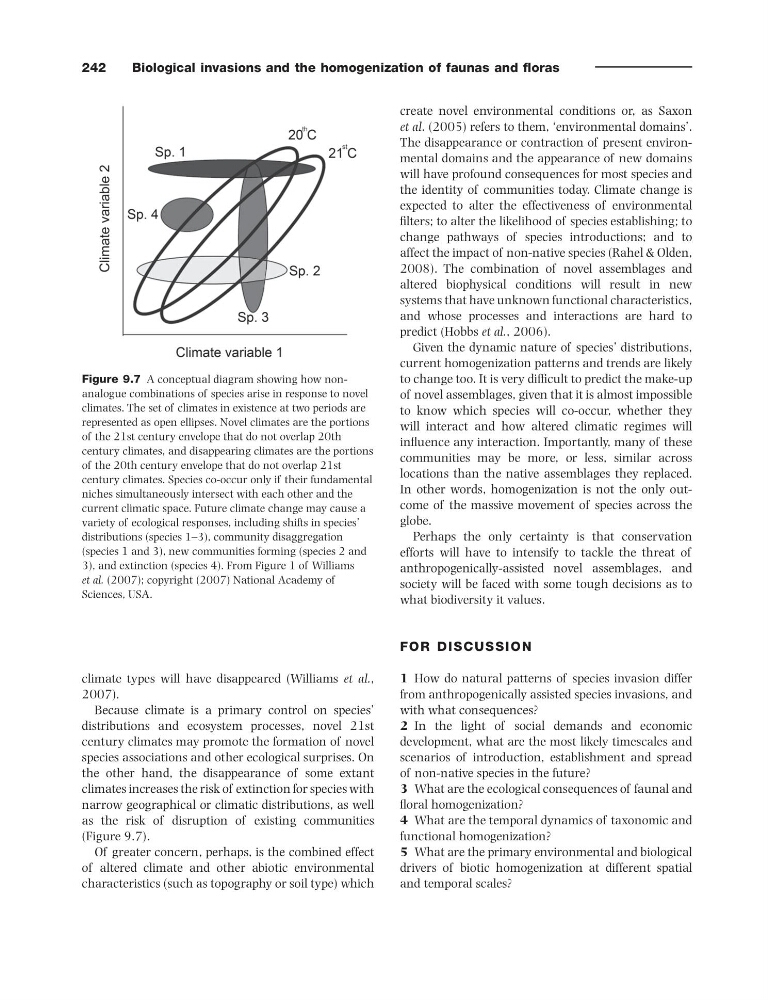
climate types will have disappeared (Williams et al. ,
2007 ).
Because climate is a primary control on species ’
distributions and ecosystem processes, novel 21st
century climates may promote the formation of novel
species associations and other ecological surprises. On
the other hand, the disappearance of some extant
climates increases the risk of extinction for species with
narrow geographical or climatic distributions, as well
as the risk of disruption of existing communities
(Figure 9.7 ).
Of greater concern, perhaps, is the combined effect
of altered climate and other abiotic environmental
characteristics (such as topography or soil type) which
Figure 9.7 A conceptual diagram showing how non -
analogue combinations of species arise in response to novel
climates. The set of climates in existence at two periods are
represented as open ellipses. Novel climates are the portions
of the 21st century envelope that do not overlap 20th
century climates, and disappearing climates are the portions
of the 20th century envelope that do not overlap 21st
century climates. Species co - occur only if their fundamental
niches simultaneously intersect with each other and the
current climatic space. Future climate change may cause a
variety of ecological responses, including shifts in species ’
distributions (species 1 – 3), community disaggregation
(species 1 and 3), new communities forming (species 2 and
3), and extinction (species 4). From Figure 1 of Williams
et al. (2007) ; copyright (2007) National Academy of
Sciences, USA.
Biological invasions and the homogenization of faunas and fl oras
create novel environmental conditions or, as Saxon
et al . (2005) refers to them, ‘ environmental domains ’ .
The disappearance or contraction of present environmental domains and the appearance of new domains
will have profound consequences for most species and
the identity of communities today. Climate change is
expected to alter the effectiveness of environmental
fi lters; to alter the likelihood of species establishing; to
change pathways of species introductions; and to
affect the impact of non - native species (Rahel & Olden,
2008 ). The combination of novel assemblages and
altered biophysical conditions will result in new
systems that have unknown functional characteristics,
and whose processes and interactions are hard to
predict (Hobbs et al. , 2006 ).
Given the dynamic nature of species ’ distributions,
current homogenization patterns and trends are likely
to change too. It is very diffi cult to predict the make - up
of novel assemblages, given that it is almost impossible
to know which species will co - occur, whether they
will interact and how altered climatic regimes will
infl uence any interaction. Importantly, many of these
communities may be more, or less, similar across
locations than the native assemblages they replaced.
In other words, homogenization is not the only outcome of the massive movement of species across the
globe.
Perhaps the only certainty is that conservation
efforts will have to intensify to tackle the threat of
anthropogenically - assisted novel assemblages, and
society will be faced with some tough decisions as to
what biodiversity it values.
FOR DISCUSSION
1 How do natural patterns of species invasion differ
from anthropogenically assisted species invasions, and
with what consequences?
2 In the light of social demands and economic
development, what are the most likely timescales and
scenarios of introduction, establishment and spread
of non - native species in the future?
3 What are the ecological consequences of faunal and
fl oral homogenization?
4 What are the temporal dynamics of taxonomic and
functional homogenization?
5 What are the primary environmental and biological
drivers of biotic homogenization at different spatial
and temporal scales?
climate types will have disappeared (Williams et al. ,
2007 ).
Because climate is a primary control on species ’
distributions and ecosystem processes, novel 21st
century climates may promote the formation of novel
species associations and other ecological surprises. On
the other hand, the disappearance of some extant
climates increases the risk of extinction for species with
narrow geographical or climatic distributions, as well
as the risk of disruption of existing communities
(Figure 9.7 ).
Of greater concern, perhaps, is the combined effect
of altered climate and other abiotic environmental
characteristics (such as topography or soil type) which
Figure 9.7 A conceptual diagram showing how non -
analogue combinations of species arise in response to novel
climates. The set of climates in existence at two periods are
represented as open ellipses. Novel climates are the portions
of the 21st century envelope that do not overlap 20th
century climates, and disappearing climates are the portions
of the 20th century envelope that do not overlap 21st
century climates. Species co - occur only if their fundamental
niches simultaneously intersect with each other and the
current climatic space. Future climate change may cause a
variety of ecological responses, including shifts in species ’
distributions (species 1 – 3), community disaggregation
(species 1 and 3), new communities forming (species 2 and
3), and extinction (species 4). From Figure 1 of Williams
et al. (2007) ; copyright (2007) National Academy of
Sciences, USA.