

Conservation planning in a changing world
231
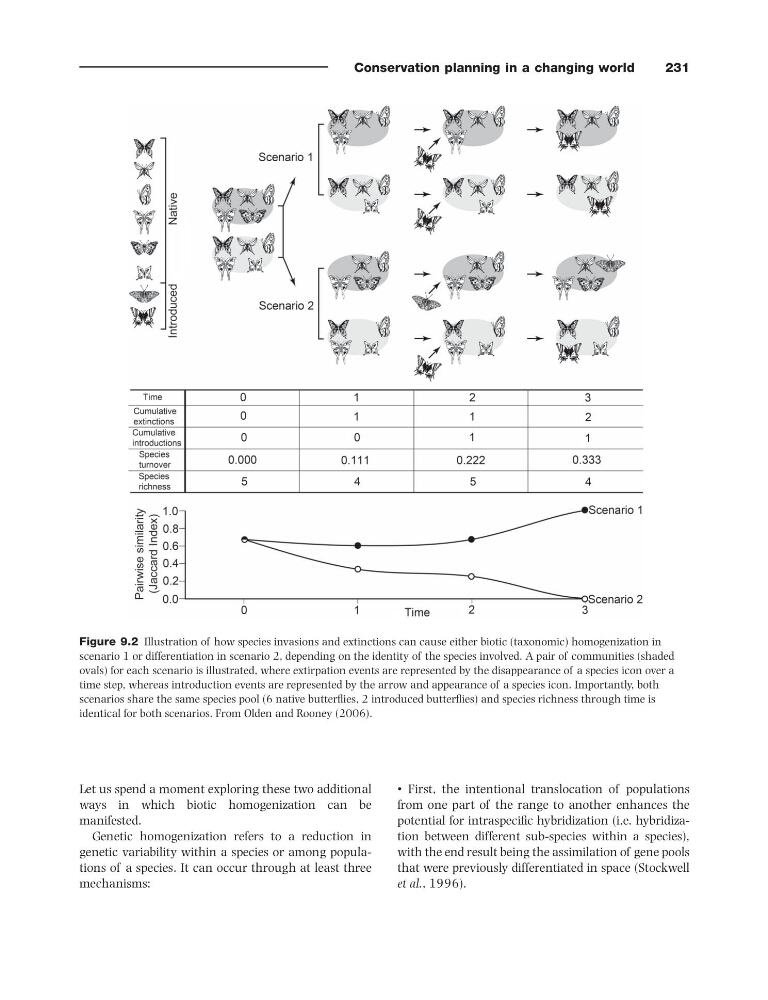
Figure 9.2 Illustration of how species invasions and extinctions can cause either biotic (taxonomic) homogenization in
scenario 1 or differentiation in scenario 2, depending on the identity of the species involved. A pair of communities (shaded
ovals) for each scenario is illustrated, where extirpation events are represented by the disappearance of a species icon over a
time step, whereas introduction events are represented by the arrow and appearance of a species icon. Importantly, both
scenarios share the same species pool (6 native butterfl ies, 2 introduced butterfl ies) and species richness through time is
identical for both scenarios. From Olden and Rooney (2006) .
Let us spend a moment exploring these two additional
ways in which biotic homogenization can be
manifested.
Genetic homogenization refers to a reduction in
genetic variability within a species or among populations of a species. It can occur through at least three
mechanisms:
• First, the intentional translocation of populations
from one part of the range to another enhances the
potential for intraspecifi c hybridization (i.e. hybridization between different sub - species within a species),
with the end result being the assimilation of gene pools
that were previously differentiated in space (Stockwell
et al. , 1996 ).
231
Figure 9.2 Illustration of how species invasions and extinctions can cause either biotic (taxonomic) homogenization in
scenario 1 or differentiation in scenario 2, depending on the identity of the species involved. A pair of communities (shaded
ovals) for each scenario is illustrated, where extirpation events are represented by the disappearance of a species icon over a
time step, whereas introduction events are represented by the arrow and appearance of a species icon. Importantly, both
scenarios share the same species pool (6 native butterfl ies, 2 introduced butterfl ies) and species richness through time is
identical for both scenarios. From Olden and Rooney (2006) .
Let us spend a moment exploring these two additional
ways in which biotic homogenization can be
manifested.
Genetic homogenization refers to a reduction in
genetic variability within a species or among populations of a species. It can occur through at least three
mechanisms:
• First, the intentional translocation of populations
from one part of the range to another enhances the
potential for intraspecifi c hybridization (i.e. hybridization between different sub - species within a species),
with the end result being the assimilation of gene pools
that were previously differentiated in space (Stockwell
et al. , 1996 ).