

Conservation planning in a changing world
225
ranges and become pests. These estimates were based,
in large part, on non - native animals and plants of
Britain. More recently, Jeschke and Strayer (2005)
investigated all freshwater fi sh, mammal and bird
species native to Europe or North America that have
been introduced outside their native range. They found
that the frequencies of transitions across all three of
the above stages averaged 6.1 per cent, 56.0 per cent
and 59.7 per cent, respectively.
Regardless of the specifi c percentages for each stage,
it is apparent that only a fraction of the species that are
moved by people, either on purpose or by accident, will
complete all stages of the invasion process. A considerable amount of research within invasion biology has
times, such as the introduction of the tamarind tree
( Tamarindus indica ) into China by way of commerce
along the Shu - Yan trade route that linked China to
India 8,000 years ago (Yan et al. , 2001 ). Some species
apparently have nearly circumglobal distributions
because of ancient trade activities, with many of these
examples only recently coming to light thanks to the
power of molecular analyses to locate the evolutionary
origins of now very widespread species (e.g. Wares
et al ., 2002 ).
There is ample historical evidence that the number
of species that were moved out of their native ranges
and introduced to somewhere novel via human actions
increased as the world began to become ever more
interconnected (Elton, 1958 ). As this number grew,
the need to understand how this process occurs, and
to differentiate natural species ’ range expansions from
those mediated by humans, became critical. Without
making this distinction, it becomes diffi cult to untangle
the mechanisms that are driving historical biodiversity
changes, to understand the role of new arrivals in
driving evolutionary dynamics and, more practically,
to stem the fl ow of species that cause ecological or
economic harm (see below).
Before continuing, however, it is very important to
recognize that a multitude of names have been given
to species that are introduced to a novel location via
human actions – such as ‘ exotic ’ , ‘ invasive ’ or ‘ alien ’
species (Lockwood et al. , 2007 ). We use the term ‘ invasion ’ to refer to the process whereby species expand
their geographical distribution outside of their natural
dispersal range via the actions of humans, while we
refer to populations that have become otherwise established outside the bounds of their native ranges as
‘ non - native ’ .
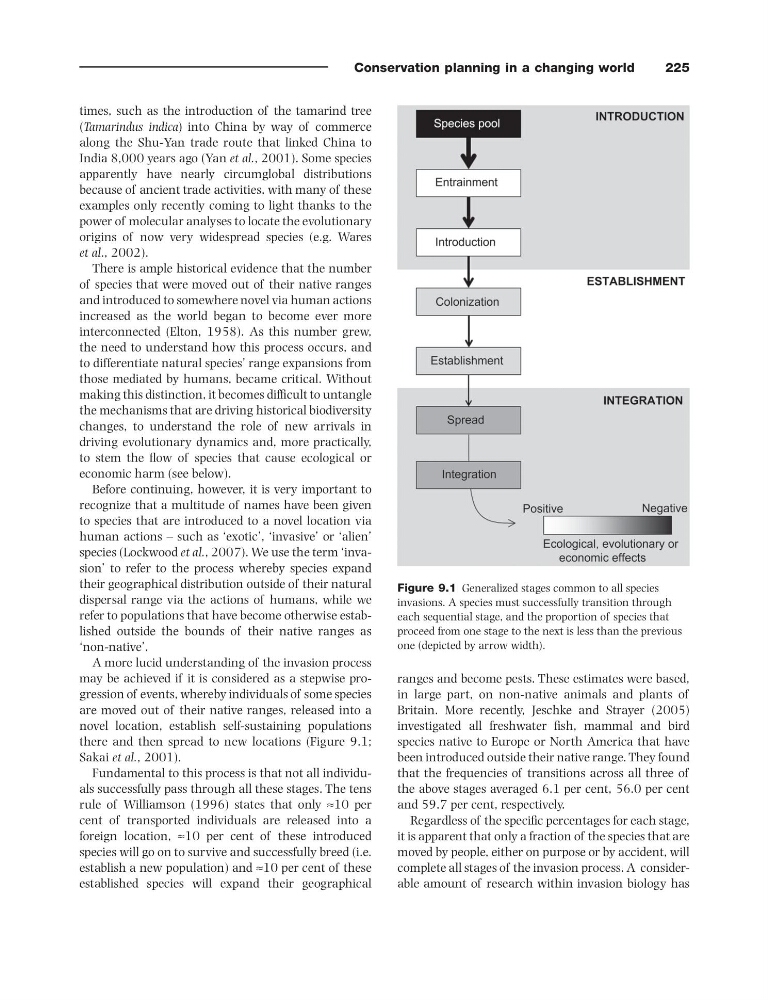
A more lucid understanding of the invasion process
may be achieved if it is considered as a stepwise progression of events, whereby individuals of some species
are moved out of their native ranges, released into a
novel location, establish self - sustaining populations
there and then spread to new locations (Figure 9.1 ;
Sakai et al. , 2001 ).
Fundamental to this process is that not all individuals successfully pass through all these stages. The tens
rule of Williamson (1996) states that only ≈ 10 per
cent of transported individuals are released into a
foreign location, ≈ 10 per cent of these introduced
species will go on to survive and successfully breed (i.e.
establish a new population) and ≈ 10 per cent of these
established species will expand their geographical
Figure 9.1 Generalized stages common to all species
invasions. A species must successfully transition through
each sequential stage, and the proportion of species that
proceed from one stage to the next is less than the previous
one (depicted by arrow width).
225
ranges and become pests. These estimates were based,
in large part, on non - native animals and plants of
Britain. More recently, Jeschke and Strayer (2005)
investigated all freshwater fi sh, mammal and bird
species native to Europe or North America that have
been introduced outside their native range. They found
that the frequencies of transitions across all three of
the above stages averaged 6.1 per cent, 56.0 per cent
and 59.7 per cent, respectively.
Regardless of the specifi c percentages for each stage,
it is apparent that only a fraction of the species that are
moved by people, either on purpose or by accident, will
complete all stages of the invasion process. A considerable amount of research within invasion biology has
times, such as the introduction of the tamarind tree
( Tamarindus indica ) into China by way of commerce
along the Shu - Yan trade route that linked China to
India 8,000 years ago (Yan et al. , 2001 ). Some species
apparently have nearly circumglobal distributions
because of ancient trade activities, with many of these
examples only recently coming to light thanks to the
power of molecular analyses to locate the evolutionary
origins of now very widespread species (e.g. Wares
et al ., 2002 ).
There is ample historical evidence that the number
of species that were moved out of their native ranges
and introduced to somewhere novel via human actions
increased as the world began to become ever more
interconnected (Elton, 1958 ). As this number grew,
the need to understand how this process occurs, and
to differentiate natural species ’ range expansions from
those mediated by humans, became critical. Without
making this distinction, it becomes diffi cult to untangle
the mechanisms that are driving historical biodiversity
changes, to understand the role of new arrivals in
driving evolutionary dynamics and, more practically,
to stem the fl ow of species that cause ecological or
economic harm (see below).
Before continuing, however, it is very important to
recognize that a multitude of names have been given
to species that are introduced to a novel location via
human actions – such as ‘ exotic ’ , ‘ invasive ’ or ‘ alien ’
species (Lockwood et al. , 2007 ). We use the term ‘ invasion ’ to refer to the process whereby species expand
their geographical distribution outside of their natural
dispersal range via the actions of humans, while we
refer to populations that have become otherwise established outside the bounds of their native ranges as
‘ non - native ’ .
A more lucid understanding of the invasion process
may be achieved if it is considered as a stepwise progression of events, whereby individuals of some species
are moved out of their native ranges, released into a
novel location, establish self - sustaining populations
there and then spread to new locations (Figure 9.1 ;
Sakai et al. , 2001 ).
Fundamental to this process is that not all individuals successfully pass through all these stages. The tens
rule of Williamson (1996) states that only ≈ 10 per
cent of transported individuals are released into a
foreign location, ≈ 10 per cent of these introduced
species will go on to survive and successfully breed (i.e.
establish a new population) and ≈ 10 per cent of these
established species will expand their geographical
Figure 9.1 Generalized stages common to all species
invasions. A species must successfully transition through
each sequential stage, and the proportion of species that
proceed from one stage to the next is less than the previous
one (depicted by arrow width).