

212
Applied island biogeography
2 where patches are so unequal in size and/or habitat
quality that most immigrations are in one direction
(from large to small patches); extinctions and recolonizations that occur in very small populations are inconsequential (mainland/island metapopulation models
may apply);
3 where patches are so close together relative to dispersal distances that they support a single population
and not a metapopulation (patchy populations);
4 where patches are so far away relative to dispersal
distances that the populations are not interconnected
and the assembly ceases to be a metapopulation (non -
equilibrium metapopulation models may apply).
Thus, whereas patches of tall forest in a savanna
landscape may be treated within the framework of
metapopulation theory, the concept may not be suitable for forest patches in a highly tree - covered landscape. This is because ecological boundaries between
forest and savanna are clear - cut, whereas those
between forest and highly tree - covered landscape are
fuzzy. Furthermore, an insurmountable barrier for one
group of organisms may be easily navigated by another
– for sunbirds, forest patches spread over a 100 km
2
the number of host populations is small, meaning that
the parasitoid may well go entirely extinct from certain
patches. However, the network of patches provides the
possibility of recolonization.
Metapopulation theory, therefore, examines the
dynamics of sets of semi - independent populations connected by dispersal (Hanski & Gilpin, 1991 ). In Levins ’ s
(1970) model, a metapopulation is a network of
extinction - prone subpopulations of a species occupying a variety of habitat patches. These subpopulations
inhabit identical patches and are subject to equal
but independent probabilities of extinction and
recolonization.
In practice, habitat patches and the landscapes in
which they are embedded are very much more complex
and heterogeneous than this, so a key challenge for
metapopulation modellers is to develop models that
are balanced between the attractive simplicity of the
general model and fi ne - tuning to such a degree that
models are restricted in application to a single system
(see case studies in Whittaker & Fern á ndez - Palacios,
2007 ).
Sometimes, conservation scientists have suggested
managing endangered species via policies that encourage the populations to function as metapopulations,
thus allowing for the idea that a mixed - use landscape
could be worth conserving, as opposed, for example, to
insisting that a large area should remain as, or be
restored entirely to, a forest cover.
However, a spatial model created by Lamberson et al .
(1992) , in order to predict how the populations of the
northern spotted owl ( Strix occidentalis caurina ) will
survive in patches surrounded by logged forest, eventually failed to predict realistic minimum viable populations of the bird (Harrison et al. , 1993 ). The populations
of the bird declined in a pattern not predicted by the
metapopulation models. On the other hand, some butterfl y species have been found to behave according to
the predictions of metapopulation models (Thomas &
Hanski, 1997 ). Therefore, the more basic question is:
how broadly and to which species does the metapopulation theory apply in habitat fragments?
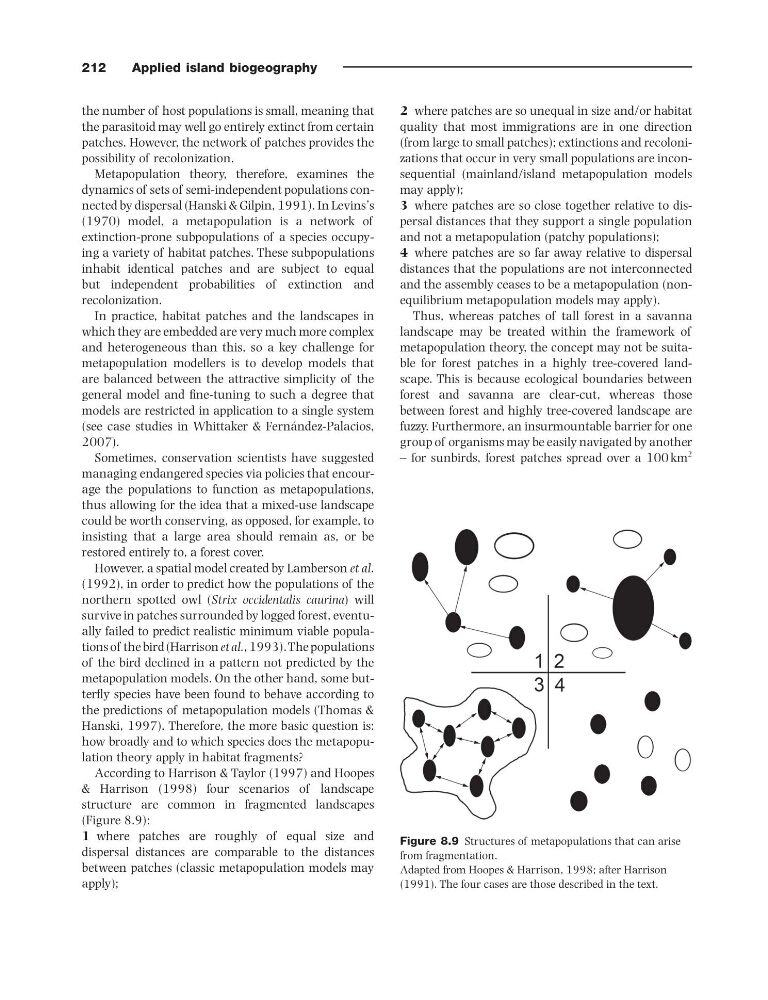
According to Harrison & Taylor (1997) and Hoopes
& Harrison (1998) four scenarios of landscape
structure are common in fragmented landscapes
(Figure 8.9 ):
1 where patches are roughly of equal size and
dispersal distances are comparable to the distances
between patches (classic metapopulation models may
apply);
Figure 8.9 Structures of metapopulations that can arise
from fragmentation.
Adapted from Hoopes & Harrison, 1998 ; after Harrison
(1991) . The four cases are those described in the text.
Applied island biogeography
2 where patches are so unequal in size and/or habitat
quality that most immigrations are in one direction
(from large to small patches); extinctions and recolonizations that occur in very small populations are inconsequential (mainland/island metapopulation models
may apply);
3 where patches are so close together relative to dispersal distances that they support a single population
and not a metapopulation (patchy populations);
4 where patches are so far away relative to dispersal
distances that the populations are not interconnected
and the assembly ceases to be a metapopulation (non -
equilibrium metapopulation models may apply).
Thus, whereas patches of tall forest in a savanna
landscape may be treated within the framework of
metapopulation theory, the concept may not be suitable for forest patches in a highly tree - covered landscape. This is because ecological boundaries between
forest and savanna are clear - cut, whereas those
between forest and highly tree - covered landscape are
fuzzy. Furthermore, an insurmountable barrier for one
group of organisms may be easily navigated by another
– for sunbirds, forest patches spread over a 100 km
2
the number of host populations is small, meaning that
the parasitoid may well go entirely extinct from certain
patches. However, the network of patches provides the
possibility of recolonization.
Metapopulation theory, therefore, examines the
dynamics of sets of semi - independent populations connected by dispersal (Hanski & Gilpin, 1991 ). In Levins ’ s
(1970) model, a metapopulation is a network of
extinction - prone subpopulations of a species occupying a variety of habitat patches. These subpopulations
inhabit identical patches and are subject to equal
but independent probabilities of extinction and
recolonization.
In practice, habitat patches and the landscapes in
which they are embedded are very much more complex
and heterogeneous than this, so a key challenge for
metapopulation modellers is to develop models that
are balanced between the attractive simplicity of the
general model and fi ne - tuning to such a degree that
models are restricted in application to a single system
(see case studies in Whittaker & Fern á ndez - Palacios,
2007 ).
Sometimes, conservation scientists have suggested
managing endangered species via policies that encourage the populations to function as metapopulations,
thus allowing for the idea that a mixed - use landscape
could be worth conserving, as opposed, for example, to
insisting that a large area should remain as, or be
restored entirely to, a forest cover.
However, a spatial model created by Lamberson et al .
(1992) , in order to predict how the populations of the
northern spotted owl ( Strix occidentalis caurina ) will
survive in patches surrounded by logged forest, eventually failed to predict realistic minimum viable populations of the bird (Harrison et al. , 1993 ). The populations
of the bird declined in a pattern not predicted by the
metapopulation models. On the other hand, some butterfl y species have been found to behave according to
the predictions of metapopulation models (Thomas &
Hanski, 1997 ). Therefore, the more basic question is:
how broadly and to which species does the metapopulation theory apply in habitat fragments?
According to Harrison & Taylor (1997) and Hoopes
& Harrison (1998) four scenarios of landscape
structure are common in fragmented landscapes
(Figure 8.9 ):
1 where patches are roughly of equal size and
dispersal distances are comparable to the distances
between patches (classic metapopulation models may
apply);
Figure 8.9 Structures of metapopulations that can arise
from fragmentation.
Adapted from Hoopes & Harrison, 1998 ; after Harrison
(1991) . The four cases are those described in the text.