

210
Applied island biogeography
1 inaccurate measurements of the patch areas;
2 the existence of patches that are unknown within
or around the study area ( ‘ missing patches ’ );
3 patch occupancy is incorrectly observed, with
patches considered to be empty actually containing
a population of the focal species (the ‘ false zero ’
problem).
Perhaps more fundamental a problem is that species
incidence functions tell us, of course, the properties of
‘ islands ’ on which a target species currently occurs,
but not those on which it may persist in the long term
or in an altered ecological conditions. Thus, they are
not equivalent to estimating MVAs.
Biedermann (2003) provides an interesting analysis
of area – incidence relationships of 50 species of vertebrates and invertebrates from 15 different fragmented
landscapes, ranging from Central European grassland
to Asian tropical forest, in which he demonstrates that
area requirements increase essentially linearly with
increasing body size on a log – log scale. Biedermann
calculated that a single pair of ivory - billed woodpeckers ( Campephilus principalis ), a species generally considered extinct, may have required 6.5 – 7.6 km
2 of
appropriate forest habitat; that the European goshawk
( Accipiter gentilis ) has a home range of about 30 –
50 km
2 (Wilcove et al. , 1986 ); and that populations of
North Island brown kiwi ( Apteryx mantelli ) in New
Zealand are unlikely to be viable in protected areas of
less than 100 km
2 (Basse & McLennan, 2003 ).
Even some plant and insect species may need surprisingly large areas if they typically occur at very low
population densities (Mawdsley et al. , 1998 ). Thus, for
many species, reserves must be really rather large if
their purpose is to maintain a MVP entirely within
their bounds. For instance, it has been estimated that
the minimum viable area for some large mammals
during a time span of 1,000 years exceeds 100 times
the area of Yellowstone National Park (Shafer, 1995 ).
The MVA approach, if focused on large - bodied fl agship species and converted into policy recommendations, may have benefi ts for the preservation of entire
ecosystems, since many other species with lesser area
requirements may benefi t from protection within the
MVA of the fl agship species. However, one limitation of
the MVA approach is that it is predicated on the idea
that each area is discrete and has no biotic (genetic)
exchange with other surrounding areas. If there is
such exchange taking place, such that the population
is actually part of a network (or metapopulation), then
the estimated MVA may be larger than is strictly necessary (see dis cussion in Whittaker & Fern á ndez - Palacios,
2007 ).
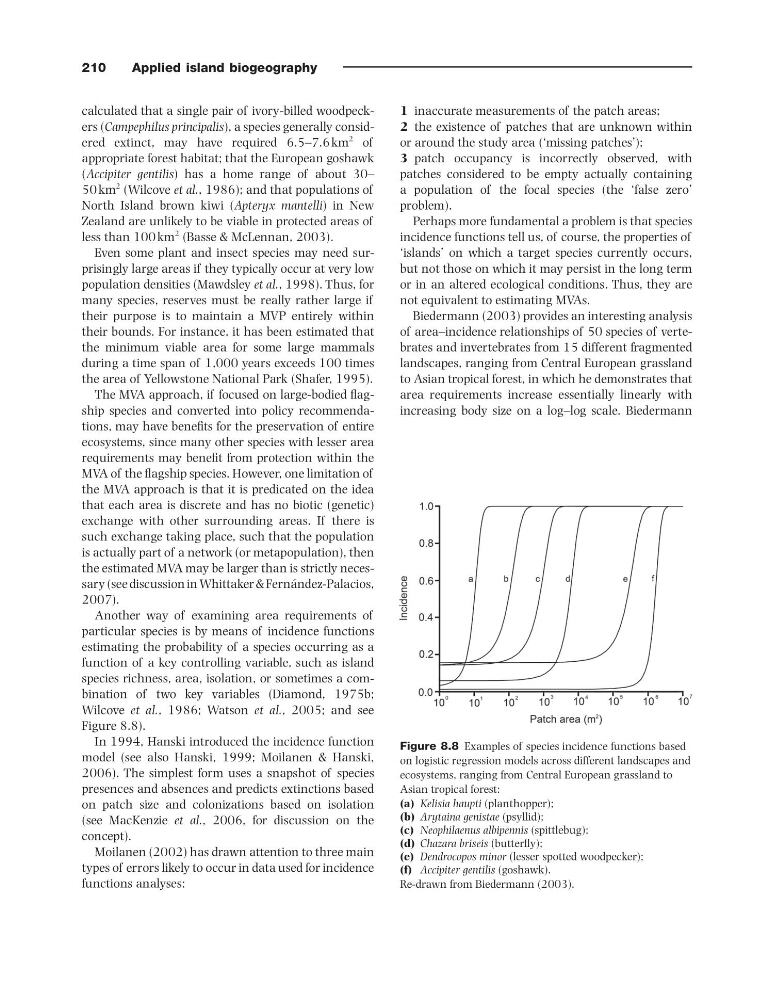
Another way of examining area requirements of
particular species is by means of incidence functions
estimating the probability of a species occurring as a
function of a key controlling variable, such as island
species richness, area, isolation, or sometimes a combination of two key variables (Diamond, 1975b ;
Wilcove et al. , 1986 ; Watson et al. , 2005 ; and see
Figure 8.8 ).
In 1994, Hanski introduced the incidence function
model (see also Hanski, 1999 ; Moilanen & Hanski,
2006 ). The simplest form uses a snapshot of species
presences and absences and predicts extinctions based
on patch size and colonizations based on isolation
(see MacKenzie et al. , 2006 , for discussion on the
concept).
Moilanen (2002) has drawn attention to three main
types of errors likely to occur in data used for incidence
functions analyses:
Figure 8.8 Examples of species incidence functions based
on logistic regression models across different landscapes and
ecosystems, ranging from Central European grassland to
Asian tropical forest:
(a) Kelisia haupti (planthopper);
(b) Arytaina genistae (psyllid);
(c) Neophilaenus albipennis (spittlebug);
(d) Chazara briseis (butterfl y);
(e) Dendrocopos minor (lesser spotted woodpecker);
(f) Accipiter gentilis (goshawk).
Re - drawn from Biedermann (2003) .
Applied island biogeography
1 inaccurate measurements of the patch areas;
2 the existence of patches that are unknown within
or around the study area ( ‘ missing patches ’ );
3 patch occupancy is incorrectly observed, with
patches considered to be empty actually containing
a population of the focal species (the ‘ false zero ’
problem).
Perhaps more fundamental a problem is that species
incidence functions tell us, of course, the properties of
‘ islands ’ on which a target species currently occurs,
but not those on which it may persist in the long term
or in an altered ecological conditions. Thus, they are
not equivalent to estimating MVAs.
Biedermann (2003) provides an interesting analysis
of area – incidence relationships of 50 species of vertebrates and invertebrates from 15 different fragmented
landscapes, ranging from Central European grassland
to Asian tropical forest, in which he demonstrates that
area requirements increase essentially linearly with
increasing body size on a log – log scale. Biedermann
calculated that a single pair of ivory - billed woodpeckers ( Campephilus principalis ), a species generally considered extinct, may have required 6.5 – 7.6 km
2 of
appropriate forest habitat; that the European goshawk
( Accipiter gentilis ) has a home range of about 30 –
50 km
2 (Wilcove et al. , 1986 ); and that populations of
North Island brown kiwi ( Apteryx mantelli ) in New
Zealand are unlikely to be viable in protected areas of
less than 100 km
2 (Basse & McLennan, 2003 ).
Even some plant and insect species may need surprisingly large areas if they typically occur at very low
population densities (Mawdsley et al. , 1998 ). Thus, for
many species, reserves must be really rather large if
their purpose is to maintain a MVP entirely within
their bounds. For instance, it has been estimated that
the minimum viable area for some large mammals
during a time span of 1,000 years exceeds 100 times
the area of Yellowstone National Park (Shafer, 1995 ).
The MVA approach, if focused on large - bodied fl agship species and converted into policy recommendations, may have benefi ts for the preservation of entire
ecosystems, since many other species with lesser area
requirements may benefi t from protection within the
MVA of the fl agship species. However, one limitation of
the MVA approach is that it is predicated on the idea
that each area is discrete and has no biotic (genetic)
exchange with other surrounding areas. If there is
such exchange taking place, such that the population
is actually part of a network (or metapopulation), then
the estimated MVA may be larger than is strictly necessary (see dis cussion in Whittaker & Fern á ndez - Palacios,
2007 ).
Another way of examining area requirements of
particular species is by means of incidence functions
estimating the probability of a species occurring as a
function of a key controlling variable, such as island
species richness, area, isolation, or sometimes a combination of two key variables (Diamond, 1975b ;
Wilcove et al. , 1986 ; Watson et al. , 2005 ; and see
Figure 8.8 ).
In 1994, Hanski introduced the incidence function
model (see also Hanski, 1999 ; Moilanen & Hanski,
2006 ). The simplest form uses a snapshot of species
presences and absences and predicts extinctions based
on patch size and colonizations based on isolation
(see MacKenzie et al. , 2006 , for discussion on the
concept).
Moilanen (2002) has drawn attention to three main
types of errors likely to occur in data used for incidence
functions analyses:
Figure 8.8 Examples of species incidence functions based
on logistic regression models across different landscapes and
ecosystems, ranging from Central European grassland to
Asian tropical forest:
(a) Kelisia haupti (planthopper);
(b) Arytaina genistae (psyllid);
(c) Neophilaenus albipennis (spittlebug);
(d) Chazara briseis (butterfl y);
(e) Dendrocopos minor (lesser spotted woodpecker);
(f) Accipiter gentilis (goshawk).
Re - drawn from Biedermann (2003) .