

Conservation planning in a changing world
167
whole history of the science of ecology has played
out over a few per cent of the lifespan of one of these
trees.
There are many ways in which long - term ecology
can contribute to present - day conservation efforts
(Chapter 3 ). Here we discuss three of them, using past
dynamics to predict future responses, interpreting
recent changes in abundance in their historical context
and understanding patterns of geographical range
collapse.
drawn onto this already perturbed historical canvas
(Jackson et al. , 2001 ).
Despite this reality, many ecologically relevant processes go well beyond the temporal span of many data
sets brought to bear on conservation problems. For
example, bristlecone pines ( Pinus longaeva ) can live for
5,000 years and their tree ring chronologies have
been used to reconstruct palaeoclimates (LaMarche,
1974 ), human settlement patterns (Ababneh, 2008 ),
and volcanic history (Salzer & Hughes, 2007 ). The
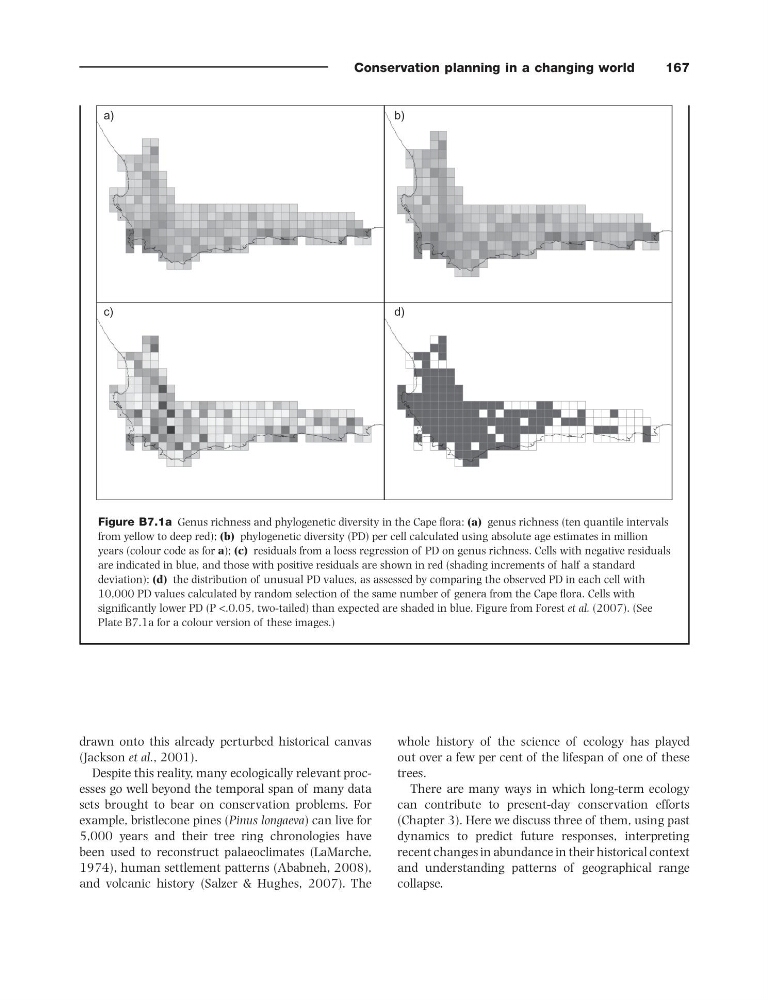
Figure B7.1a Genus richness and phylogenetic diversity in the Cape fl ora: (a) genus richness (ten quantile intervals
from yellow to deep red); (b) phylogenetic diversity (PD) per cell calculated using absolute age estimates in million
years (colour code as for a ); (c) residuals from a loess regression of PD on genus richness. Cells with negative residuals
are indicated in blue, and those with positive residuals are shown in red (shading increments of half a standard
deviation); (d) the distribution of unusual PD values, as assessed by comparing the observed PD in each cell with
10,000 PD values calculated by random selection of the same number of genera from the Cape fl ora. Cells with
signifi cantly lower PD (P < .0.05, two - tailed) than expected are shaded in blue. Figure from Forest et al. (2007) . (See
Plate B7.1a for a colour version of these images.)
a)
b)
c)
d)
167
whole history of the science of ecology has played
out over a few per cent of the lifespan of one of these
trees.
There are many ways in which long - term ecology
can contribute to present - day conservation efforts
(Chapter 3 ). Here we discuss three of them, using past
dynamics to predict future responses, interpreting
recent changes in abundance in their historical context
and understanding patterns of geographical range
collapse.
drawn onto this already perturbed historical canvas
(Jackson et al. , 2001 ).
Despite this reality, many ecologically relevant processes go well beyond the temporal span of many data
sets brought to bear on conservation problems. For
example, bristlecone pines ( Pinus longaeva ) can live for
5,000 years and their tree ring chronologies have
been used to reconstruct palaeoclimates (LaMarche,
1974 ), human settlement patterns (Ababneh, 2008 ),
and volcanic history (Salzer & Hughes, 2007 ). The
Figure B7.1a Genus richness and phylogenetic diversity in the Cape fl ora: (a) genus richness (ten quantile intervals
from yellow to deep red); (b) phylogenetic diversity (PD) per cell calculated using absolute age estimates in million
years (colour code as for a ); (c) residuals from a loess regression of PD on genus richness. Cells with negative residuals
are indicated in blue, and those with positive residuals are shown in red (shading increments of half a standard
deviation); (d) the distribution of unusual PD values, as assessed by comparing the observed PD in each cell with
10,000 PD values calculated by random selection of the same number of genera from the Cape fl ora. Cells with
signifi cantly lower PD (P < .0.05, two - tailed) than expected are shaded in blue. Figure from Forest et al. (2007) . (See
Plate B7.1a for a colour version of these images.)
a)
b)
c)
d)