

148
Systematic conservation planning: past, present and future
Biodiversity data used in the analysis were environmental surrogates which included rocky reef,
soft bottom, kelp forests, submarine canyons, eelgrass, surfgrass, and estuaries. Each of these
habitats was targeted for inclusion in a network of marine protected areas under a number of different scenarios (e.g. 10 per cent representation, 20 per cent representation and 50 per cent representation in the reserve system).
The socio - economic data included information on the number of recreational fi shing trips and an
expert - derived assessment of the relative importance of an area for commercial fi shing. The expert -
driven assessment involved 109 commercial fi shermen being interviewed to determine accurate
spatial data on fi shing effort and to map their fi shing grounds. From this, an index of relative fi shing
effort was used to calculate the impact of fi sheries in the reserve design (i.e. those marine waters
that would be closed to fi shing). The two types of fi shing data were combined to deliver a relative
index of fi shing effort, which was used as a ‘ cost ’ to minimize in the Marxan software.
Marine reserves were chosen that would meet the different biodiversity targets and minimize the
impact on fi shermen in terms of lost fi shing effort due to reservation. Explicitly considering commercial and recreational fi sheries in the analysis allowed the impact to the fi sheries to be reduced
by up to 21 per cent, depending on the scenario selected (Klein et al ., 2008a ).
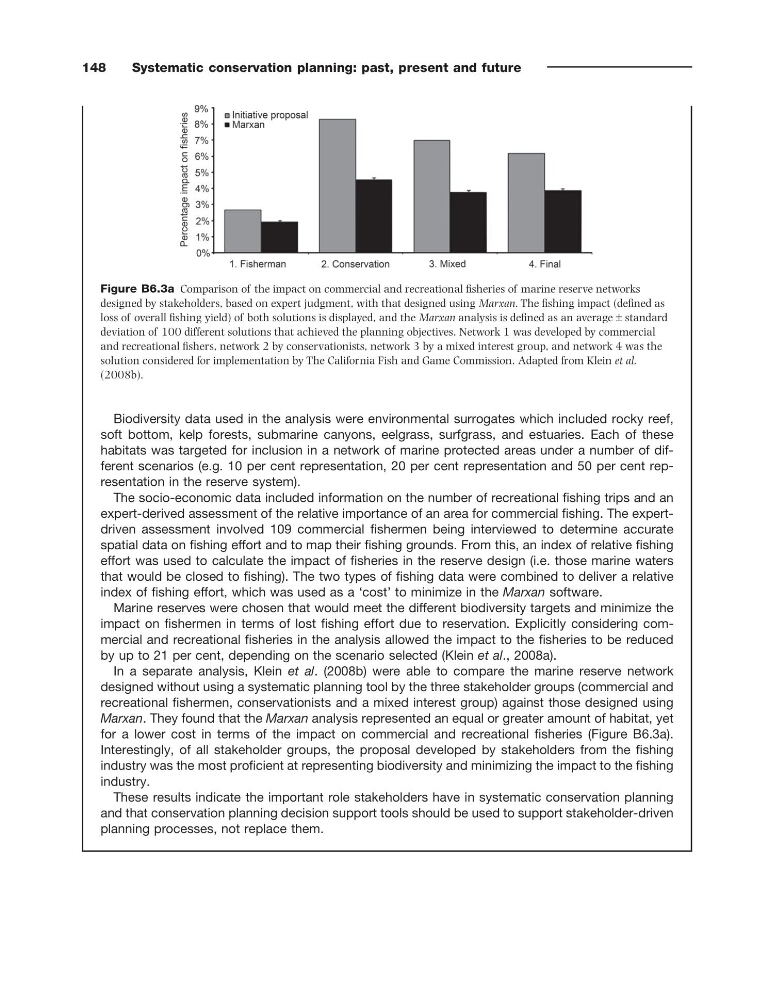
In a separate analysis, Klein et al . (2008b) were able to compare the marine reserve network
designed without using a systematic planning tool by the three stakeholder groups (commercial and
recreational fi shermen, conservationists and a mixed interest group) against those designed using
Marxan . They found that the Marxan analysis represented an equal or greater amount of habitat, yet
for a lower cost in terms of the impact on commercial and recreational fi sheries (Figure B6.3a ).
Interestingly, of all stakeholder groups, the proposal developed by stakeholders from the fi shing
industry was the most profi cient at representing biodiversity and minimizing the impact to the fi shing
industry.
These results indicate the important role stakeholders have in systematic conservation planning
and that conservation planning decision support tools should be used to support stakeholder - driven
planning processes, not replace them.
Figure B6.3a Comparison of the impact on commercial and recreational fi sheries of marine reserve networks
designed by stakeholders, based on expert judgment, with that designed using Marxan . The fi shing impact (defi ned as
loss of overall fi shing yield) of both solutions is displayed, and the Marxan analysis is defi ned as an average ± standard
deviation of 100 different solutions that achieved the planning objectives. Network 1 was developed by commercial
and recreational fi shers, network 2 by conservationists, network 3 by a mixed interest group, and network 4 was the
solution considered for implementation by The California Fish and Game Commission. Adapted from Klein et al.
(2008b) .
Systematic conservation planning: past, present and future
Biodiversity data used in the analysis were environmental surrogates which included rocky reef,
soft bottom, kelp forests, submarine canyons, eelgrass, surfgrass, and estuaries. Each of these
habitats was targeted for inclusion in a network of marine protected areas under a number of different scenarios (e.g. 10 per cent representation, 20 per cent representation and 50 per cent representation in the reserve system).
The socio - economic data included information on the number of recreational fi shing trips and an
expert - derived assessment of the relative importance of an area for commercial fi shing. The expert -
driven assessment involved 109 commercial fi shermen being interviewed to determine accurate
spatial data on fi shing effort and to map their fi shing grounds. From this, an index of relative fi shing
effort was used to calculate the impact of fi sheries in the reserve design (i.e. those marine waters
that would be closed to fi shing). The two types of fi shing data were combined to deliver a relative
index of fi shing effort, which was used as a ‘ cost ’ to minimize in the Marxan software.
Marine reserves were chosen that would meet the different biodiversity targets and minimize the
impact on fi shermen in terms of lost fi shing effort due to reservation. Explicitly considering commercial and recreational fi sheries in the analysis allowed the impact to the fi sheries to be reduced
by up to 21 per cent, depending on the scenario selected (Klein et al ., 2008a ).
In a separate analysis, Klein et al . (2008b) were able to compare the marine reserve network
designed without using a systematic planning tool by the three stakeholder groups (commercial and
recreational fi shermen, conservationists and a mixed interest group) against those designed using
Marxan . They found that the Marxan analysis represented an equal or greater amount of habitat, yet
for a lower cost in terms of the impact on commercial and recreational fi sheries (Figure B6.3a ).
Interestingly, of all stakeholder groups, the proposal developed by stakeholders from the fi shing
industry was the most profi cient at representing biodiversity and minimizing the impact to the fi shing
industry.
These results indicate the important role stakeholders have in systematic conservation planning
and that conservation planning decision support tools should be used to support stakeholder - driven
planning processes, not replace them.
Figure B6.3a Comparison of the impact on commercial and recreational fi sheries of marine reserve networks
designed by stakeholders, based on expert judgment, with that designed using Marxan . The fi shing impact (defi ned as
loss of overall fi shing yield) of both solutions is displayed, and the Marxan analysis is defi ned as an average ± standard
deviation of 100 different solutions that achieved the planning objectives. Network 1 was developed by commercial
and recreational fi shers, network 2 by conservationists, network 3 by a mixed interest group, and network 4 was the
solution considered for implementation by The California Fish and Game Commission. Adapted from Klein et al.
(2008b) .