

4
The roots of conservation biogeography
1.2 THE EMERGENCE OF
CONSERVATION BIOLOGY AND
CONSERVATION BIOGEOGRAPHY
Real - world biogeographers must balance their roles
as citizens wanting to make the world a better place
against their roles as scientists who are honest and
skilful about their scientifi c limitations. Getting the
science right is undoubtedly important for making
policy decisions, but a wise approach to uncertainty
is all the more so.
(Thomson, 1991 , p. 475)
As an applied and interdisciplinary science concerned
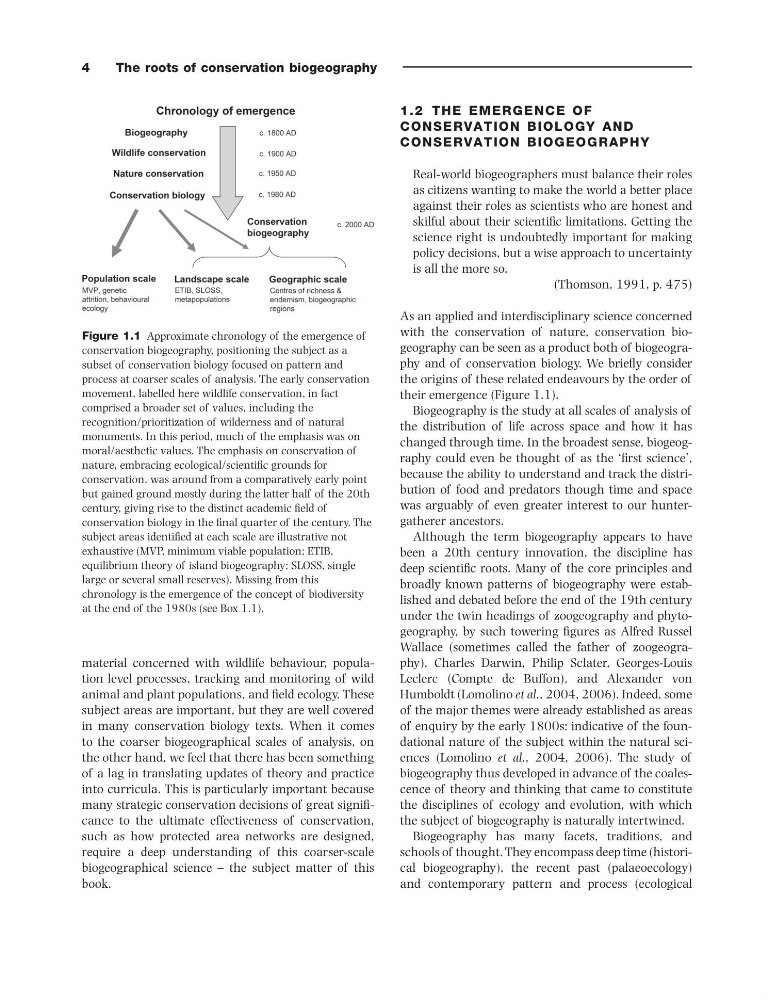
with the conservation of nature, conservation biogeography can be seen as a product both of biogeography and of conservation biology. We briefl y consider
the origins of these related endeavours by the order of
their emergence (Figure 1.1 ).
Biogeography is the study at all scales of analysis of
the distribution of life across space and how it has
changed through time. In the broadest sense, biogeography could even be thought of as the ‘ fi rst science ’ ,
because the ability to understand and track the distribution of food and predators though time and space
was arguably of even greater interest to our hunter -
gatherer ancestors.
Although the term biogeography appears to have
been a 20th century innovation, the discipline has
deep scientifi c roots. Many of the core principles and
broadly known patterns of biogeography were established and debated before the end of the 19th century
under the twin headings of zoogeography and phytogeography, by such towering fi gures as Alfred Russel
Wallace (sometimes called the father of zoogeography), Charles Darwin, Philip Sclater, Georges - Louis
Leclerc (Compte de Buffon), and Alexander von
Humboldt (Lomolino et al ., 2004, 2006 ). Indeed, some
of the major themes were already established as areas
of enquiry by the early 1800s: indicative of the foundational nature of the subject within the natural sciences (Lomolino et al. , 2004, 2006 ). The study of
biogeography thus developed in advance of the coalescence of theory and thinking that came to constitute
the disciplines of ecology and evolution, with which
the subject of biogeography is naturally intertwined.
Biogeography has many facets, traditions, and
schools of thought. They encompass deep time (historical biogeography), the recent past (palaeoecology)
and contemporary pattern and process (ecological
material concerned with wildlife behaviour, population level processes, tracking and monitoring of wild
animal and plant populations, and fi eld ecology. These
subject areas are important, but they are well covered
in many conservation biology texts. When it comes
to the coarser biogeographical scales of analysis, on
the other hand, we feel that there has been something
of a lag in translating updates of theory and practice
into curricula. This is particularly important because
many strategic conservation decisions of great signifi -
cance to the ultimate effectiveness of conservation,
such as how protected area networks are designed,
require a deep understanding of this coarser - scale
biogeographical science – the subject matter of this
book.
Figure 1.1 Approximate chronology of the emergence of
conservation biogeography, positioning the subject as a
subset of conservation biology focused on pattern and
process at coarser scales of analysis. The early conservation
movement, labelled here wildlife conservation, in fact
comprised a broader set of values, including the
recognition/prioritization of wilderness and of natural
monuments. In this period, much of the emphasis was on
moral/aesthetic values. The emphasis on conservation of
nature, embracing ecological/scientifi c grounds for
conservation, was around from a comparatively early point
but gained ground mostly during the latter half of the 20th
century, giving rise to the distinct academic fi eld of
conservation biology in the fi nal quarter of the century. The
subject areas identifi ed at each scale are illustrative not
exhaustive (MVP, minimum viable population; ETIB,
equilibrium theory of island biogeography; SLOSS, single
large or several small reserves). Missing from this
chronology is the emergence of the concept of biodiversity
at the end of the 1980s (see Box 1.1 ).
The roots of conservation biogeography
1.2 THE EMERGENCE OF
CONSERVATION BIOLOGY AND
CONSERVATION BIOGEOGRAPHY
Real - world biogeographers must balance their roles
as citizens wanting to make the world a better place
against their roles as scientists who are honest and
skilful about their scientifi c limitations. Getting the
science right is undoubtedly important for making
policy decisions, but a wise approach to uncertainty
is all the more so.
(Thomson, 1991 , p. 475)
As an applied and interdisciplinary science concerned
with the conservation of nature, conservation biogeography can be seen as a product both of biogeography and of conservation biology. We briefl y consider
the origins of these related endeavours by the order of
their emergence (Figure 1.1 ).
Biogeography is the study at all scales of analysis of
the distribution of life across space and how it has
changed through time. In the broadest sense, biogeography could even be thought of as the ‘ fi rst science ’ ,
because the ability to understand and track the distribution of food and predators though time and space
was arguably of even greater interest to our hunter -
gatherer ancestors.
Although the term biogeography appears to have
been a 20th century innovation, the discipline has
deep scientifi c roots. Many of the core principles and
broadly known patterns of biogeography were established and debated before the end of the 19th century
under the twin headings of zoogeography and phytogeography, by such towering fi gures as Alfred Russel
Wallace (sometimes called the father of zoogeography), Charles Darwin, Philip Sclater, Georges - Louis
Leclerc (Compte de Buffon), and Alexander von
Humboldt (Lomolino et al ., 2004, 2006 ). Indeed, some
of the major themes were already established as areas
of enquiry by the early 1800s: indicative of the foundational nature of the subject within the natural sciences (Lomolino et al. , 2004, 2006 ). The study of
biogeography thus developed in advance of the coalescence of theory and thinking that came to constitute
the disciplines of ecology and evolution, with which
the subject of biogeography is naturally intertwined.
Biogeography has many facets, traditions, and
schools of thought. They encompass deep time (historical biogeography), the recent past (palaeoecology)
and contemporary pattern and process (ecological
material concerned with wildlife behaviour, population level processes, tracking and monitoring of wild
animal and plant populations, and fi eld ecology. These
subject areas are important, but they are well covered
in many conservation biology texts. When it comes
to the coarser biogeographical scales of analysis, on
the other hand, we feel that there has been something
of a lag in translating updates of theory and practice
into curricula. This is particularly important because
many strategic conservation decisions of great signifi -
cance to the ultimate effectiveness of conservation,
such as how protected area networks are designed,
require a deep understanding of this coarser - scale
biogeographical science – the subject matter of this
book.
Figure 1.1 Approximate chronology of the emergence of
conservation biogeography, positioning the subject as a
subset of conservation biology focused on pattern and
process at coarser scales of analysis. The early conservation
movement, labelled here wildlife conservation, in fact
comprised a broader set of values, including the
recognition/prioritization of wilderness and of natural
monuments. In this period, much of the emphasis was on
moral/aesthetic values. The emphasis on conservation of
nature, embracing ecological/scientifi c grounds for
conservation, was around from a comparatively early point
but gained ground mostly during the latter half of the 20th
century, giving rise to the distinct academic fi eld of
conservation biology in the fi nal quarter of the century. The
subject areas identifi ed at each scale are illustrative not
exhaustive (MVP, minimum viable population; ETIB,
equilibrium theory of island biogeography; SLOSS, single
large or several small reserves). Missing from this
chronology is the emergence of the concept of biodiversity
at the end of the 1980s (see Box 1.1 ).