

The distribution of diversity: challenges and applications
139
The principle of effi ciency is based on the idea that
conservation planners should try to achieve biodiversity objectives for the least possible cost. ‘ Cost ’ here
may refl ect the fi nancial cost of implementing and
managing protected areas or the costs of lost opportunities for economic development (Naidoo et al ., 2006 ).
It can also include other socio - economic considerations, such as the willingness of people to assist with
conservation management, with the expectation that
it is more cost - effective to do conservation where
people are willing to act.
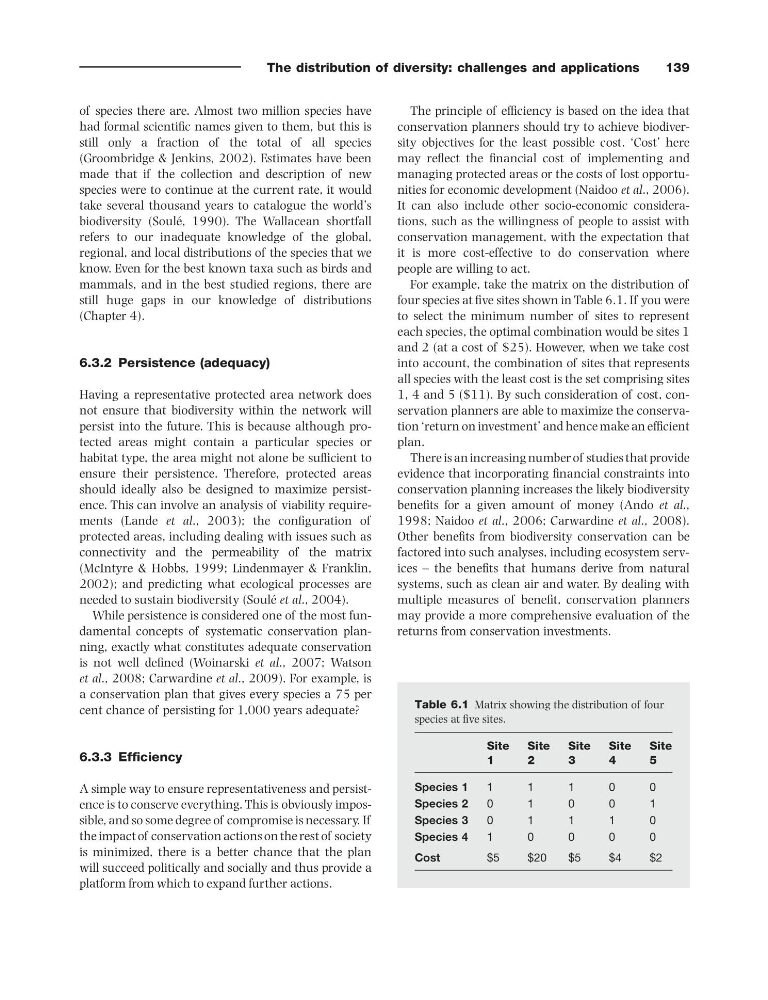
For example, take the matrix on the distribution of
four species at fi ve sites shown in Table 6.1 . If you were
to select the minimum number of sites to represent
each species, the optimal combination would be sites 1
and 2 (at a cost of $25). However, when we take cost
into account, the combination of sites that represents
all species with the least cost is the set comprising sites
1, 4 and 5 ($11). By such consideration of cost, conservation planners are able to maximize the conservation ‘ return on investment ’ and hence make an effi cient
plan.
There is an increasing number of studies that provide
evidence that incorporating fi nancial constraints into
conservation planning increases the likely biodiversity
benefi ts for a given amount of money (Ando et al .,
1998 ; Naidoo et al ., 2006 ; Carwardine et al ., 2008 ).
Other benefi ts from biodiversity conservation can be
factored into such analyses, including ecosystem services – the benefi ts that humans derive from natural
systems, such as clean air and water. By dealing with
multiple measures of benefi t, conservation planners
may provide a more comprehensive evaluation of the
returns from conservation investments.
of species there are. Almost two million species have
had formal scientifi c names given to them, but this is
still only a fraction of the total of all species
(Groombridge & Jenkins, 2002 ). Estimates have been
made that if the collection and description of new
species were to continue at the current rate, it would
take several thousand years to catalogue the world ’ s
biodiversity (Soul é , 1990 ). The Wallacean shortfall
refers to our inadequate knowledge of the global,
regional, and local distributions of the species that we
know. Even for the best known taxa such as birds and
mammals, and in the best studied regions, there are
still huge gaps in our knowledge of distributions
(Chapter 4 ).
6.3.2 Persistence ( a dequacy)
Having a representative protected area network does
not ensure that biodiversity within the network will
persist into the future. This is because although protected areas might contain a particular species or
habitat type, the area might not alone be suffi cient to
ensure their persistence. Therefore, protected areas
should ideally also be designed to maximize persistence. This can involve an analysis of viability requirements (Lande et al ., 2003 ); the confi guration of
protected areas, including dealing with issues such as
connectivity and the permeability of the matrix
(McIntyre & Hobbs, 1999 ; Lindenmayer & Franklin,
2002 ); and predicting what ecological processes are
needed to sustain biodiversity (Soul é et al ., 2004 ).
While persistence is considered one of the most fundamental concepts of systematic conservation planning, exactly what constitutes adequate conservation
is not well defi ned (Woinarski et al ., 2007 ; Watson
et al ., 2008 ; Carwardine et al ., 2009 ). For example, is
a conservation plan that gives every species a 75 per
cent chance of persisting for 1,000 years adequate?
6.3.3 Effi ciency
A simple way to ensure representativeness and persistence is to conserve everything. This is obviously impossible, and so some degree of compromise is necessary. If
the impact of conservation actions on the rest of society
is minimized, there is a better chance that the plan
will succeed politically and socially and thus provide a
platform from which to expand further actions.
Table 6.1 Matrix showing the distribution of four
species at fi ve sites.
Site
1
Site
2
Site
3
Site
4
Site
5
Species 1
1
1
1
0
0
Species 2
0
1
0
0
1
Species 3
0
1
1
1
0
Species 4
1
0
0
0
0
Cost
$5
$20
$5
$4
$2
139
The principle of effi ciency is based on the idea that
conservation planners should try to achieve biodiversity objectives for the least possible cost. ‘ Cost ’ here
may refl ect the fi nancial cost of implementing and
managing protected areas or the costs of lost opportunities for economic development (Naidoo et al ., 2006 ).
It can also include other socio - economic considerations, such as the willingness of people to assist with
conservation management, with the expectation that
it is more cost - effective to do conservation where
people are willing to act.
For example, take the matrix on the distribution of
four species at fi ve sites shown in Table 6.1 . If you were
to select the minimum number of sites to represent
each species, the optimal combination would be sites 1
and 2 (at a cost of $25). However, when we take cost
into account, the combination of sites that represents
all species with the least cost is the set comprising sites
1, 4 and 5 ($11). By such consideration of cost, conservation planners are able to maximize the conservation ‘ return on investment ’ and hence make an effi cient
plan.
There is an increasing number of studies that provide
evidence that incorporating fi nancial constraints into
conservation planning increases the likely biodiversity
benefi ts for a given amount of money (Ando et al .,
1998 ; Naidoo et al ., 2006 ; Carwardine et al ., 2008 ).
Other benefi ts from biodiversity conservation can be
factored into such analyses, including ecosystem services – the benefi ts that humans derive from natural
systems, such as clean air and water. By dealing with
multiple measures of benefi t, conservation planners
may provide a more comprehensive evaluation of the
returns from conservation investments.
of species there are. Almost two million species have
had formal scientifi c names given to them, but this is
still only a fraction of the total of all species
(Groombridge & Jenkins, 2002 ). Estimates have been
made that if the collection and description of new
species were to continue at the current rate, it would
take several thousand years to catalogue the world ’ s
biodiversity (Soul é , 1990 ). The Wallacean shortfall
refers to our inadequate knowledge of the global,
regional, and local distributions of the species that we
know. Even for the best known taxa such as birds and
mammals, and in the best studied regions, there are
still huge gaps in our knowledge of distributions
(Chapter 4 ).
6.3.2 Persistence ( a dequacy)
Having a representative protected area network does
not ensure that biodiversity within the network will
persist into the future. This is because although protected areas might contain a particular species or
habitat type, the area might not alone be suffi cient to
ensure their persistence. Therefore, protected areas
should ideally also be designed to maximize persistence. This can involve an analysis of viability requirements (Lande et al ., 2003 ); the confi guration of
protected areas, including dealing with issues such as
connectivity and the permeability of the matrix
(McIntyre & Hobbs, 1999 ; Lindenmayer & Franklin,
2002 ); and predicting what ecological processes are
needed to sustain biodiversity (Soul é et al ., 2004 ).
While persistence is considered one of the most fundamental concepts of systematic conservation planning, exactly what constitutes adequate conservation
is not well defi ned (Woinarski et al ., 2007 ; Watson
et al ., 2008 ; Carwardine et al ., 2009 ). For example, is
a conservation plan that gives every species a 75 per
cent chance of persisting for 1,000 years adequate?
6.3.3 Effi ciency
A simple way to ensure representativeness and persistence is to conserve everything. This is obviously impossible, and so some degree of compromise is necessary. If
the impact of conservation actions on the rest of society
is minimized, there is a better chance that the plan
will succeed politically and socially and thus provide a
platform from which to expand further actions.
Table 6.1 Matrix showing the distribution of four
species at fi ve sites.
Site
1
Site
2
Site
3
Site
4
Site
5
Species 1
1
1
1
0
0
Species 2
0
1
0
0
1
Species 3
0
1
1
1
0
Species 4
1
0
0
0
0
Cost
$5
$20
$5
$4
$2