

110
The shaping of the global protected area estate
Table 5.5 Properties of Conservation International ’ s hotspots scheme, the most infl uential such scheme globally.
(key sources: Myers et al. , 2000 ; http://multimedia.conservation.org/cabs/online_pubs/hotspots2/introduction.html ,
visited August 2008)
Organization
Conservation International (developed 2000 – 2004).
Lead authors
N. Myers (1988, 1990) , with R.A. Mittermeier and others (2000 – 2004).
General goal
To allow large numbers of species to be protected for least cost outlay.
Purpose
Provide a framework for fundraising, with resources then targeted within regions
combining high diversity and threat.
Key design
consideration
Select a meaningful measure of diversity and threat and identify the geographical
entities to be used, in order to generate a shortlist of priority regions for immediate
mobilization of resources.
Scale
Regions chosen that possess > 0.5% (1,500) of the world ’ s plant species and which
have experienced the loss of > 70% of their primary vegetation cover based on
compilation of diverse data sources. In the 2000 version, the areas identifi ed within the
framework varied in size from 18,600 to 2,362,000 km
2
, judged by the data for the
original extent of primary vegetation cover (median size 324,000 km
2
; mean size
787,760km
2 (Olson et al. , 2001 ).
Explicitness and
reproducibility
Mixed: clearly defi ned purpose and key criteria, but the criteria for defi ning the regions
enclosed within the hotspots were rather opaque. Most recent major update (2004) is
more explicit on this point, demonstrating some sensitivity changes due to alteration of
underlying choice of base map units.
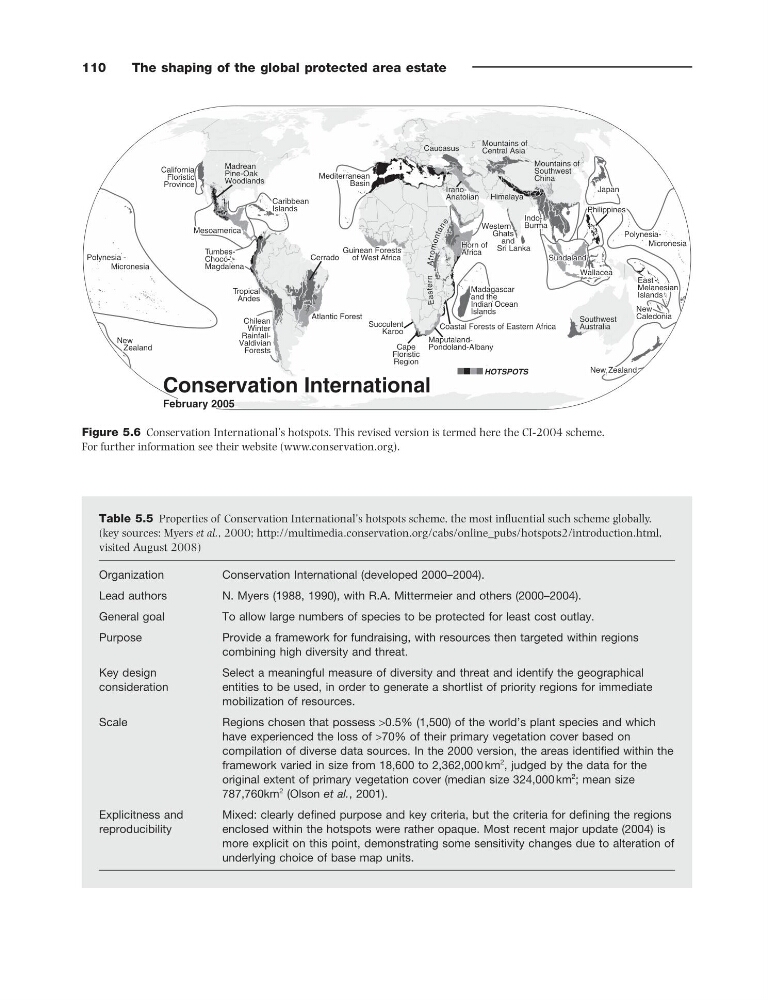
Figure 5.6 Conservation International ’ s hotspots. This revised version is termed here the CI - 2004 scheme.
For further information see their website ( www.conservation.org ).
Polynesia -
Micronesia
PolynesiaMicronesia
PolynesiaMicronesia
California
Floristic
Province
Madrean
Pine-Oak
Woodlands
Madrean
Pine-Oak
Woodlands
Mesoamerica Mesoamerica
Caribbean
Islands
Caribbean
Islands
ChocóMagdalena
ChocóMagdalena
Tropical
Andes
Chilean
Winter
RainfallValdivian
Forests
Chilean
Winter
RainfallValdivian
Forests
Cerrado
Atlantic Forest
Cape
Floristic
Region
Succulent
Karoo
Guinean Forests
of West Africa
MaputalandPondoland-Albany
Madagascar
and the
Indian Ocean
Islands
Madagascar
and the
Indian Ocean
Islands
e
n
a
t
n
o
m
o
r
f
A
n r e t s a E
Coastal Forests of Eastern Africa
Horn of
Africa
Horn of
Africa
Mediterranean
Basin
Mediterranean
Basin
Caucasus Caucasus
IranoAnatolian Himalaya Himalaya
Mountains of
Central Asia
Mountains of
Central Asia
Mountains of
Southwest
China
Mountains of
Southwest
China
Western
Ghats
and
Sri Lanka
Wallacea Wallacea
Sundaland Sundaland
Philippines Philippines
Japan Japan
New
Caledonia
New
Caledonia
New Zealand
New Zealand
East
Melanesian
Islands
East
Melanesian
Islands
Southwest
Australia
New
Zealand
New
Zealand
IndoBurma
IndoBurma
HOTSPOTS
Wilderness Areas
Conservation International
February 2005
The shaping of the global protected area estate
Table 5.5 Properties of Conservation International ’ s hotspots scheme, the most infl uential such scheme globally.
(key sources: Myers et al. , 2000 ; http://multimedia.conservation.org/cabs/online_pubs/hotspots2/introduction.html ,
visited August 2008)
Organization
Conservation International (developed 2000 – 2004).
Lead authors
N. Myers (1988, 1990) , with R.A. Mittermeier and others (2000 – 2004).
General goal
To allow large numbers of species to be protected for least cost outlay.
Purpose
Provide a framework for fundraising, with resources then targeted within regions
combining high diversity and threat.
Key design
consideration
Select a meaningful measure of diversity and threat and identify the geographical
entities to be used, in order to generate a shortlist of priority regions for immediate
mobilization of resources.
Scale
Regions chosen that possess > 0.5% (1,500) of the world ’ s plant species and which
have experienced the loss of > 70% of their primary vegetation cover based on
compilation of diverse data sources. In the 2000 version, the areas identifi ed within the
framework varied in size from 18,600 to 2,362,000 km
2
, judged by the data for the
original extent of primary vegetation cover (median size 324,000 km
2
; mean size
787,760km
2 (Olson et al. , 2001 ).
Explicitness and
reproducibility
Mixed: clearly defi ned purpose and key criteria, but the criteria for defi ning the regions
enclosed within the hotspots were rather opaque. Most recent major update (2004) is
more explicit on this point, demonstrating some sensitivity changes due to alteration of
underlying choice of base map units.
Figure 5.6 Conservation International ’ s hotspots. This revised version is termed here the CI - 2004 scheme.
For further information see their website ( www.conservation.org ).
Polynesia -
Micronesia
PolynesiaMicronesia
PolynesiaMicronesia
California
Floristic
Province
Madrean
Pine-Oak
Woodlands
Madrean
Pine-Oak
Woodlands
Mesoamerica Mesoamerica
Caribbean
Islands
Caribbean
Islands
ChocóMagdalena
ChocóMagdalena
Tropical
Andes
Chilean
Winter
RainfallValdivian
Forests
Chilean
Winter
RainfallValdivian
Forests
Cerrado
Atlantic Forest
Cape
Floristic
Region
Succulent
Karoo
Guinean Forests
of West Africa
MaputalandPondoland-Albany
Madagascar
and the
Indian Ocean
Islands
Madagascar
and the
Indian Ocean
Islands
e
n
a
t
n
o
m
o
r
f
A
n r e t s a E
Coastal Forests of Eastern Africa
Horn of
Africa
Horn of
Africa
Mediterranean
Basin
Mediterranean
Basin
Caucasus Caucasus
IranoAnatolian Himalaya Himalaya
Mountains of
Central Asia
Mountains of
Central Asia
Mountains of
Southwest
China
Mountains of
Southwest
China
Western
Ghats
and
Sri Lanka
Wallacea Wallacea
Sundaland Sundaland
Philippines Philippines
Japan Japan
New
Caledonia
New
Caledonia
New Zealand
New Zealand
East
Melanesian
Islands
East
Melanesian
Islands
Southwest
Australia
New
Zealand
New
Zealand
IndoBurma
IndoBurma
HOTSPOTS
Wilderness Areas
Conservation International
February 2005