

The distribution of diversity: challenges and applications
99
Box 5.1 The High Conservation Value approach
The interplay of market forces, NGO pressure, new policies and regulation is creating a commercial
imperative for international companies to identify and protect important natural habitats within their
land - holdings. This is particularly the case within the forestry and plantation sectors, where regulation for a minimum renewable content in road transport fuel (10 per cent by 2020 in the case of the
EU) is driving an expansion of oil palm and soya cultivation. This is happening at a time when most
tropical forest land has been logged - over and the residual timber value and potential for generating
tax revenues are at an all - time low.
The High Conservation Value Forest (HCVF) approach emerged in 2001 as a supplementary
standard within the Forest Stewardship Scheme. The standard was developed by ProForest, a
specialist forestry consultancy based in Oxford, UK. It identifi es six values, namely biodiversity,
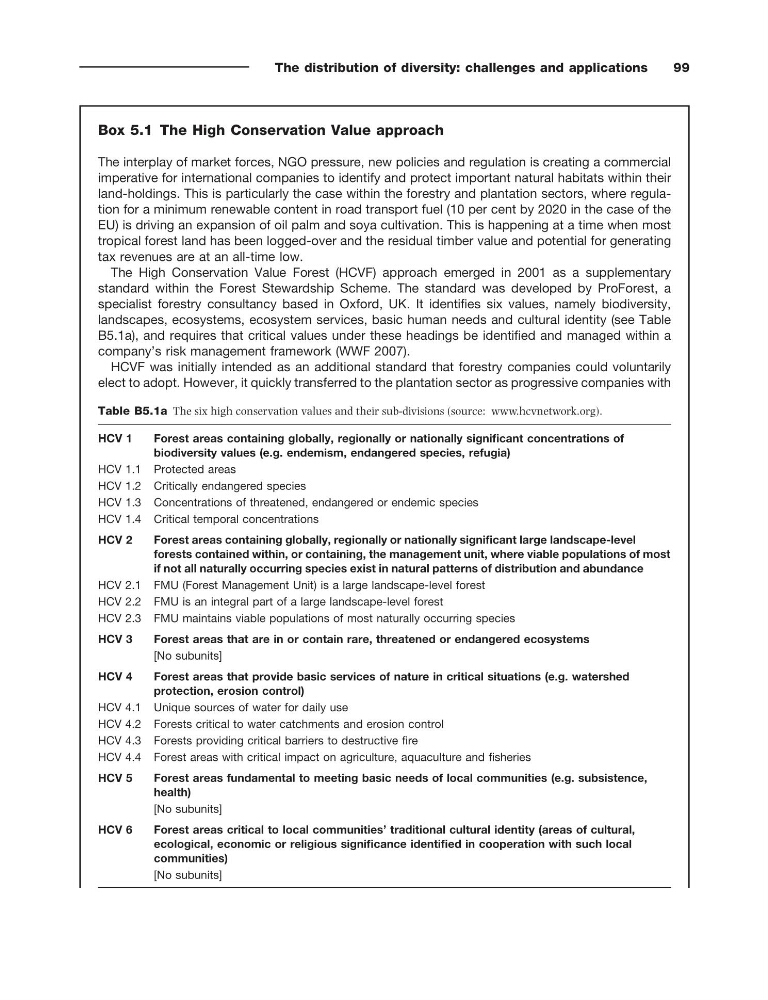
landscapes, ecosystems, ecosystem services, basic human needs and cultural identity (see Table
B5.1a ), and requires that critical values under these headings be identifi ed and managed within a
company ’ s risk management framework (WWF 2007 ).
HCVF was initially intended as an additional standard that forestry companies could voluntarily
elect to adopt. However, it quickly transferred to the plantation sector as progressive companies with
Table B5.1a The six high conservation values and their sub - divisions (source: www.hcvnetwork.org ).
HCV 1
Forest areas containing globally, regionally or nationally signifi cant concentrations of
biodiversity values (e.g. endemism, endangered species, refugia)
HCV 1.1 Protected areas
HCV 1.2 Critically endangered species
HCV 1.3 Concentrations of threatened, endangered or endemic species
HCV 1.4 Critical temporal concentrations
HCV 2
Forest areas containing globally, regionally or nationally signifi cant large landscape - level
forests contained within, or containing, the management unit, where viable populations of most
if not all naturally occurring species exist in natural patterns of distribution and abundance
HCV 2.1 FMU (Forest Management Unit) is a large landscape - level forest
HCV 2.2 FMU is an integral part of a large landscape - level forest
HCV 2.3 FMU maintains viable populations of most naturally occurring species
HCV 3
Forest areas that are in or contain rare, threatened or endangered ecosystems
[No subunits]
HCV 4
Forest areas that provide basic services of nature in critical situations (e.g. watershed
protection, erosion control)
HCV 4.1 Unique sources of water for daily use
HCV 4.2 Forests critical to water catchments and erosion control
HCV 4.3 Forests providing critical barriers to destructive fi re
HCV 4.4 Forest areas with critical impact on agriculture, aquaculture and fi sheries
HCV 5
Forest areas fundamental to meeting basic needs of local communities (e.g. subsistence,
health)
[No subunits]
HCV 6
Forest areas critical to local communities ’ traditional cultural identity (areas of cultural,
ecological, economic or religious signifi cance identifi ed in cooperation with such local
communities)
[No subunits]
99
Box 5.1 The High Conservation Value approach
The interplay of market forces, NGO pressure, new policies and regulation is creating a commercial
imperative for international companies to identify and protect important natural habitats within their
land - holdings. This is particularly the case within the forestry and plantation sectors, where regulation for a minimum renewable content in road transport fuel (10 per cent by 2020 in the case of the
EU) is driving an expansion of oil palm and soya cultivation. This is happening at a time when most
tropical forest land has been logged - over and the residual timber value and potential for generating
tax revenues are at an all - time low.
The High Conservation Value Forest (HCVF) approach emerged in 2001 as a supplementary
standard within the Forest Stewardship Scheme. The standard was developed by ProForest, a
specialist forestry consultancy based in Oxford, UK. It identifi es six values, namely biodiversity,
landscapes, ecosystems, ecosystem services, basic human needs and cultural identity (see Table
B5.1a ), and requires that critical values under these headings be identifi ed and managed within a
company ’ s risk management framework (WWF 2007 ).
HCVF was initially intended as an additional standard that forestry companies could voluntarily
elect to adopt. However, it quickly transferred to the plantation sector as progressive companies with
Table B5.1a The six high conservation values and their sub - divisions (source: www.hcvnetwork.org ).
HCV 1
Forest areas containing globally, regionally or nationally signifi cant concentrations of
biodiversity values (e.g. endemism, endangered species, refugia)
HCV 1.1 Protected areas
HCV 1.2 Critically endangered species
HCV 1.3 Concentrations of threatened, endangered or endemic species
HCV 1.4 Critical temporal concentrations
HCV 2
Forest areas containing globally, regionally or nationally signifi cant large landscape - level
forests contained within, or containing, the management unit, where viable populations of most
if not all naturally occurring species exist in natural patterns of distribution and abundance
HCV 2.1 FMU (Forest Management Unit) is a large landscape - level forest
HCV 2.2 FMU is an integral part of a large landscape - level forest
HCV 2.3 FMU maintains viable populations of most naturally occurring species
HCV 3
Forest areas that are in or contain rare, threatened or endangered ecosystems
[No subunits]
HCV 4
Forest areas that provide basic services of nature in critical situations (e.g. watershed
protection, erosion control)
HCV 4.1 Unique sources of water for daily use
HCV 4.2 Forests critical to water catchments and erosion control
HCV 4.3 Forests providing critical barriers to destructive fi re
HCV 4.4 Forest areas with critical impact on agriculture, aquaculture and fi sheries
HCV 5
Forest areas fundamental to meeting basic needs of local communities (e.g. subsistence,
health)
[No subunits]
HCV 6
Forest areas critical to local communities ’ traditional cultural identity (areas of cultural,
ecological, economic or religious signifi cance identifi ed in cooperation with such local
communities)
[No subunits]