

82
Verena TUNNICLIFFE et al.
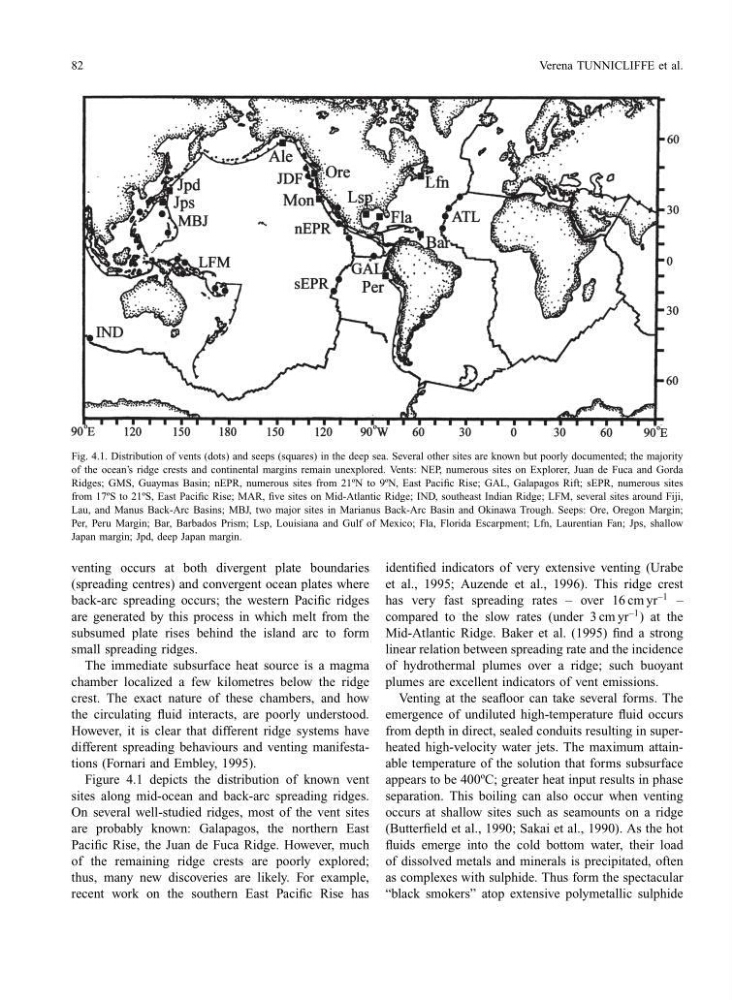
Fig. 4.1. Distribution of vents (dots) and seeps (squares) in the deep sea. Several other sites are known but poorly documented; the majority
of the ocean’s ridge crests and continental margins remain unexplored. Vents: NEP, numerous sites on Explorer, Juan de Fuca and Gorda
Ridges; GMS, Guaymas Basin; nEPR, numerous sites from 21ºN to 9ºN, East Pacific Rise; GAL, Galapagos Rift; sEPR, numerous sites
from 17ºS to 21ºS, East Pacific Rise; MAR, five sites on Mid-Atlantic Ridge; IND, southeast Indian Ridge; LFM, several sites around Fiji,
Lau, and Manus Back-Arc Basins; MBJ, two major sites in Marianus Back-Arc Basin and Okinawa Trough. Seeps: Ore, Oregon Margin;
Per, Peru Margin; Bar, Barbados Prism; Lsp, Louisiana and Gulf of Mexico; Fla, Florida Escarpment; Lfn, Laurentian Fan; Jps, shallow
Japan margin; Jpd, deep Japan margin.
venting occurs at both divergent plate boundaries
(spreading centres) and convergent ocean plates where
back-arc spreading occurs; the western Pacific ridges
are generated by this process in which melt from the
subsumed plate rises behind the island arc to form
small spreading ridges.
The immediate subsurface heat source is a magma
chamber localized a few kilometres below the ridge
crest. The exact nature of these chambers, and how
the circulating fluid interacts, are poorly understood.
However, it is clear that different ridge systems have
different spreading behaviours and venting manifestations (Fornari and Embley, 1995).
Figure 4.1 depicts the distribution of known vent
sites along mid-ocean and back-arc spreading ridges.
On several well-studied ridges, most of the vent sites
are probably known: Galapagos, the northern East
Pacific Rise, the Juan de Fuca Ridge. However, much
of the remaining ridge crests are poorly explored;
thus, many new discoveries are likely. For example,
recent work on the southern East Pacific Rise has
identified indicators of very extensive venting (Urabe
et al., 1995; Auzende et al., 1996). This ridge crest
has very fast spreading rates – over 16 cm yr
−1 –
compared to the slow rates (under 3 cm yr
−1 ) at the
Mid-Atlantic Ridge. Baker et al. (1995) find a strong
linear relation between spreading rate and the incidence
of hydrothermal plumes over a ridge; such buoyant
plumes are excellent indicators of vent emissions.
Venting at the seafloor can take several forms. The
emergence of undiluted high-temperature fluid occurs
from depth in direct, sealed conduits resulting in superheated high-velocity water jets. The maximum attainable temperature of the solution that forms subsurface
appears to be 400ºC; greater heat input results in phase
separation. This boiling can also occur when venting
occurs at shallow sites such as seamounts on a ridge
(Butterfield et al., 1990; Sakai et al., 1990). As the hot
fluids emerge into the cold bottom water, their load
of dissolved metals and minerals is precipitated, often
as complexes with sulphide. Thus form the spectacular
“black smokers” atop extensive polymetallic sulphide
Verena TUNNICLIFFE et al.
Fig. 4.1. Distribution of vents (dots) and seeps (squares) in the deep sea. Several other sites are known but poorly documented; the majority
of the ocean’s ridge crests and continental margins remain unexplored. Vents: NEP, numerous sites on Explorer, Juan de Fuca and Gorda
Ridges; GMS, Guaymas Basin; nEPR, numerous sites from 21ºN to 9ºN, East Pacific Rise; GAL, Galapagos Rift; sEPR, numerous sites
from 17ºS to 21ºS, East Pacific Rise; MAR, five sites on Mid-Atlantic Ridge; IND, southeast Indian Ridge; LFM, several sites around Fiji,
Lau, and Manus Back-Arc Basins; MBJ, two major sites in Marianus Back-Arc Basin and Okinawa Trough. Seeps: Ore, Oregon Margin;
Per, Peru Margin; Bar, Barbados Prism; Lsp, Louisiana and Gulf of Mexico; Fla, Florida Escarpment; Lfn, Laurentian Fan; Jps, shallow
Japan margin; Jpd, deep Japan margin.
venting occurs at both divergent plate boundaries
(spreading centres) and convergent ocean plates where
back-arc spreading occurs; the western Pacific ridges
are generated by this process in which melt from the
subsumed plate rises behind the island arc to form
small spreading ridges.
The immediate subsurface heat source is a magma
chamber localized a few kilometres below the ridge
crest. The exact nature of these chambers, and how
the circulating fluid interacts, are poorly understood.
However, it is clear that different ridge systems have
different spreading behaviours and venting manifestations (Fornari and Embley, 1995).
Figure 4.1 depicts the distribution of known vent
sites along mid-ocean and back-arc spreading ridges.
On several well-studied ridges, most of the vent sites
are probably known: Galapagos, the northern East
Pacific Rise, the Juan de Fuca Ridge. However, much
of the remaining ridge crests are poorly explored;
thus, many new discoveries are likely. For example,
recent work on the southern East Pacific Rise has
identified indicators of very extensive venting (Urabe
et al., 1995; Auzende et al., 1996). This ridge crest
has very fast spreading rates – over 16 cm yr
−1 –
compared to the slow rates (under 3 cm yr
−1 ) at the
Mid-Atlantic Ridge. Baker et al. (1995) find a strong
linear relation between spreading rate and the incidence
of hydrothermal plumes over a ridge; such buoyant
plumes are excellent indicators of vent emissions.
Venting at the seafloor can take several forms. The
emergence of undiluted high-temperature fluid occurs
from depth in direct, sealed conduits resulting in superheated high-velocity water jets. The maximum attainable temperature of the solution that forms subsurface
appears to be 400ºC; greater heat input results in phase
separation. This boiling can also occur when venting
occurs at shallow sites such as seamounts on a ridge
(Butterfield et al., 1990; Sakai et al., 1990). As the hot
fluids emerge into the cold bottom water, their load
of dissolved metals and minerals is precipitated, often
as complexes with sulphide. Thus form the spectacular
“black smokers” atop extensive polymetallic sulphide