

58
Martin V. ANGEL
undertakes diel vertical migrations. Its eyes, olfactory
organs and muscles are well developed; it has a
well-calcified skeleton and a gas-filled swimbladder
with which to regulate its buoyancy. In contrast,
G. bathyphilum is a non-migratory species and is totally
black with poorly developed ventral photophores. Its
eyes are half the size of those in G. denudatum and
in adults have probably regressed and become nonfunctional. Its mouth is relatively large and capable
of engulfing much larger prey. Its skeleton is weakly
calcified, and it lacks a swim bladder. The reductions in
physiological demands resulting from these reductions
in size of its organs also leads to the bathypelagic
species having evolved with smaller and less elaborate
gills, smaller heart and kidneys, and a less elaborate
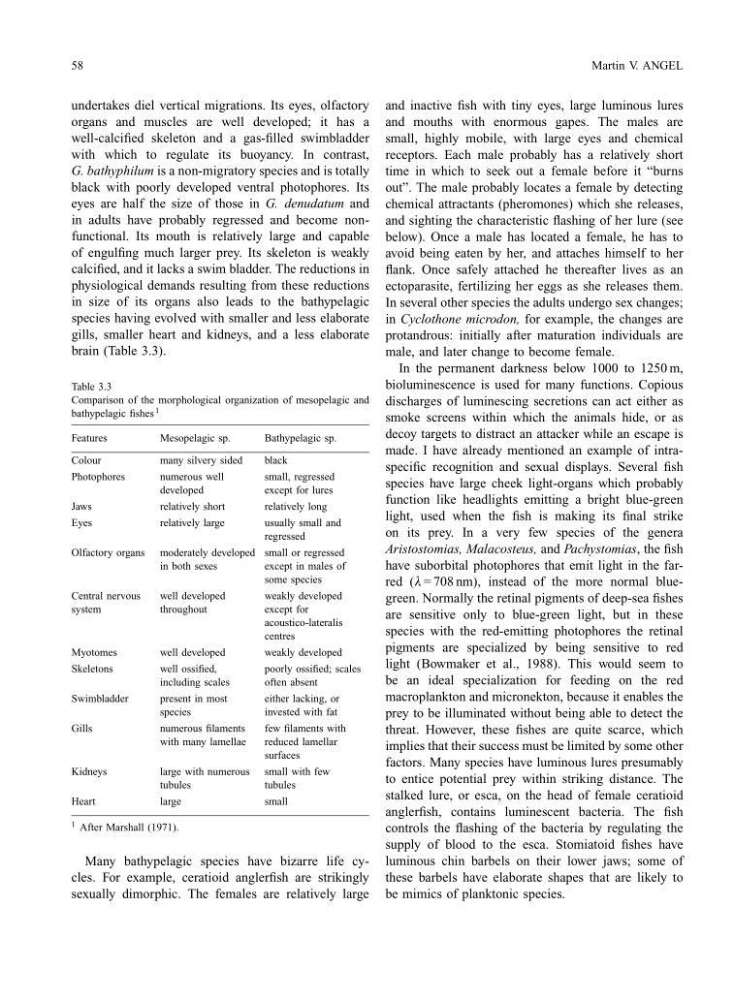
brain (Table 3.3).
Table 3.3
Comparison of the morphological organization of mesopelagic and
bathypelagic fishes 1
Features
Mesopelagic sp.
Bathypelagic sp.
Colour
many silvery sided
black
Photophores
numerous well
developed
small, regressed
except for lures
Jaws
relatively short
relatively long
Eyes
relatively large
usually small and
regressed
Olfactory organs moderately developed
in both sexes
small or regressed
except in males of
some species
Central nervous
system
well developed
throughout
weakly developed
except for
acoustico-lateralis
centres
Myotomes
well developed
weakly developed
Skeletons
well ossified,
including scales
poorly ossified; scales
often absent
Swimbladder
present in most
species
either lacking, or
invested with fat
Gills
numerous filaments
with many lamellae
few filaments with
reduced lamellar
surfaces
Kidneys
large with numerous
tubules
small with few
tubules
Heart
large
small
1 After Marshall (1971).
Many bathypelagic species have bizarre life cycles. For example, ceratioid anglerfish are strikingly
sexually dimorphic. The females are relatively large
and inactive fish with tiny eyes, large luminous lures
and mouths with enormous gapes. The males are
small, highly mobile, with large eyes and chemical
receptors. Each male probably has a relatively short
time in which to seek out a female before it “burns
out”. The male probably locates a female by detecting
chemical attractants (pheromones) which she releases,
and sighting the characteristic flashing of her lure (see
below). Once a male has located a female, he has to
avoid being eaten by her, and attaches himself to her
flank. Once safely attached he thereafter lives as an
ectoparasite, fertilizing her eggs as she releases them.
In several other species the adults undergo sex changes;
in Cyclothone microdon, for example, the changes are
protandrous: initially after maturation individuals are
male, and later change to become female.
In the permanent darkness below 1000 to 1250 m,
bioluminescence is used for many functions. Copious
discharges of luminescing secretions can act either as
smoke screens within which the animals hide, or as
decoy targets to distract an attacker while an escape is
made. I have already mentioned an example of intraspecific recognition and sexual displays. Several fish
species have large cheek light-organs which probably
function like headlights emitting a bright blue-green
light, used when the fish is making its final strike
on its prey. In a very few species of the genera
Aristostomias, Malacosteus, and Pachystomias, the fish
have suborbital photophores that emit light in the farred (l = 708 nm), instead of the more normal bluegreen. Normally the retinal pigments of deep-sea fishes
are sensitive only to blue-green light, but in these
species with the red-emitting photophores the retinal
pigments are specialized by being sensitive to red
light (Bowmaker et al., 1988). This would seem to
be an ideal specialization for feeding on the red
macroplankton and micronekton, because it enables the
prey to be illuminated without being able to detect the
threat. However, these fishes are quite scarce, which
implies that their success must be limited by some other
factors. Many species have luminous lures presumably
to entice potential prey within striking distance. The
stalked lure, or esca, on the head of female ceratioid
anglerfish, contains luminescent bacteria. The fish
controls the flashing of the bacteria by regulating the
supply of blood to the esca. Stomiatoid fishes have
luminous chin barbels on their lower jaws; some of
these barbels have elaborate shapes that are likely to
be mimics of planktonic species.
Martin V. ANGEL
undertakes diel vertical migrations. Its eyes, olfactory
organs and muscles are well developed; it has a
well-calcified skeleton and a gas-filled swimbladder
with which to regulate its buoyancy. In contrast,
G. bathyphilum is a non-migratory species and is totally
black with poorly developed ventral photophores. Its
eyes are half the size of those in G. denudatum and
in adults have probably regressed and become nonfunctional. Its mouth is relatively large and capable
of engulfing much larger prey. Its skeleton is weakly
calcified, and it lacks a swim bladder. The reductions in
physiological demands resulting from these reductions
in size of its organs also leads to the bathypelagic
species having evolved with smaller and less elaborate
gills, smaller heart and kidneys, and a less elaborate
brain (Table 3.3).
Table 3.3
Comparison of the morphological organization of mesopelagic and
bathypelagic fishes 1
Features
Mesopelagic sp.
Bathypelagic sp.
Colour
many silvery sided
black
Photophores
numerous well
developed
small, regressed
except for lures
Jaws
relatively short
relatively long
Eyes
relatively large
usually small and
regressed
Olfactory organs moderately developed
in both sexes
small or regressed
except in males of
some species
Central nervous
system
well developed
throughout
weakly developed
except for
acoustico-lateralis
centres
Myotomes
well developed
weakly developed
Skeletons
well ossified,
including scales
poorly ossified; scales
often absent
Swimbladder
present in most
species
either lacking, or
invested with fat
Gills
numerous filaments
with many lamellae
few filaments with
reduced lamellar
surfaces
Kidneys
large with numerous
tubules
small with few
tubules
Heart
large
small
1 After Marshall (1971).
Many bathypelagic species have bizarre life cycles. For example, ceratioid anglerfish are strikingly
sexually dimorphic. The females are relatively large
and inactive fish with tiny eyes, large luminous lures
and mouths with enormous gapes. The males are
small, highly mobile, with large eyes and chemical
receptors. Each male probably has a relatively short
time in which to seek out a female before it “burns
out”. The male probably locates a female by detecting
chemical attractants (pheromones) which she releases,
and sighting the characteristic flashing of her lure (see
below). Once a male has located a female, he has to
avoid being eaten by her, and attaches himself to her
flank. Once safely attached he thereafter lives as an
ectoparasite, fertilizing her eggs as she releases them.
In several other species the adults undergo sex changes;
in Cyclothone microdon, for example, the changes are
protandrous: initially after maturation individuals are
male, and later change to become female.
In the permanent darkness below 1000 to 1250 m,
bioluminescence is used for many functions. Copious
discharges of luminescing secretions can act either as
smoke screens within which the animals hide, or as
decoy targets to distract an attacker while an escape is
made. I have already mentioned an example of intraspecific recognition and sexual displays. Several fish
species have large cheek light-organs which probably
function like headlights emitting a bright blue-green
light, used when the fish is making its final strike
on its prey. In a very few species of the genera
Aristostomias, Malacosteus, and Pachystomias, the fish
have suborbital photophores that emit light in the farred (l = 708 nm), instead of the more normal bluegreen. Normally the retinal pigments of deep-sea fishes
are sensitive only to blue-green light, but in these
species with the red-emitting photophores the retinal
pigments are specialized by being sensitive to red
light (Bowmaker et al., 1988). This would seem to
be an ideal specialization for feeding on the red
macroplankton and micronekton, because it enables the
prey to be illuminated without being able to detect the
threat. However, these fishes are quite scarce, which
implies that their success must be limited by some other
factors. Many species have luminous lures presumably
to entice potential prey within striking distance. The
stalked lure, or esca, on the head of female ceratioid
anglerfish, contains luminescent bacteria. The fish
controls the flashing of the bacteria by regulating the
supply of blood to the esca. Stomiatoid fishes have
luminous chin barbels on their lower jaws; some of
these barbels have elaborate shapes that are likely to
be mimics of planktonic species.