

54
Martin V. ANGEL
q
q
q
q
q
q
q
q
q
q
q
q
q
q
q
q
q
q
q
q
q
q
q
q
q
q
q
q
q
q
q
q
q
q
q
q
Day
Night
Day
Night
Macroplankton
Micronekton
0
1
2
3
4
Depth km
0
1
2
log 10 DV/1000m
3
q
A B
C
D
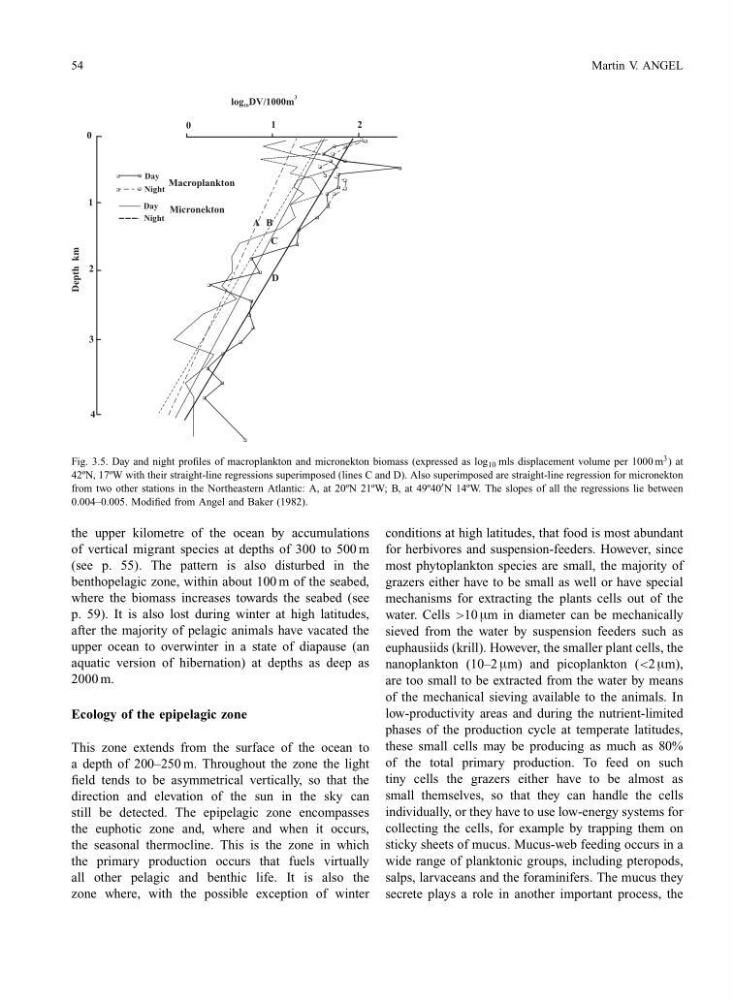
Fig. 3.5. Day and night profiles of macroplankton and micronekton biomass (expressed as log 10 mls displacement volume per 1000 m 3 ) at
42ºN, 17ºW with their straight-line regressions superimposed (lines C and D). Also superimposed are straight-line regression for micronekton
from two other stations in the Northeastern Atlantic: A, at 20ºN 21ºW; B, at 49º40 N 14ºW. The slopes of all the regressions lie between
0.004–0.005. Modified from Angel and Baker (1982).
the upper kilometre of the ocean by accumulations
of vertical migrant species at depths of 300 to 500 m
(see p. 55). The pattern is also disturbed in the
benthopelagic zone, within about 100 m of the seabed,
where the biomass increases towards the seabed (see
p. 59). It is also lost during winter at high latitudes,
after the majority of pelagic animals have vacated the
upper ocean to overwinter in a state of diapause (an
aquatic version of hibernation) at depths as deep as
2000 m.
Ecology of the epipelagic zone
This zone extends from the surface of the ocean to
a depth of 200–250 m. Throughout the zone the light
field tends to be asymmetrical vertically, so that the
direction and elevation of the sun in the sky can
still be detected. The epipelagic zone encompasses
the euphotic zone and, where and when it occurs,
the seasonal thermocline. This is the zone in which
the primary production occurs that fuels virtually
all other pelagic and benthic life. It is also the
zone where, with the possible exception of winter
conditions at high latitudes, that food is most abundant
for herbivores and suspension-feeders. However, since
most phytoplankton species are small, the majority of
grazers either have to be small as well or have special
mechanisms for extracting the plants cells out of the
water. Cells >10 mm in diameter can be mechanically
sieved from the water by suspension feeders such as
euphausiids (krill). However, the smaller plant cells, the
nanoplankton (10–2 mm) and picoplankton (<2 mm),
are too small to be extracted from the water by means
of the mechanical sieving available to the animals. In
low-productivity areas and during the nutrient-limited
phases of the production cycle at temperate latitudes,
these small cells may be producing as much as 80%
of the total primary production. To feed on such
tiny cells the grazers either have to be almost as
small themselves, so that they can handle the cells
individually, or they have to use low-energy systems for
collecting the cells, for example by trapping them on
sticky sheets of mucus. Mucus-web feeding occurs in a
wide range of planktonic groups, including pteropods,
salps, larvaceans and the foraminifers. The mucus they
secrete plays a role in another important process, the
Martin V. ANGEL
q
q
q
q
q
q
q
q
q
q
q
q
q
q
q
q
q
q
q
q
q
q
q
q
q
q
q
q
q
q
q
q
q
q
q
q
Day
Night
Day
Night
Macroplankton
Micronekton
0
1
2
3
4
Depth km
0
1
2
log 10 DV/1000m
3
q
A B
C
D
Fig. 3.5. Day and night profiles of macroplankton and micronekton biomass (expressed as log 10 mls displacement volume per 1000 m 3 ) at
42ºN, 17ºW with their straight-line regressions superimposed (lines C and D). Also superimposed are straight-line regression for micronekton
from two other stations in the Northeastern Atlantic: A, at 20ºN 21ºW; B, at 49º40 N 14ºW. The slopes of all the regressions lie between
0.004–0.005. Modified from Angel and Baker (1982).
the upper kilometre of the ocean by accumulations
of vertical migrant species at depths of 300 to 500 m
(see p. 55). The pattern is also disturbed in the
benthopelagic zone, within about 100 m of the seabed,
where the biomass increases towards the seabed (see
p. 59). It is also lost during winter at high latitudes,
after the majority of pelagic animals have vacated the
upper ocean to overwinter in a state of diapause (an
aquatic version of hibernation) at depths as deep as
2000 m.
Ecology of the epipelagic zone
This zone extends from the surface of the ocean to
a depth of 200–250 m. Throughout the zone the light
field tends to be asymmetrical vertically, so that the
direction and elevation of the sun in the sky can
still be detected. The epipelagic zone encompasses
the euphotic zone and, where and when it occurs,
the seasonal thermocline. This is the zone in which
the primary production occurs that fuels virtually
all other pelagic and benthic life. It is also the
zone where, with the possible exception of winter
conditions at high latitudes, that food is most abundant
for herbivores and suspension-feeders. However, since
most phytoplankton species are small, the majority of
grazers either have to be small as well or have special
mechanisms for extracting the plants cells out of the
water. Cells >10 mm in diameter can be mechanically
sieved from the water by suspension feeders such as
euphausiids (krill). However, the smaller plant cells, the
nanoplankton (10–2 mm) and picoplankton (<2 mm),
are too small to be extracted from the water by means
of the mechanical sieving available to the animals. In
low-productivity areas and during the nutrient-limited
phases of the production cycle at temperate latitudes,
these small cells may be producing as much as 80%
of the total primary production. To feed on such
tiny cells the grazers either have to be almost as
small themselves, so that they can handle the cells
individually, or they have to use low-energy systems for
collecting the cells, for example by trapping them on
sticky sheets of mucus. Mucus-web feeding occurs in a
wide range of planktonic groups, including pteropods,
salps, larvaceans and the foraminifers. The mucus they
secrete plays a role in another important process, the