

52
Martin V. ANGEL
30
18
12
6
6
6
6
18
30
12
6
6
18
24
30
12
30
30
24
12
30
24
12
24
12
12
6
18
24
30
18
6
12
12
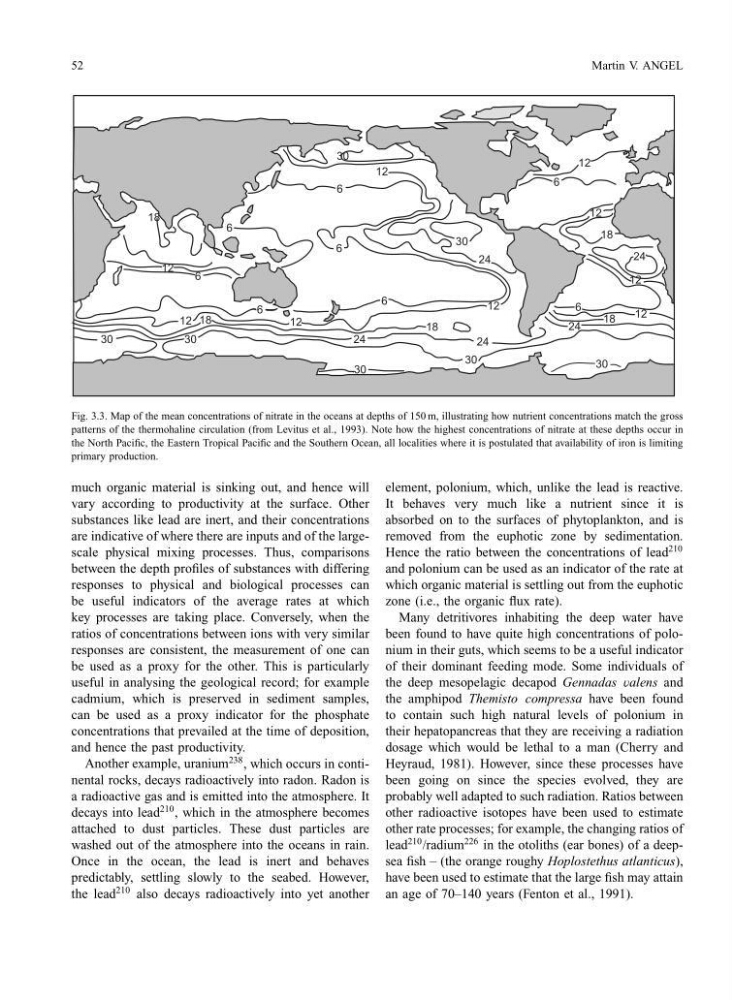
Fig. 3.3. Map of the mean concentrations of nitrate in the oceans at depths of 150 m, illustrating how nutrient concentrations match the gross
patterns of the thermohaline circulation (from Levitus et al., 1993). Note how the highest concentrations of nitrate at these depths occur in
the North Pacific, the Eastern Tropical Pacific and the Southern Ocean, all localities where it is postulated that availability of iron is limiting
primary production.
much organic material is sinking out, and hence will
vary according to productivity at the surface. Other
substances like lead are inert, and their concentrations
are indicative of where there are inputs and of the largescale physical mixing processes. Thus, comparisons
between the depth profiles of substances with differing
responses to physical and biological processes can
be useful indicators of the average rates at which
key processes are taking place. Conversely, when the
ratios of concentrations between ions with very similar
responses are consistent, the measurement of one can
be used as a proxy for the other. This is particularly
useful in analysing the geological record; for example
cadmium, which is preserved in sediment samples,
can be used as a proxy indicator for the phosphate
concentrations that prevailed at the time of deposition,
and hence the past productivity.
Another example, uranium
238 , which occurs in continental rocks, decays radioactively into radon. Radon is
a radioactive gas and is emitted into the atmosphere. It
decays into lead
210 , which in the atmosphere becomes
attached to dust particles. These dust particles are
washed out of the atmosphere into the oceans in rain.
Once in the ocean, the lead is inert and behaves
predictably, settling slowly to the seabed. However,
the lead
210 also decays radioactively into yet another
element, polonium, which, unlike the lead is reactive.
It behaves very much like a nutrient since it is
absorbed on to the surfaces of phytoplankton, and is
removed from the euphotic zone by sedimentation.
Hence the ratio between the concentrations of lead
210
and polonium can be used as an indicator of the rate at
which organic material is settling out from the euphotic
zone (i.e., the organic flux rate).
Many detritivores inhabiting the deep water have
been found to have quite high concentrations of polonium in their guts, which seems to be a useful indicator
of their dominant feeding mode. Some individuals of
the deep mesopelagic decapod Gennadas valens and
the amphipod Themisto compressa have been found
to contain such high natural levels of polonium in
their hepatopancreas that they are receiving a radiation
dosage which would be lethal to a man (Cherry and
Heyraud, 1981). However, since these processes have
been going on since the species evolved, they are
probably well adapted to such radiation. Ratios between
other radioactive isotopes have been used to estimate
other rate processes; for example, the changing ratios of
lead
210 /radium
226 in the otoliths (ear bones) of a deepsea fish – (the orange roughy Hoplostethus atlanticus),
have been used to estimate that the large fish may attain
an age of 70–140 years (Fenton et al., 1991).
Martin V. ANGEL
30
18
12
6
6
6
6
18
30
12
6
6
18
24
30
12
30
30
24
12
30
24
12
24
12
12
6
18
24
30
18
6
12
12
Fig. 3.3. Map of the mean concentrations of nitrate in the oceans at depths of 150 m, illustrating how nutrient concentrations match the gross
patterns of the thermohaline circulation (from Levitus et al., 1993). Note how the highest concentrations of nitrate at these depths occur in
the North Pacific, the Eastern Tropical Pacific and the Southern Ocean, all localities where it is postulated that availability of iron is limiting
primary production.
much organic material is sinking out, and hence will
vary according to productivity at the surface. Other
substances like lead are inert, and their concentrations
are indicative of where there are inputs and of the largescale physical mixing processes. Thus, comparisons
between the depth profiles of substances with differing
responses to physical and biological processes can
be useful indicators of the average rates at which
key processes are taking place. Conversely, when the
ratios of concentrations between ions with very similar
responses are consistent, the measurement of one can
be used as a proxy for the other. This is particularly
useful in analysing the geological record; for example
cadmium, which is preserved in sediment samples,
can be used as a proxy indicator for the phosphate
concentrations that prevailed at the time of deposition,
and hence the past productivity.
Another example, uranium
238 , which occurs in continental rocks, decays radioactively into radon. Radon is
a radioactive gas and is emitted into the atmosphere. It
decays into lead
210 , which in the atmosphere becomes
attached to dust particles. These dust particles are
washed out of the atmosphere into the oceans in rain.
Once in the ocean, the lead is inert and behaves
predictably, settling slowly to the seabed. However,
the lead
210 also decays radioactively into yet another
element, polonium, which, unlike the lead is reactive.
It behaves very much like a nutrient since it is
absorbed on to the surfaces of phytoplankton, and is
removed from the euphotic zone by sedimentation.
Hence the ratio between the concentrations of lead
210
and polonium can be used as an indicator of the rate at
which organic material is settling out from the euphotic
zone (i.e., the organic flux rate).
Many detritivores inhabiting the deep water have
been found to have quite high concentrations of polonium in their guts, which seems to be a useful indicator
of their dominant feeding mode. Some individuals of
the deep mesopelagic decapod Gennadas valens and
the amphipod Themisto compressa have been found
to contain such high natural levels of polonium in
their hepatopancreas that they are receiving a radiation
dosage which would be lethal to a man (Cherry and
Heyraud, 1981). However, since these processes have
been going on since the species evolved, they are
probably well adapted to such radiation. Ratios between
other radioactive isotopes have been used to estimate
other rate processes; for example, the changing ratios of
lead
210 /radium
226 in the otoliths (ear bones) of a deepsea fish – (the orange roughy Hoplostethus atlanticus),
have been used to estimate that the large fish may attain
an age of 70–140 years (Fenton et al., 1991).