

THE PELAGIC ENVIRONMENT OF THE OPEN OCEAN
47
90ºW
180º
1-2
3-4
5-6
9-10
5-6
3-4
1-2
0
3-4 5-6
5-6
1-2
0
3-4
7-8
5-6
3-4
1-2
0
1-2
3-4
0
5-6
1-2
7-8
5-6
3-4
1-2
0
1-2
3-4
5-6
7-8
9-10
13
5-6
7-8
3-4
7-8
9-10
11-12
90ºE
0º
90ºW
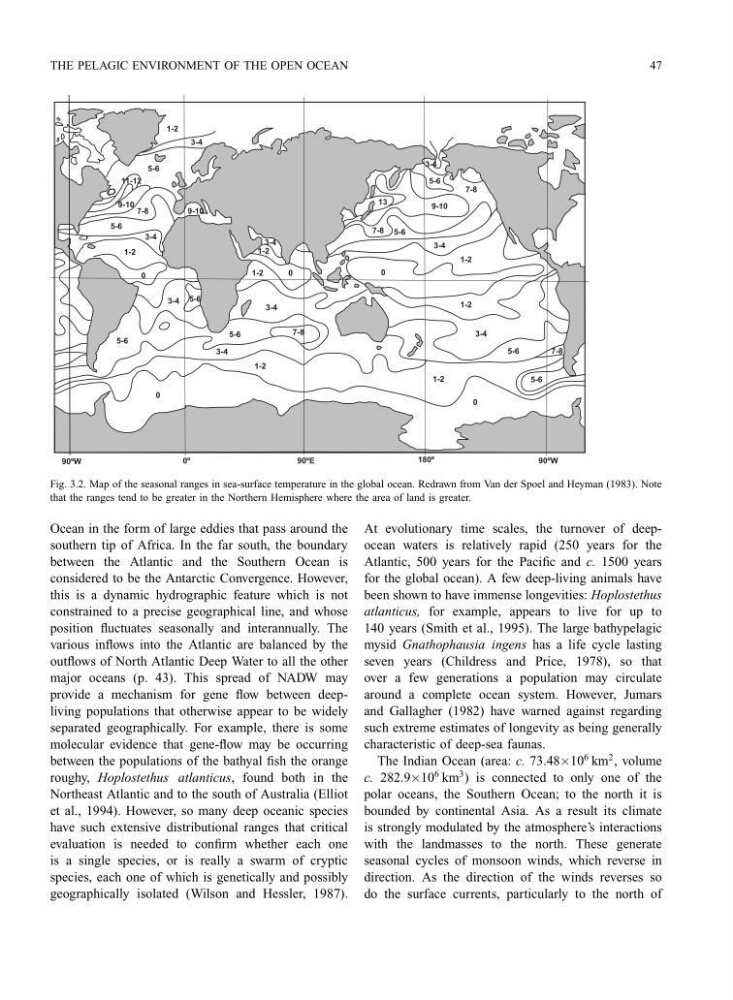
Fig. 3.2. Map of the seasonal ranges in sea-surface temperature in the global ocean. Redrawn from Van der Spoel and Heyman (1983). Note
that the ranges tend to be greater in the Northern Hemisphere where the area of land is greater.
Ocean in the form of large eddies that pass around the
southern tip of Africa. In the far south, the boundary
between the Atlantic and the Southern Ocean is
considered to be the Antarctic Convergence. However,
this is a dynamic hydrographic feature which is not
constrained to a precise geographical line, and whose
position fluctuates seasonally and interannually. The
various inflows into the Atlantic are balanced by the
outflows of North Atlantic Deep Water to all the other
major oceans (p. 43). This spread of NADW may
provide a mechanism for gene flow between deepliving populations that otherwise appear to be widely
separated geographically. For example, there is some
molecular evidence that gene-flow may be occurring
between the populations of the bathyal fish the orange
roughy, Hoplostethus atlanticus, found both in the
Northeast Atlantic and to the south of Australia (Elliot
et al., 1994). However, so many deep oceanic species
have such extensive distributional ranges that critical
evaluation is needed to confirm whether each one
is a single species, or is really a swarm of cryptic
species, each one of which is genetically and possibly
geographically isolated (Wilson and Hessler, 1987).
At evolutionary time scales, the turnover of deepocean waters is relatively rapid (250 years for the
Atlantic, 500 years for the Pacific and c. 1500 years
for the global ocean). A few deep-living animals have
been shown to have immense longevities: Hoplostethus
atlanticus, for example, appears to live for up to
140 years (Smith et al., 1995). The large bathypelagic
mysid Gnathophausia ingens has a life cycle lasting
seven years (Childress and Price, 1978), so that
over a few generations a population may circulate
around a complete ocean system. However, Jumars
and Gallagher (1982) have warned against regarding
such extreme estimates of longevity as being generally
characteristic of deep-sea faunas.
The Indian Ocean (area: c. 73.48×10
6 km
2 , volume
c. 282.9×10
6 km
3 ) is connected to only one of the
polar oceans, the Southern Ocean; to the north it is
bounded by continental Asia. As a result its climate
is strongly modulated by the atmosphere’s interactions
with the landmasses to the north. These generate
seasonal cycles of monsoon winds, which reverse in
direction. As the direction of the winds reverses so
do the surface currents, particularly to the north of
47
90ºW
180º
1-2
3-4
5-6
9-10
5-6
3-4
1-2
0
3-4 5-6
5-6
1-2
0
3-4
7-8
5-6
3-4
1-2
0
1-2
3-4
0
5-6
1-2
7-8
5-6
3-4
1-2
0
1-2
3-4
5-6
7-8
9-10
13
5-6
7-8
3-4
7-8
9-10
11-12
90ºE
0º
90ºW
Fig. 3.2. Map of the seasonal ranges in sea-surface temperature in the global ocean. Redrawn from Van der Spoel and Heyman (1983). Note
that the ranges tend to be greater in the Northern Hemisphere where the area of land is greater.
Ocean in the form of large eddies that pass around the
southern tip of Africa. In the far south, the boundary
between the Atlantic and the Southern Ocean is
considered to be the Antarctic Convergence. However,
this is a dynamic hydrographic feature which is not
constrained to a precise geographical line, and whose
position fluctuates seasonally and interannually. The
various inflows into the Atlantic are balanced by the
outflows of North Atlantic Deep Water to all the other
major oceans (p. 43). This spread of NADW may
provide a mechanism for gene flow between deepliving populations that otherwise appear to be widely
separated geographically. For example, there is some
molecular evidence that gene-flow may be occurring
between the populations of the bathyal fish the orange
roughy, Hoplostethus atlanticus, found both in the
Northeast Atlantic and to the south of Australia (Elliot
et al., 1994). However, so many deep oceanic species
have such extensive distributional ranges that critical
evaluation is needed to confirm whether each one
is a single species, or is really a swarm of cryptic
species, each one of which is genetically and possibly
geographically isolated (Wilson and Hessler, 1987).
At evolutionary time scales, the turnover of deepocean waters is relatively rapid (250 years for the
Atlantic, 500 years for the Pacific and c. 1500 years
for the global ocean). A few deep-living animals have
been shown to have immense longevities: Hoplostethus
atlanticus, for example, appears to live for up to
140 years (Smith et al., 1995). The large bathypelagic
mysid Gnathophausia ingens has a life cycle lasting
seven years (Childress and Price, 1978), so that
over a few generations a population may circulate
around a complete ocean system. However, Jumars
and Gallagher (1982) have warned against regarding
such extreme estimates of longevity as being generally
characteristic of deep-sea faunas.
The Indian Ocean (area: c. 73.48×10
6 km
2 , volume
c. 282.9×10
6 km
3 ) is connected to only one of the
polar oceans, the Southern Ocean; to the north it is
bounded by continental Asia. As a result its climate
is strongly modulated by the atmosphere’s interactions
with the landmasses to the north. These generate
seasonal cycles of monsoon winds, which reverse in
direction. As the direction of the winds reverses so
do the surface currents, particularly to the north of