

Chapter 3
THE PELAGIC ENVIRONMENT OF THE OPEN OCEAN
Martin V. ANGEL
INTRODUCTION
The waters of the ocean provide the most voluminous
habitat on the planet, since 71% of the Earth’s surface
is covered by sea to an average depth of 3800 m. The
water in the oceans is estimated to have a volume of
1.368×10
9 km
3 , and to be equivalent to about 0.24%
of the Earth’s total mass. The shelf seas 0–200 m deep,
that fringe the continental landmasses, extend over
about 5% of the Earth’s area. At the outer edge of
most shelf seas is the shelf-break where the seabed falls
quite steeply to depths of around 3000 m, forming the
continental slope and rise; these continental margins
account for a further 13% of the Earth’s area. Beyond
that, abyssal depths 3000 to 6000 m deep cover about
51% of the Earth’s surface, and the deepest or hadal
depths (including many of the ocean trenches) where
depths are >6000 m cover less than 2%. The volume
of the living space provided by the water of the oceans
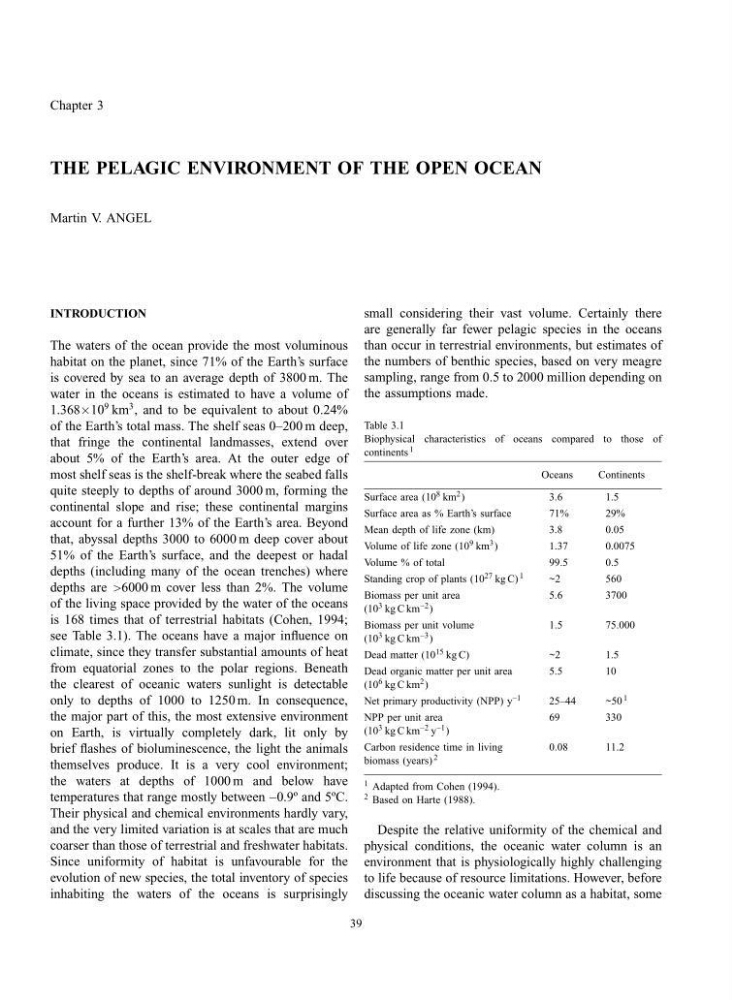
is 168 times that of terrestrial habitats (Cohen, 1994;
see Table 3.1). The oceans have a major influence on
climate, since they transfer substantial amounts of heat
from equatorial zones to the polar regions. Beneath
the clearest of oceanic waters sunlight is detectable
only to depths of 1000 to 1250 m. In consequence,
the major part of this, the most extensive environment
on Earth, is virtually completely dark, lit only by
brief flashes of bioluminescence, the light the animals
themselves produce. It is a very cool environment;
the waters at depths of 1000 m and below have
temperatures that range mostly between −0.9º and 5ºC.
Their physical and chemical environments hardly vary,
and the very limited variation is at scales that are much
coarser than those of terrestrial and freshwater habitats.
Since uniformity of habitat is unfavourable for the
evolution of new species, the total inventory of species
inhabiting the waters of the oceans is surprisingly
small considering their vast volume. Certainly there
are generally far fewer pelagic species in the oceans
than occur in terrestrial environments, but estimates of
the numbers of benthic species, based on very meagre
sampling, range from 0.5 to 2000 million depending on
the assumptions made.
Table 3.1
Biophysical characteristics of oceans compared to those of
continents 1
Oceans
Continents
Surface area (10 8 km 2 )
3.6
1.5
Surface area as % Earth’s surface
71%
29%
Mean depth of life zone (km)
3.8
0.05
Volume of life zone (10 9 km 3 )
1.37
0.0075
Volume % of total
99.5
0.5
Standing crop of plants (10 27 kg C) 1
~2
560
Biomass per unit area
(10 3 kg C km −2 )
5.6
3700
Biomass per unit volume
(10 3 kg C km −3 )
1.5
75.000
Dead matter (10 15 kg C)
~2
1.5
Dead organic matter per unit area
(10 6 kg C km 2 )
5.5
10
Net primary productivity (NPP) y −1
25–44
~50 1
NPP per unit area
(10 3 kg C km −2 y −1 )
69
330
Carbon residence time in living
biomass (years) 2
0.08
11.2
1 Adapted from Cohen (1994).
2 Based on Harte (1988).
Despite the relative uniformity of the chemical and
physical conditions, the oceanic water column is an
environment that is physiologically highly challenging
to life because of resource limitations. However, before
discussing the oceanic water column as a habitat, some
39
THE PELAGIC ENVIRONMENT OF THE OPEN OCEAN
Martin V. ANGEL
INTRODUCTION
The waters of the ocean provide the most voluminous
habitat on the planet, since 71% of the Earth’s surface
is covered by sea to an average depth of 3800 m. The
water in the oceans is estimated to have a volume of
1.368×10
9 km
3 , and to be equivalent to about 0.24%
of the Earth’s total mass. The shelf seas 0–200 m deep,
that fringe the continental landmasses, extend over
about 5% of the Earth’s area. At the outer edge of
most shelf seas is the shelf-break where the seabed falls
quite steeply to depths of around 3000 m, forming the
continental slope and rise; these continental margins
account for a further 13% of the Earth’s area. Beyond
that, abyssal depths 3000 to 6000 m deep cover about
51% of the Earth’s surface, and the deepest or hadal
depths (including many of the ocean trenches) where
depths are >6000 m cover less than 2%. The volume
of the living space provided by the water of the oceans
is 168 times that of terrestrial habitats (Cohen, 1994;
see Table 3.1). The oceans have a major influence on
climate, since they transfer substantial amounts of heat
from equatorial zones to the polar regions. Beneath
the clearest of oceanic waters sunlight is detectable
only to depths of 1000 to 1250 m. In consequence,
the major part of this, the most extensive environment
on Earth, is virtually completely dark, lit only by
brief flashes of bioluminescence, the light the animals
themselves produce. It is a very cool environment;
the waters at depths of 1000 m and below have
temperatures that range mostly between −0.9º and 5ºC.
Their physical and chemical environments hardly vary,
and the very limited variation is at scales that are much
coarser than those of terrestrial and freshwater habitats.
Since uniformity of habitat is unfavourable for the
evolution of new species, the total inventory of species
inhabiting the waters of the oceans is surprisingly
small considering their vast volume. Certainly there
are generally far fewer pelagic species in the oceans
than occur in terrestrial environments, but estimates of
the numbers of benthic species, based on very meagre
sampling, range from 0.5 to 2000 million depending on
the assumptions made.
Table 3.1
Biophysical characteristics of oceans compared to those of
continents 1
Oceans
Continents
Surface area (10 8 km 2 )
3.6
1.5
Surface area as % Earth’s surface
71%
29%
Mean depth of life zone (km)
3.8
0.05
Volume of life zone (10 9 km 3 )
1.37
0.0075
Volume % of total
99.5
0.5
Standing crop of plants (10 27 kg C) 1
~2
560
Biomass per unit area
(10 3 kg C km −2 )
5.6
3700
Biomass per unit volume
(10 3 kg C km −3 )
1.5
75.000
Dead matter (10 15 kg C)
~2
1.5
Dead organic matter per unit area
(10 6 kg C km 2 )
5.5
10
Net primary productivity (NPP) y −1
25–44
~50 1
NPP per unit area
(10 3 kg C km −2 y −1 )
69
330
Carbon residence time in living
biomass (years) 2
0.08
11.2
1 Adapted from Cohen (1994).
2 Based on Harte (1988).
Despite the relative uniformity of the chemical and
physical conditions, the oceanic water column is an
environment that is physiologically highly challenging
to life because of resource limitations. However, before
discussing the oceanic water column as a habitat, some
39