

454
Hjalmar THIEL
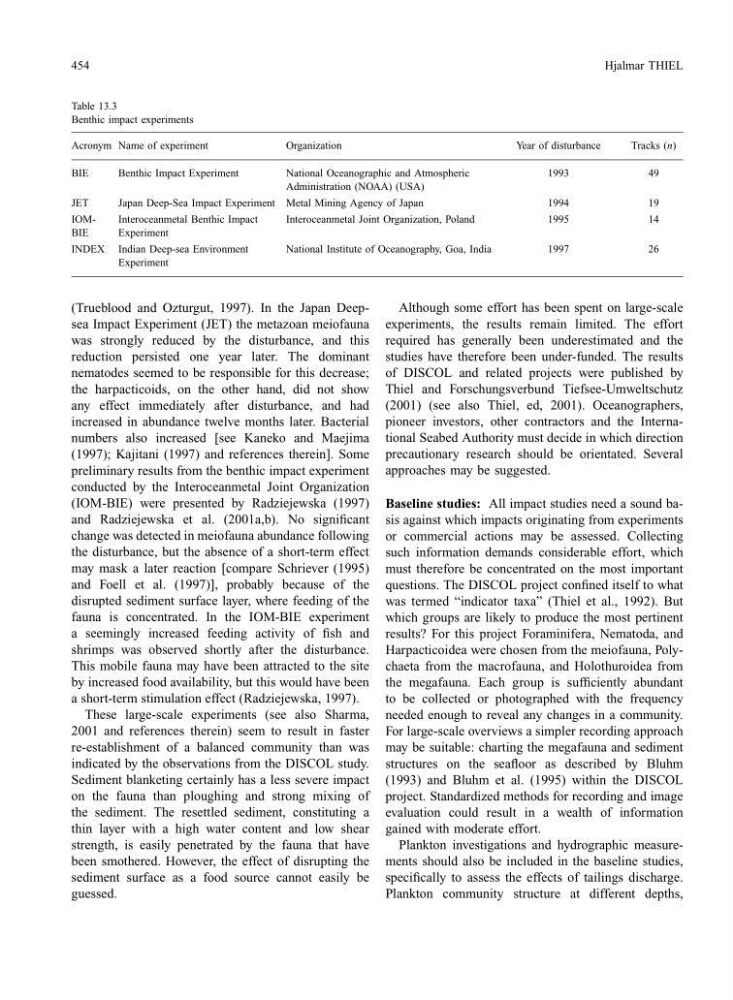
Table 13.3
Benthic impact experiments
Acronym Name of experiment
Organization
Year of disturbance
Tracks (n)
BIE
Benthic Impact Experiment
National Oceanographic and Atmospheric
Administration (NOAA) (USA)
1993
49
JET
Japan Deep-Sea Impact Experiment Metal Mining Agency of Japan
1994
19
IOMBIE
Interoceanmetal Benthic Impact
Experiment
Interoceanmetal Joint Organization, Poland
1995
14
INDEX Indian Deep-sea Environment
Experiment
National Institute of Oceanography, Goa, India
1997
26
(Trueblood and Ozturgut, 1997). In the Japan Deepsea Impact Experiment (JET) the metazoan meiofauna
was strongly reduced by the disturbance, and this
reduction persisted one year later. The dominant
nematodes seemed to be responsible for this decrease;
the harpacticoids, on the other hand, did not show
any effect immediately after disturbance, and had
increased in abundance twelve months later. Bacterial
numbers also increased [see Kaneko and Maejima
(1997); Kajitani (1997) and references therein]. Some
preliminary results from the benthic impact experiment
conducted by the Interoceanmetal Joint Organization
(IOM-BIE) were presented by Radziejewska (1997)
and Radziejewska et al. (2001a,b). No significant
change was detected in meiofauna abundance following
the disturbance, but the absence of a short-term effect
may mask a later reaction [compare Schriever (1995)
and Foell et al. (1997)], probably because of the
disrupted sediment surface layer, where feeding of the
fauna is concentrated. In the IOM-BIE experiment
a seemingly increased feeding activity of fish and
shrimps was observed shortly after the disturbance.
This mobile fauna may have been attracted to the site
by increased food availability, but this would have been
a short-term stimulation effect (Radziejewska, 1997).
These large-scale experiments (see also Sharma,
2001 and references therein) seem to result in faster
re-establishment of a balanced community than was
indicated by the observations from the DISCOL study.
Sediment blanketing certainly has a less severe impact
on the fauna than ploughing and strong mixing of
the sediment. The resettled sediment, constituting a
thin layer with a high water content and low shear
strength, is easily penetrated by the fauna that have
been smothered. However, the effect of disrupting the
sediment surface as a food source cannot easily be
guessed.
Although some effort has been spent on large-scale
experiments, the results remain limited. The effort
required has generally been underestimated and the
studies have therefore been under-funded. The results
of DISCOL and related projects were published by
Thiel and Forschungsverbund Tiefsee-Umweltschutz
(2001) (see also Thiel, ed, 2001). Oceanographers,
pioneer investors, other contractors and the International Seabed Authority must decide in which direction
precautionary research should be orientated. Several
approaches may be suggested.
Baseline studies: All impact studies need a sound basis against which impacts originating from experiments
or commercial actions may be assessed. Collecting
such information demands considerable effort, which
must therefore be concentrated on the most important
questions. The DISCOL project confined itself to what
was termed “indicator taxa” (Thiel et al., 1992). But
which groups are likely to produce the most pertinent
results? For this project Foraminifera, Nematoda, and
Harpacticoidea were chosen from the meiofauna, Polychaeta from the macrofauna, and Holothuroidea from
the megafauna. Each group is sufficiently abundant
to be collected or photographed with the frequency
needed enough to reveal any changes in a community.
For large-scale overviews a simpler recording approach
may be suitable: charting the megafauna and sediment
structures on the seafloor as described by Bluhm
(1993) and Bluhm et al. (1995) within the DISCOL
project. Standardized methods for recording and image
evaluation could result in a wealth of information
gained with moderate effort.
Plankton investigations and hydrographic measurements should also be included in the baseline studies,
specifically to assess the effects of tailings discharge.
Plankton community structure at different depths,
Hjalmar THIEL
Table 13.3
Benthic impact experiments
Acronym Name of experiment
Organization
Year of disturbance
Tracks (n)
BIE
Benthic Impact Experiment
National Oceanographic and Atmospheric
Administration (NOAA) (USA)
1993
49
JET
Japan Deep-Sea Impact Experiment Metal Mining Agency of Japan
1994
19
IOMBIE
Interoceanmetal Benthic Impact
Experiment
Interoceanmetal Joint Organization, Poland
1995
14
INDEX Indian Deep-sea Environment
Experiment
National Institute of Oceanography, Goa, India
1997
26
(Trueblood and Ozturgut, 1997). In the Japan Deepsea Impact Experiment (JET) the metazoan meiofauna
was strongly reduced by the disturbance, and this
reduction persisted one year later. The dominant
nematodes seemed to be responsible for this decrease;
the harpacticoids, on the other hand, did not show
any effect immediately after disturbance, and had
increased in abundance twelve months later. Bacterial
numbers also increased [see Kaneko and Maejima
(1997); Kajitani (1997) and references therein]. Some
preliminary results from the benthic impact experiment
conducted by the Interoceanmetal Joint Organization
(IOM-BIE) were presented by Radziejewska (1997)
and Radziejewska et al. (2001a,b). No significant
change was detected in meiofauna abundance following
the disturbance, but the absence of a short-term effect
may mask a later reaction [compare Schriever (1995)
and Foell et al. (1997)], probably because of the
disrupted sediment surface layer, where feeding of the
fauna is concentrated. In the IOM-BIE experiment
a seemingly increased feeding activity of fish and
shrimps was observed shortly after the disturbance.
This mobile fauna may have been attracted to the site
by increased food availability, but this would have been
a short-term stimulation effect (Radziejewska, 1997).
These large-scale experiments (see also Sharma,
2001 and references therein) seem to result in faster
re-establishment of a balanced community than was
indicated by the observations from the DISCOL study.
Sediment blanketing certainly has a less severe impact
on the fauna than ploughing and strong mixing of
the sediment. The resettled sediment, constituting a
thin layer with a high water content and low shear
strength, is easily penetrated by the fauna that have
been smothered. However, the effect of disrupting the
sediment surface as a food source cannot easily be
guessed.
Although some effort has been spent on large-scale
experiments, the results remain limited. The effort
required has generally been underestimated and the
studies have therefore been under-funded. The results
of DISCOL and related projects were published by
Thiel and Forschungsverbund Tiefsee-Umweltschutz
(2001) (see also Thiel, ed, 2001). Oceanographers,
pioneer investors, other contractors and the International Seabed Authority must decide in which direction
precautionary research should be orientated. Several
approaches may be suggested.
Baseline studies: All impact studies need a sound basis against which impacts originating from experiments
or commercial actions may be assessed. Collecting
such information demands considerable effort, which
must therefore be concentrated on the most important
questions. The DISCOL project confined itself to what
was termed “indicator taxa” (Thiel et al., 1992). But
which groups are likely to produce the most pertinent
results? For this project Foraminifera, Nematoda, and
Harpacticoidea were chosen from the meiofauna, Polychaeta from the macrofauna, and Holothuroidea from
the megafauna. Each group is sufficiently abundant
to be collected or photographed with the frequency
needed enough to reveal any changes in a community.
For large-scale overviews a simpler recording approach
may be suitable: charting the megafauna and sediment
structures on the seafloor as described by Bluhm
(1993) and Bluhm et al. (1995) within the DISCOL
project. Standardized methods for recording and image
evaluation could result in a wealth of information
gained with moderate effort.
Plankton investigations and hydrographic measurements should also be included in the baseline studies,
specifically to assess the effects of tailings discharge.
Plankton community structure at different depths,