

ANTHROPOGENIC IMPACTS ON THE DEEP SEA
449
thought to be applicable for crust mining (Masuda,
1991), although the crusts need to be broken away
from the rock beneath and must be available in small
fragments. But the simplicity of the system may not
outweigh the shortcomings.
More promising techniques have separated the functions of ore collection and transport to the surface.
For nodule mining the proposed collector systems
consist of a towed or self-propelled vehicle, carrying
a collector at its leading edge. This may employ
mechanical screening, bucket or scraper methods or
hydraulic principles to lift the nodules from the
seafloor; probably both may be combined in one hybrid
system (Fig. 13.10) (Burns and Suh, 1979; Bath, 1989;
Fig. 13.10. Nodule collection with the help of water jets (modified
from Oebius, 1997).
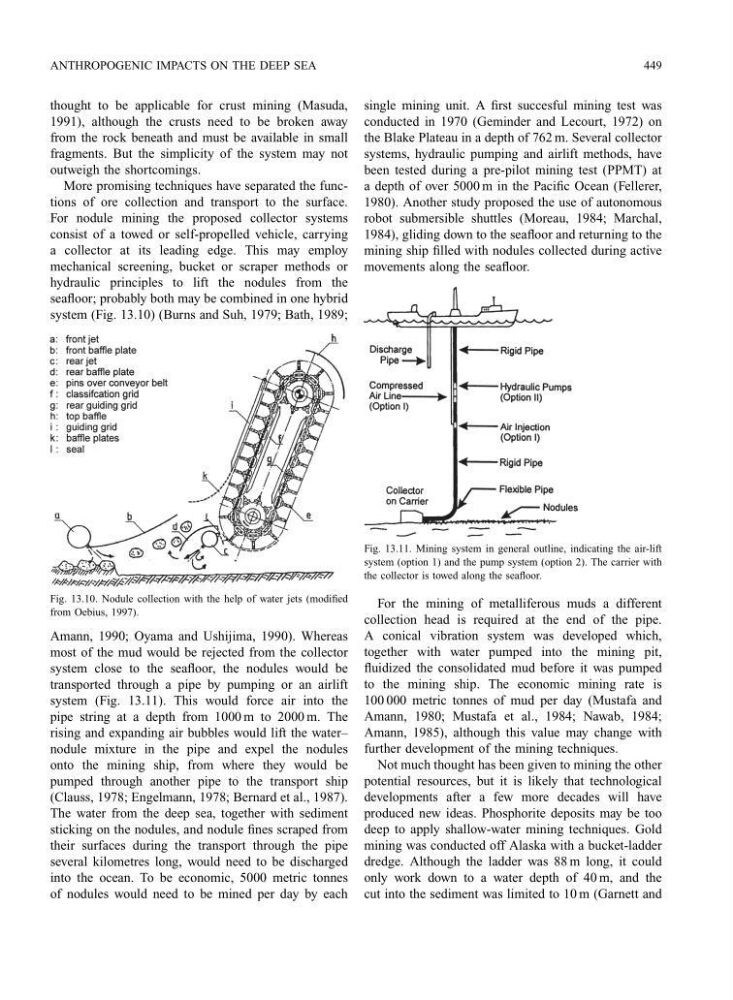
Amann, 1990; Oyama and Ushijima, 1990). Whereas
most of the mud would be rejected from the collector
system close to the seafloor, the nodules would be
transported through a pipe by pumping or an airlift
system (Fig. 13.11). This would force air into the
pipe string at a depth from 1000 m to 2000 m. The
rising and expanding air bubbles would lift the water–
nodule mixture in the pipe and expel the nodules
onto the mining ship, from where they would be
pumped through another pipe to the transport ship
(Clauss, 1978; Engelmann, 1978; Bernard et al., 1987).
The water from the deep sea, together with sediment
sticking on the nodules, and nodule fines scraped from
their surfaces during the transport through the pipe
several kilometres long, would need to be discharged
into the ocean. To be economic, 5000 metric tonnes
of nodules would need to be mined per day by each
single mining unit. A first succesful mining test was
conducted in 1970 (Geminder and Lecourt, 1972) on
the Blake Plateau in a depth of 762 m. Several collector
systems, hydraulic pumping and airlift methods, have
been tested during a pre-pilot mining test (PPMT) at
a depth of over 5000 m in the Pacific Ocean (Fellerer,
1980). Another study proposed the use of autonomous
robot submersible shuttles (Moreau, 1984; Marchal,
1984), gliding down to the seafloor and returning to the
mining ship filled with nodules collected during active
movements along the seafloor.
Fig. 13.11. Mining system in general outline, indicating the air-lift
system (option 1) and the pump system (option 2). The carrier with
the collector is towed along the seafloor.
For the mining of metalliferous muds a different
collection head is required at the end of the pipe.
A conical vibration system was developed which,
together with water pumped into the mining pit,
fluidized the consolidated mud before it was pumped
to the mining ship. The economic mining rate is
100 000 metric tonnes of mud per day (Mustafa and
Amann, 1980; Mustafa et al., 1984; Nawab, 1984;
Amann, 1985), although this value may change with
further development of the mining techniques.
Not much thought has been given to mining the other
potential resources, but it is likely that technological
developments after a few more decades will have
produced new ideas. Phosphorite deposits may be too
deep to apply shallow-water mining techniques. Gold
mining was conducted off Alaska with a bucket-ladder
dredge. Although the ladder was 88 m long, it could
only work down to a water depth of 40 m, and the
cut into the sediment was limited to 10 m (Garnett and
449
thought to be applicable for crust mining (Masuda,
1991), although the crusts need to be broken away
from the rock beneath and must be available in small
fragments. But the simplicity of the system may not
outweigh the shortcomings.
More promising techniques have separated the functions of ore collection and transport to the surface.
For nodule mining the proposed collector systems
consist of a towed or self-propelled vehicle, carrying
a collector at its leading edge. This may employ
mechanical screening, bucket or scraper methods or
hydraulic principles to lift the nodules from the
seafloor; probably both may be combined in one hybrid
system (Fig. 13.10) (Burns and Suh, 1979; Bath, 1989;
Fig. 13.10. Nodule collection with the help of water jets (modified
from Oebius, 1997).
Amann, 1990; Oyama and Ushijima, 1990). Whereas
most of the mud would be rejected from the collector
system close to the seafloor, the nodules would be
transported through a pipe by pumping or an airlift
system (Fig. 13.11). This would force air into the
pipe string at a depth from 1000 m to 2000 m. The
rising and expanding air bubbles would lift the water–
nodule mixture in the pipe and expel the nodules
onto the mining ship, from where they would be
pumped through another pipe to the transport ship
(Clauss, 1978; Engelmann, 1978; Bernard et al., 1987).
The water from the deep sea, together with sediment
sticking on the nodules, and nodule fines scraped from
their surfaces during the transport through the pipe
several kilometres long, would need to be discharged
into the ocean. To be economic, 5000 metric tonnes
of nodules would need to be mined per day by each
single mining unit. A first succesful mining test was
conducted in 1970 (Geminder and Lecourt, 1972) on
the Blake Plateau in a depth of 762 m. Several collector
systems, hydraulic pumping and airlift methods, have
been tested during a pre-pilot mining test (PPMT) at
a depth of over 5000 m in the Pacific Ocean (Fellerer,
1980). Another study proposed the use of autonomous
robot submersible shuttles (Moreau, 1984; Marchal,
1984), gliding down to the seafloor and returning to the
mining ship filled with nodules collected during active
movements along the seafloor.
Fig. 13.11. Mining system in general outline, indicating the air-lift
system (option 1) and the pump system (option 2). The carrier with
the collector is towed along the seafloor.
For the mining of metalliferous muds a different
collection head is required at the end of the pipe.
A conical vibration system was developed which,
together with water pumped into the mining pit,
fluidized the consolidated mud before it was pumped
to the mining ship. The economic mining rate is
100 000 metric tonnes of mud per day (Mustafa and
Amann, 1980; Mustafa et al., 1984; Nawab, 1984;
Amann, 1985), although this value may change with
further development of the mining techniques.
Not much thought has been given to mining the other
potential resources, but it is likely that technological
developments after a few more decades will have
produced new ideas. Phosphorite deposits may be too
deep to apply shallow-water mining techniques. Gold
mining was conducted off Alaska with a bucket-ladder
dredge. Although the ladder was 88 m long, it could
only work down to a water depth of 40 m, and the
cut into the sediment was limited to 10 m (Garnett and