

ANTHROPOGENIC IMPACTS ON THE DEEP SEA
443
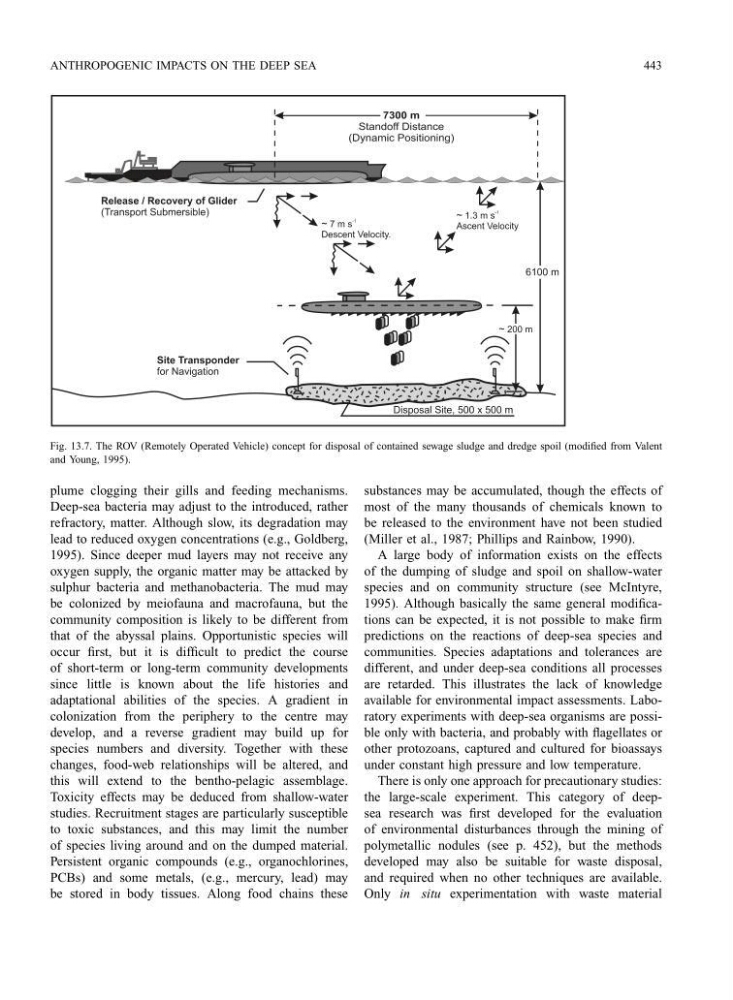
Fig. 13.7. The ROV (Remotely Operated Vehicle) concept for disposal of contained sewage sludge and dredge spoil (modified from Valent
and Young, 1995).
plume clogging their gills and feeding mechanisms.
Deep-sea bacteria may adjust to the introduced, rather
refractory, matter. Although slow, its degradation may
lead to reduced oxygen concentrations (e.g., Goldberg,
1995). Since deeper mud layers may not receive any
oxygen supply, the organic matter may be attacked by
sulphur bacteria and methanobacteria. The mud may
be colonized by meiofauna and macrofauna, but the
community composition is likely to be different from
that of the abyssal plains. Opportunistic species will
occur first, but it is difficult to predict the course
of short-term or long-term community developments
since little is known about the life histories and
adaptational abilities of the species. A gradient in
colonization from the periphery to the centre may
develop, and a reverse gradient may build up for
species numbers and diversity. Together with these
changes, food-web relationships will be altered, and
this will extend to the bentho-pelagic assemblage.
Toxicity effects may be deduced from shallow-water
studies. Recruitment stages are particularly susceptible
to toxic substances, and this may limit the number
of species living around and on the dumped material.
Persistent organic compounds (e.g., organochlorines,
PCBs) and some metals, (e.g., mercury, lead) may
be stored in body tissues. Along food chains these
substances may be accumulated, though the effects of
most of the many thousands of chemicals known to
be released to the environment have not been studied
(Miller et al., 1987; Phillips and Rainbow, 1990).
A large body of information exists on the effects
of the dumping of sludge and spoil on shallow-water
species and on community structure (see McIntyre,
1995). Although basically the same general modifications can be expected, it is not possible to make firm
predictions on the reactions of deep-sea species and
communities. Species adaptations and tolerances are
different, and under deep-sea conditions all processes
are retarded. This illustrates the lack of knowledge
available for environmental impact assessments. Laboratory experiments with deep-sea organisms are possible only with bacteria, and probably with flagellates or
other protozoans, captured and cultured for bioassays
under constant high pressure and low temperature.
There is only one approach for precautionary studies:
the large-scale experiment. This category of deepsea research was first developed for the evaluation
of environmental disturbances through the mining of
polymetallic nodules (see p. 452), but the methods
developed may also be suitable for waste disposal,
and required when no other techniques are available.
Only in situ experimentation with waste material
443
Fig. 13.7. The ROV (Remotely Operated Vehicle) concept for disposal of contained sewage sludge and dredge spoil (modified from Valent
and Young, 1995).
plume clogging their gills and feeding mechanisms.
Deep-sea bacteria may adjust to the introduced, rather
refractory, matter. Although slow, its degradation may
lead to reduced oxygen concentrations (e.g., Goldberg,
1995). Since deeper mud layers may not receive any
oxygen supply, the organic matter may be attacked by
sulphur bacteria and methanobacteria. The mud may
be colonized by meiofauna and macrofauna, but the
community composition is likely to be different from
that of the abyssal plains. Opportunistic species will
occur first, but it is difficult to predict the course
of short-term or long-term community developments
since little is known about the life histories and
adaptational abilities of the species. A gradient in
colonization from the periphery to the centre may
develop, and a reverse gradient may build up for
species numbers and diversity. Together with these
changes, food-web relationships will be altered, and
this will extend to the bentho-pelagic assemblage.
Toxicity effects may be deduced from shallow-water
studies. Recruitment stages are particularly susceptible
to toxic substances, and this may limit the number
of species living around and on the dumped material.
Persistent organic compounds (e.g., organochlorines,
PCBs) and some metals, (e.g., mercury, lead) may
be stored in body tissues. Along food chains these
substances may be accumulated, though the effects of
most of the many thousands of chemicals known to
be released to the environment have not been studied
(Miller et al., 1987; Phillips and Rainbow, 1990).
A large body of information exists on the effects
of the dumping of sludge and spoil on shallow-water
species and on community structure (see McIntyre,
1995). Although basically the same general modifications can be expected, it is not possible to make firm
predictions on the reactions of deep-sea species and
communities. Species adaptations and tolerances are
different, and under deep-sea conditions all processes
are retarded. This illustrates the lack of knowledge
available for environmental impact assessments. Laboratory experiments with deep-sea organisms are possible only with bacteria, and probably with flagellates or
other protozoans, captured and cultured for bioassays
under constant high pressure and low temperature.
There is only one approach for precautionary studies:
the large-scale experiment. This category of deepsea research was first developed for the evaluation
of environmental disturbances through the mining of
polymetallic nodules (see p. 452), but the methods
developed may also be suitable for waste disposal,
and required when no other techniques are available.
Only in situ experimentation with waste material