

ANTHROPOGENIC IMPACTS ON THE DEEP SEA
439
Energy Agency, 1991). Yablokov et al. (1993) reported
on the dumping of nuclear wastes by the former Soviet
Union, though only a few items were deposited in the
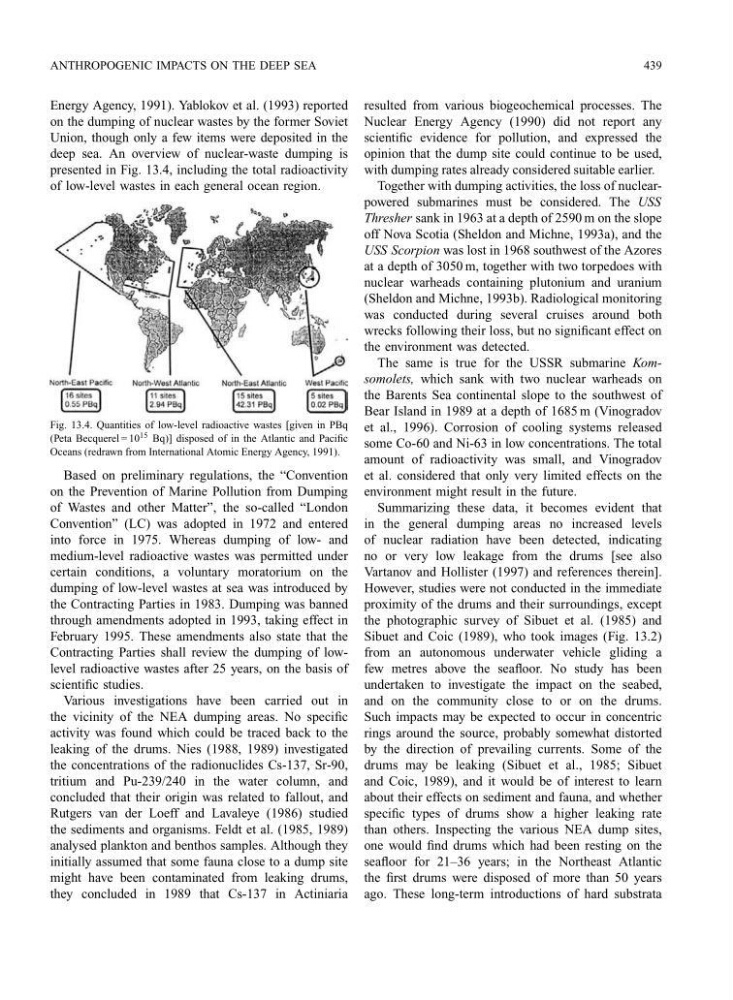
deep sea. An overview of nuclear-waste dumping is
presented in Fig. 13.4, including the total radioactivity
of low-level wastes in each general ocean region.
Fig. 13.4. Quantities of low-level radioactive wastes [given in PBq
(Peta Becquerel = 10 15 Bq)] disposed of in the Atlantic and Pacific
Oceans (redrawn from International Atomic Energy Agency, 1991).
Based on preliminary regulations, the “Convention
on the Prevention of Marine Pollution from Dumping
of Wastes and other Matter”, the so-called “London
Convention” (LC) was adopted in 1972 and entered
into force in 1975. Whereas dumping of low- and
medium-level radioactive wastes was permitted under
certain conditions, a voluntary moratorium on the
dumping of low-level wastes at sea was introduced by
the Contracting Parties in 1983. Dumping was banned
through amendments adopted in 1993, taking effect in
February 1995. These amendments also state that the
Contracting Parties shall review the dumping of lowlevel radioactive wastes after 25 years, on the basis of
scientific studies.
Various investigations have been carried out in
the vicinity of the NEA dumping areas. No specific
activity was found which could be traced back to the
leaking of the drums. Nies (1988, 1989) investigated
the concentrations of the radionuclides Cs-137, Sr-90,
tritium and Pu-239/240 in the water column, and
concluded that their origin was related to fallout, and
Rutgers van der Loeff and Lavaleye (1986) studied
the sediments and organisms. Feldt et al. (1985, 1989)
analysed plankton and benthos samples. Although they
initially assumed that some fauna close to a dump site
might have been contaminated from leaking drums,
they concluded in 1989 that Cs-137 in Actiniaria
resulted from various biogeochemical processes. The
Nuclear Energy Agency (1990) did not report any
scientific evidence for pollution, and expressed the
opinion that the dump site could continue to be used,
with dumping rates already considered suitable earlier.
Together with dumping activities, the loss of nuclearpowered submarines must be considered. The USS
Thresher sank in 1963 at a depth of 2590 m on the slope
off Nova Scotia (Sheldon and Michne, 1993a), and the
USS Scorpion was lost in 1968 southwest of the Azores
at a depth of 3050 m, together with two torpedoes with
nuclear warheads containing plutonium and uranium
(Sheldon and Michne, 1993b). Radiological monitoring
was conducted during several cruises around both
wrecks following their loss, but no significant effect on
the environment was detected.
The same is true for the USSR submarine Komsomolets, which sank with two nuclear warheads on
the Barents Sea continental slope to the southwest of
Bear Island in 1989 at a depth of 1685 m (Vinogradov
et al., 1996). Corrosion of cooling systems released
some Co-60 and Ni-63 in low concentrations. The total
amount of radioactivity was small, and Vinogradov
et al. considered that only very limited effects on the
environment might result in the future.
Summarizing these data, it becomes evident that
in the general dumping areas no increased levels
of nuclear radiation have been detected, indicating
no or very low leakage from the drums [see also
Vartanov and Hollister (1997) and references therein].
However, studies were not conducted in the immediate
proximity of the drums and their surroundings, except
the photographic survey of Sibuet et al. (1985) and
Sibuet and Coic (1989), who took images (Fig. 13.2)
from an autonomous underwater vehicle gliding a
few metres above the seafloor. No study has been
undertaken to investigate the impact on the seabed,
and on the community close to or on the drums.
Such impacts may be expected to occur in concentric
rings around the source, probably somewhat distorted
by the direction of prevailing currents. Some of the
drums may be leaking (Sibuet et al., 1985; Sibuet
and Coic, 1989), and it would be of interest to learn
about their effects on sediment and fauna, and whether
specific types of drums show a higher leaking rate
than others. Inspecting the various NEA dump sites,
one would find drums which had been resting on the
seafloor for 21–36 years; in the Northeast Atlantic
the first drums were disposed of more than 50 years
ago. These long-term introductions of hard substrata
439
Energy Agency, 1991). Yablokov et al. (1993) reported
on the dumping of nuclear wastes by the former Soviet
Union, though only a few items were deposited in the
deep sea. An overview of nuclear-waste dumping is
presented in Fig. 13.4, including the total radioactivity
of low-level wastes in each general ocean region.
Fig. 13.4. Quantities of low-level radioactive wastes [given in PBq
(Peta Becquerel = 10 15 Bq)] disposed of in the Atlantic and Pacific
Oceans (redrawn from International Atomic Energy Agency, 1991).
Based on preliminary regulations, the “Convention
on the Prevention of Marine Pollution from Dumping
of Wastes and other Matter”, the so-called “London
Convention” (LC) was adopted in 1972 and entered
into force in 1975. Whereas dumping of low- and
medium-level radioactive wastes was permitted under
certain conditions, a voluntary moratorium on the
dumping of low-level wastes at sea was introduced by
the Contracting Parties in 1983. Dumping was banned
through amendments adopted in 1993, taking effect in
February 1995. These amendments also state that the
Contracting Parties shall review the dumping of lowlevel radioactive wastes after 25 years, on the basis of
scientific studies.
Various investigations have been carried out in
the vicinity of the NEA dumping areas. No specific
activity was found which could be traced back to the
leaking of the drums. Nies (1988, 1989) investigated
the concentrations of the radionuclides Cs-137, Sr-90,
tritium and Pu-239/240 in the water column, and
concluded that their origin was related to fallout, and
Rutgers van der Loeff and Lavaleye (1986) studied
the sediments and organisms. Feldt et al. (1985, 1989)
analysed plankton and benthos samples. Although they
initially assumed that some fauna close to a dump site
might have been contaminated from leaking drums,
they concluded in 1989 that Cs-137 in Actiniaria
resulted from various biogeochemical processes. The
Nuclear Energy Agency (1990) did not report any
scientific evidence for pollution, and expressed the
opinion that the dump site could continue to be used,
with dumping rates already considered suitable earlier.
Together with dumping activities, the loss of nuclearpowered submarines must be considered. The USS
Thresher sank in 1963 at a depth of 2590 m on the slope
off Nova Scotia (Sheldon and Michne, 1993a), and the
USS Scorpion was lost in 1968 southwest of the Azores
at a depth of 3050 m, together with two torpedoes with
nuclear warheads containing plutonium and uranium
(Sheldon and Michne, 1993b). Radiological monitoring
was conducted during several cruises around both
wrecks following their loss, but no significant effect on
the environment was detected.
The same is true for the USSR submarine Komsomolets, which sank with two nuclear warheads on
the Barents Sea continental slope to the southwest of
Bear Island in 1989 at a depth of 1685 m (Vinogradov
et al., 1996). Corrosion of cooling systems released
some Co-60 and Ni-63 in low concentrations. The total
amount of radioactivity was small, and Vinogradov
et al. considered that only very limited effects on the
environment might result in the future.
Summarizing these data, it becomes evident that
in the general dumping areas no increased levels
of nuclear radiation have been detected, indicating
no or very low leakage from the drums [see also
Vartanov and Hollister (1997) and references therein].
However, studies were not conducted in the immediate
proximity of the drums and their surroundings, except
the photographic survey of Sibuet et al. (1985) and
Sibuet and Coic (1989), who took images (Fig. 13.2)
from an autonomous underwater vehicle gliding a
few metres above the seafloor. No study has been
undertaken to investigate the impact on the seabed,
and on the community close to or on the drums.
Such impacts may be expected to occur in concentric
rings around the source, probably somewhat distorted
by the direction of prevailing currents. Some of the
drums may be leaking (Sibuet et al., 1985; Sibuet
and Coic, 1989), and it would be of interest to learn
about their effects on sediment and fauna, and whether
specific types of drums show a higher leaking rate
than others. Inspecting the various NEA dump sites,
one would find drums which had been resting on the
seafloor for 21–36 years; in the Northeast Atlantic
the first drums were disposed of more than 50 years
ago. These long-term introductions of hard substrata