

REPRODUCTION, DEVELOPMENT AND LIFE-HISTORY TRAITS
413
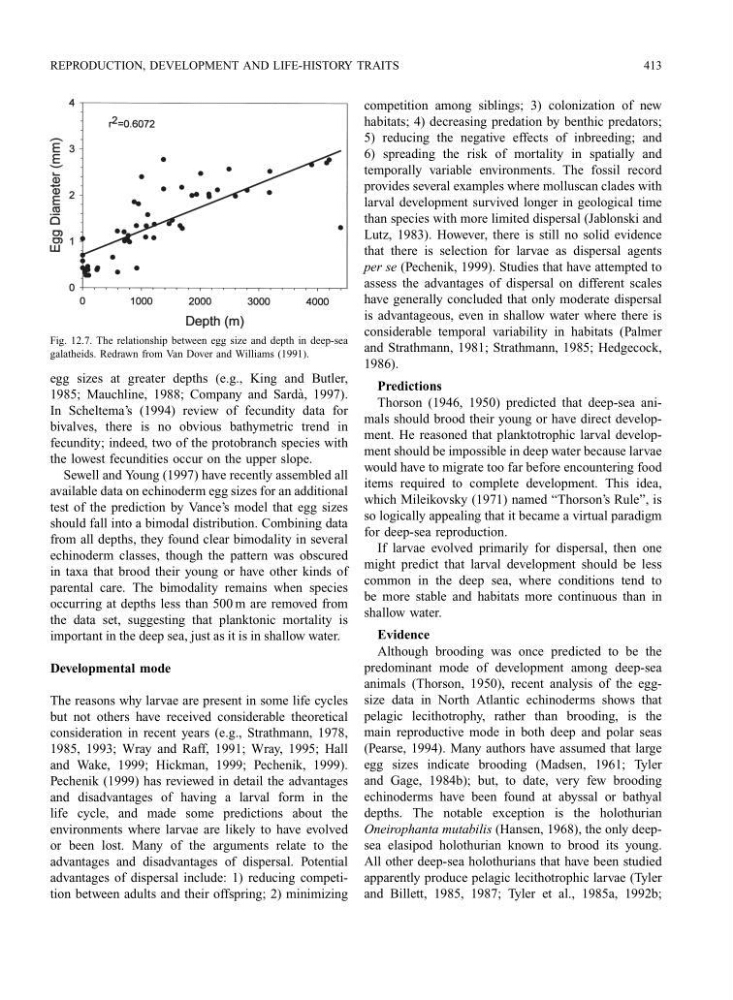
Fig. 12.7. The relationship between egg size and depth in deep-sea
galatheids. Redrawn from Van Dover and Williams (1991).
egg sizes at greater depths (e.g., King and Butler,
1985; Mauchline, 1988; Company and Sard` a, 1997).
In Scheltema’s (1994) review of fecundity data for
bivalves, there is no obvious bathymetric trend in
fecundity; indeed, two of the protobranch species with
the lowest fecundities occur on the upper slope.
Sewell and Young (1997) have recently assembled all
available data on echinoderm egg sizes for an additional
test of the prediction by Vance’s model that egg sizes
should fall into a bimodal distribution. Combining data
from all depths, they found clear bimodality in several
echinoderm classes, though the pattern was obscured
in taxa that brood their young or have other kinds of
parental care. The bimodality remains when species
occurring at depths less than 500 m are removed from
the data set, suggesting that planktonic mortality is
important in the deep sea, just as it is in shallow water.
Developmental mode
The reasons why larvae are present in some life cycles
but not others have received considerable theoretical
consideration in recent years (e.g., Strathmann, 1978,
1985, 1993; Wray and Raff, 1991; Wray, 1995; Hall
and Wake, 1999; Hickman, 1999; Pechenik, 1999).
Pechenik (1999) has reviewed in detail the advantages
and disadvantages of having a larval form in the
life cycle, and made some predictions about the
environments where larvae are likely to have evolved
or been lost. Many of the arguments relate to the
advantages and disadvantages of dispersal. Potential
advantages of dispersal include: 1) reducing competition between adults and their offspring; 2) minimizing
competition among siblings; 3) colonization of new
habitats; 4) decreasing predation by benthic predators;
5) reducing the negative effects of inbreeding; and
6) spreading the risk of mortality in spatially and
temporally variable environments. The fossil record
provides several examples where molluscan clades with
larval development survived longer in geological time
than species with more limited dispersal (Jablonski and
Lutz, 1983). However, there is still no solid evidence
that there is selection for larvae as dispersal agents
per se (Pechenik, 1999). Studies that have attempted to
assess the advantages of dispersal on different scales
have generally concluded that only moderate dispersal
is advantageous, even in shallow water where there is
considerable temporal variability in habitats (Palmer
and Strathmann, 1981; Strathmann, 1985; Hedgecock,
1986).
Predictions
Thorson (1946, 1950) predicted that deep-sea animals should brood their young or have direct development. He reasoned that planktotrophic larval development should be impossible in deep water because larvae
would have to migrate too far before encountering food
items required to complete development. This idea,
which Mileikovsky (1971) named “Thorson’s Rule”, is
so logically appealing that it became a virtual paradigm
for deep-sea reproduction.
If larvae evolved primarily for dispersal, then one
might predict that larval development should be less
common in the deep sea, where conditions tend to
be more stable and habitats more continuous than in
shallow water.
Evidence
Although brooding was once predicted to be the
predominant mode of development among deep-sea
animals (Thorson, 1950), recent analysis of the eggsize data in North Atlantic echinoderms shows that
pelagic lecithotrophy, rather than brooding, is the
main reproductive mode in both deep and polar seas
(Pearse, 1994). Many authors have assumed that large
egg sizes indicate brooding (Madsen, 1961; Tyler
and Gage, 1984b); but, to date, very few brooding
echinoderms have been found at abyssal or bathyal
depths. The notable exception is the holothurian
Oneirophanta mutabilis (Hansen, 1968), the only deepsea elasipod holothurian known to brood its young.
All other deep-sea holothurians that have been studied
apparently produce pelagic lecithotrophic larvae (Tyler
and Billett, 1985, 1987; Tyler et al., 1985a, 1992b;
413
Fig. 12.7. The relationship between egg size and depth in deep-sea
galatheids. Redrawn from Van Dover and Williams (1991).
egg sizes at greater depths (e.g., King and Butler,
1985; Mauchline, 1988; Company and Sard` a, 1997).
In Scheltema’s (1994) review of fecundity data for
bivalves, there is no obvious bathymetric trend in
fecundity; indeed, two of the protobranch species with
the lowest fecundities occur on the upper slope.
Sewell and Young (1997) have recently assembled all
available data on echinoderm egg sizes for an additional
test of the prediction by Vance’s model that egg sizes
should fall into a bimodal distribution. Combining data
from all depths, they found clear bimodality in several
echinoderm classes, though the pattern was obscured
in taxa that brood their young or have other kinds of
parental care. The bimodality remains when species
occurring at depths less than 500 m are removed from
the data set, suggesting that planktonic mortality is
important in the deep sea, just as it is in shallow water.
Developmental mode
The reasons why larvae are present in some life cycles
but not others have received considerable theoretical
consideration in recent years (e.g., Strathmann, 1978,
1985, 1993; Wray and Raff, 1991; Wray, 1995; Hall
and Wake, 1999; Hickman, 1999; Pechenik, 1999).
Pechenik (1999) has reviewed in detail the advantages
and disadvantages of having a larval form in the
life cycle, and made some predictions about the
environments where larvae are likely to have evolved
or been lost. Many of the arguments relate to the
advantages and disadvantages of dispersal. Potential
advantages of dispersal include: 1) reducing competition between adults and their offspring; 2) minimizing
competition among siblings; 3) colonization of new
habitats; 4) decreasing predation by benthic predators;
5) reducing the negative effects of inbreeding; and
6) spreading the risk of mortality in spatially and
temporally variable environments. The fossil record
provides several examples where molluscan clades with
larval development survived longer in geological time
than species with more limited dispersal (Jablonski and
Lutz, 1983). However, there is still no solid evidence
that there is selection for larvae as dispersal agents
per se (Pechenik, 1999). Studies that have attempted to
assess the advantages of dispersal on different scales
have generally concluded that only moderate dispersal
is advantageous, even in shallow water where there is
considerable temporal variability in habitats (Palmer
and Strathmann, 1981; Strathmann, 1985; Hedgecock,
1986).
Predictions
Thorson (1946, 1950) predicted that deep-sea animals should brood their young or have direct development. He reasoned that planktotrophic larval development should be impossible in deep water because larvae
would have to migrate too far before encountering food
items required to complete development. This idea,
which Mileikovsky (1971) named “Thorson’s Rule”, is
so logically appealing that it became a virtual paradigm
for deep-sea reproduction.
If larvae evolved primarily for dispersal, then one
might predict that larval development should be less
common in the deep sea, where conditions tend to
be more stable and habitats more continuous than in
shallow water.
Evidence
Although brooding was once predicted to be the
predominant mode of development among deep-sea
animals (Thorson, 1950), recent analysis of the eggsize data in North Atlantic echinoderms shows that
pelagic lecithotrophy, rather than brooding, is the
main reproductive mode in both deep and polar seas
(Pearse, 1994). Many authors have assumed that large
egg sizes indicate brooding (Madsen, 1961; Tyler
and Gage, 1984b); but, to date, very few brooding
echinoderms have been found at abyssal or bathyal
depths. The notable exception is the holothurian
Oneirophanta mutabilis (Hansen, 1968), the only deepsea elasipod holothurian known to brood its young.
All other deep-sea holothurians that have been studied
apparently produce pelagic lecithotrophic larvae (Tyler
and Billett, 1985, 1987; Tyler et al., 1985a, 1992b;