

396
Craig M. YOUNG
permanent record of larval size and growth (Thorson,
1950; Jablonski and Lutz, 1983; Scheltema, 1994).
The shell-apex method permits discrimination between
species with non-planktotrophic and planktotrophic
larvae, but does not resolve differences between species
with pelagic lecithotrophic larvae and species that
brood their young or hatch as juveniles from benthic
egg capsules (Jablonski and Lutz, 1983). Despite this
limitation, the method has been applied to a very
large number of deep-sea species. Many such studies
have focused on species from distinct geographical
regions of the Atlantic (Bouchet, 1976b; Rex and
War´ en, 1982; Colman et al., 1986b) and on species
from cold seeps and hydrothermal vents (reviewed
by Gustafson and Lutz, 1994). A selection of these
studies is summarized in Table 12.5. Although both
planktotrophic and non-planktotrophic development are
common among bathyal and abyssal molluscs, some
groups have peak numbers of lecithotrophic species
at slope depths (Rex and War´ en, 1982), and others,
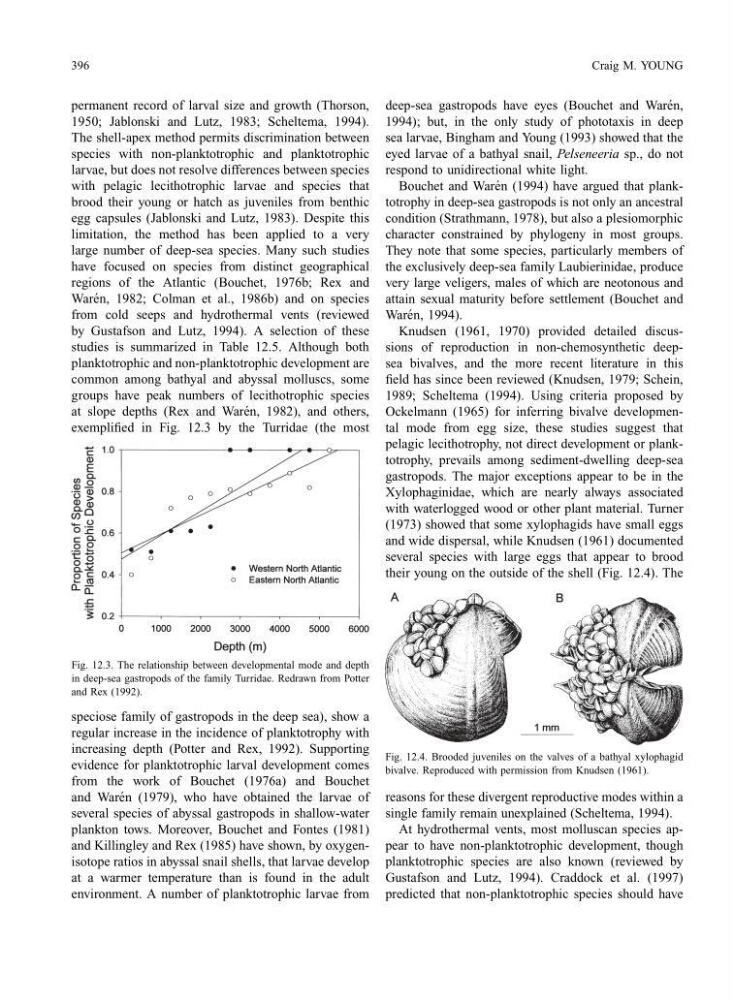
exemplified in Fig. 12.3 by the Turridae (the most
Fig. 12.3. The relationship between developmental mode and depth
in deep-sea gastropods of the family Turridae. Redrawn from Potter
and Rex (1992).
speciose family of gastropods in the deep sea), show a
regular increase in the incidence of planktotrophy with
increasing depth (Potter and Rex, 1992). Supporting
evidence for planktotrophic larval development comes
from the work of Bouchet (1976a) and Bouchet
and War´ en (1979), who have obtained the larvae of
several species of abyssal gastropods in shallow-water
plankton tows. Moreover, Bouchet and Fontes (1981)
and Killingley and Rex (1985) have shown, by oxygenisotope ratios in abyssal snail shells, that larvae develop
at a warmer temperature than is found in the adult
environment. A number of planktotrophic larvae from
deep-sea gastropods have eyes (Bouchet and War´ en,
1994); but, in the only study of phototaxis in deep
sea larvae, Bingham and Young (1993) showed that the
eyed larvae of a bathyal snail, Pelseneeria sp., do not
respond to unidirectional white light.
Bouchet and War´ en (1994) have argued that planktotrophy in deep-sea gastropods is not only an ancestral
condition (Strathmann, 1978), but also a plesiomorphic
character constrained by phylogeny in most groups.
They note that some species, particularly members of
the exclusively deep-sea family Laubierinidae, produce
very large veligers, males of which are neotonous and
attain sexual maturity before settlement (Bouchet and
War´ en, 1994).
Knudsen (1961, 1970) provided detailed discussions of reproduction in non-chemosynthetic deepsea bivalves, and the more recent literature in this
field has since been reviewed (Knudsen, 1979; Schein,
1989; Scheltema (1994). Using criteria proposed by
Ockelmann (1965) for inferring bivalve developmental mode from egg size, these studies suggest that
pelagic lecithotrophy, not direct development or planktotrophy, prevails among sediment-dwelling deep-sea
gastropods. The major exceptions appear to be in the
Xylophaginidae, which are nearly always associated
with waterlogged wood or other plant material. Turner
(1973) showed that some xylophagids have small eggs
and wide dispersal, while Knudsen (1961) documented
several species with large eggs that appear to brood
their young on the outside of the shell (Fig. 12.4). The
Fig. 12.4. Brooded juveniles on the valves of a bathyal xylophagid
bivalve. Reproduced with permission from Knudsen (1961).
reasons for these divergent reproductive modes within a
single family remain unexplained (Scheltema, 1994).
At hydrothermal vents, most molluscan species appear to have non-planktotrophic development, though
planktotrophic species are also known (reviewed by
Gustafson and Lutz, 1994). Craddock et al. (1997)
predicted that non-planktotrophic species should have
Craig M. YOUNG
permanent record of larval size and growth (Thorson,
1950; Jablonski and Lutz, 1983; Scheltema, 1994).
The shell-apex method permits discrimination between
species with non-planktotrophic and planktotrophic
larvae, but does not resolve differences between species
with pelagic lecithotrophic larvae and species that
brood their young or hatch as juveniles from benthic
egg capsules (Jablonski and Lutz, 1983). Despite this
limitation, the method has been applied to a very
large number of deep-sea species. Many such studies
have focused on species from distinct geographical
regions of the Atlantic (Bouchet, 1976b; Rex and
War´ en, 1982; Colman et al., 1986b) and on species
from cold seeps and hydrothermal vents (reviewed
by Gustafson and Lutz, 1994). A selection of these
studies is summarized in Table 12.5. Although both
planktotrophic and non-planktotrophic development are
common among bathyal and abyssal molluscs, some
groups have peak numbers of lecithotrophic species
at slope depths (Rex and War´ en, 1982), and others,
exemplified in Fig. 12.3 by the Turridae (the most
Fig. 12.3. The relationship between developmental mode and depth
in deep-sea gastropods of the family Turridae. Redrawn from Potter
and Rex (1992).
speciose family of gastropods in the deep sea), show a
regular increase in the incidence of planktotrophy with
increasing depth (Potter and Rex, 1992). Supporting
evidence for planktotrophic larval development comes
from the work of Bouchet (1976a) and Bouchet
and War´ en (1979), who have obtained the larvae of
several species of abyssal gastropods in shallow-water
plankton tows. Moreover, Bouchet and Fontes (1981)
and Killingley and Rex (1985) have shown, by oxygenisotope ratios in abyssal snail shells, that larvae develop
at a warmer temperature than is found in the adult
environment. A number of planktotrophic larvae from
deep-sea gastropods have eyes (Bouchet and War´ en,
1994); but, in the only study of phototaxis in deep
sea larvae, Bingham and Young (1993) showed that the
eyed larvae of a bathyal snail, Pelseneeria sp., do not
respond to unidirectional white light.
Bouchet and War´ en (1994) have argued that planktotrophy in deep-sea gastropods is not only an ancestral
condition (Strathmann, 1978), but also a plesiomorphic
character constrained by phylogeny in most groups.
They note that some species, particularly members of
the exclusively deep-sea family Laubierinidae, produce
very large veligers, males of which are neotonous and
attain sexual maturity before settlement (Bouchet and
War´ en, 1994).
Knudsen (1961, 1970) provided detailed discussions of reproduction in non-chemosynthetic deepsea bivalves, and the more recent literature in this
field has since been reviewed (Knudsen, 1979; Schein,
1989; Scheltema (1994). Using criteria proposed by
Ockelmann (1965) for inferring bivalve developmental mode from egg size, these studies suggest that
pelagic lecithotrophy, not direct development or planktotrophy, prevails among sediment-dwelling deep-sea
gastropods. The major exceptions appear to be in the
Xylophaginidae, which are nearly always associated
with waterlogged wood or other plant material. Turner
(1973) showed that some xylophagids have small eggs
and wide dispersal, while Knudsen (1961) documented
several species with large eggs that appear to brood
their young on the outside of the shell (Fig. 12.4). The
Fig. 12.4. Brooded juveniles on the valves of a bathyal xylophagid
bivalve. Reproduced with permission from Knudsen (1961).
reasons for these divergent reproductive modes within a
single family remain unexplained (Scheltema, 1994).
At hydrothermal vents, most molluscan species appear to have non-planktotrophic development, though
planktotrophic species are also known (reviewed by
Gustafson and Lutz, 1994). Craddock et al. (1997)
predicted that non-planktotrophic species should have