

REPRODUCTION, DEVELOPMENT AND LIFE-HISTORY TRAITS
391
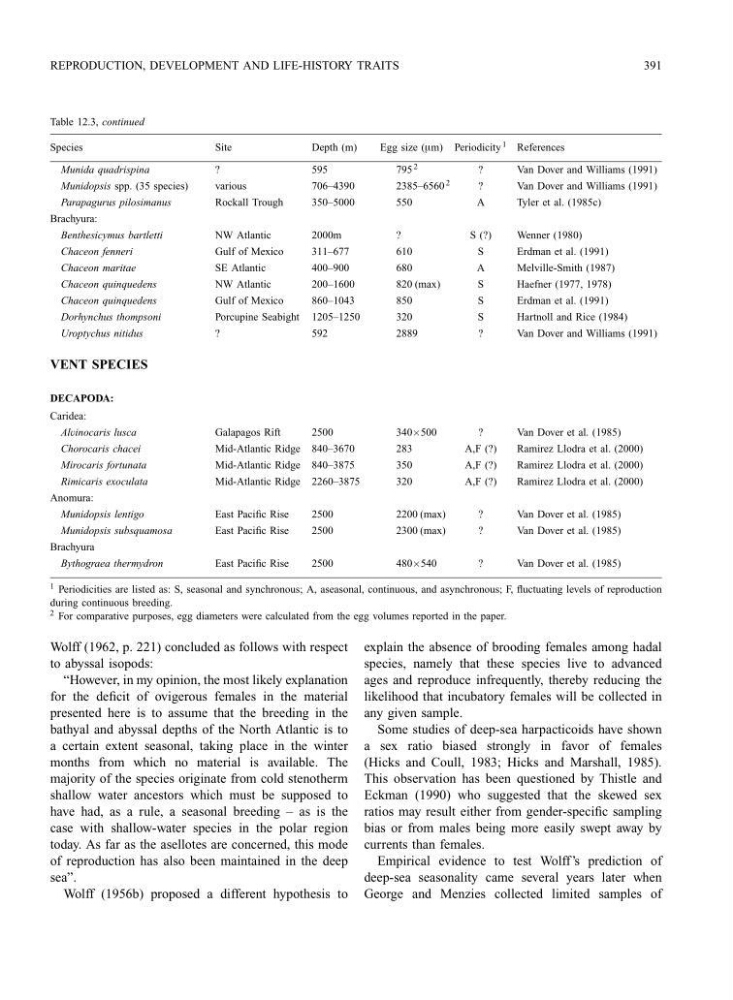
Table 12.3, continued
Species
Site
Depth (m)
Egg size (mm) Periodicity 1 References
Munida quadrispina
?
595
795 2
?
Van Dover and Williams (1991)
Munidopsis spp. (35 species)
various
706–4390
2385–6560 2
?
Van Dover and Williams (1991)
Parapagurus pilosimanus
Rockall Trough
350–5000
550
A
Tyler et al. (1985c)
Brachyura:
Benthesicymus bartletti
NW Atlantic
2000m
?
S (?)
Wenner (1980)
Chaceon fenneri
Gulf of Mexico
311–677
610
S
Erdman et al. (1991)
Chaceon maritae
SE Atlantic
400–900
680
A
Melville-Smith (1987)
Chaceon quinquedens
NW Atlantic
200–1600
820 (max)
S
Haefner (1977, 1978)
Chaceon quinquedens
Gulf of Mexico
860–1043
850
S
Erdman et al. (1991)
Dorhynchus thompsoni
Porcupine Seabight 1205–1250
320
S
Hartnoll and Rice (1984)
Uroptychus nitidus
?
592
2889
?
Van Dover and Williams (1991)
VENT SPECIES
DECAPODA:
Caridea:
Alvinocaris lusca
Galapagos Rift
2500
340×500
?
Van Dover et al. (1985)
Chorocaris chacei
Mid-Atlantic Ridge 840–3670
283
A,F (?)
Ramirez Llodra et al. (2000)
Mirocaris fortunata
Mid-Atlantic Ridge 840–3875
350
A,F (?)
Ramirez Llodra et al. (2000)
Rimicaris exoculata
Mid-Atlantic Ridge 2260–3875
320
A,F (?)
Ramirez Llodra et al. (2000)
Anomura:
Munidopsis lentigo
East Pacific Rise
2500
2200 (max)
?
Van Dover et al. (1985)
Munidopsis subsquamosa
East Pacific Rise
2500
2300 (max)
?
Van Dover et al. (1985)
Brachyura
Bythograea thermydron
East Pacific Rise
2500
480×540
?
Van Dover et al. (1985)
1 Periodicities are listed as: S, seasonal and synchronous; A, aseasonal, continuous, and asynchronous; F, fluctuating levels of reproduction
during continuous breeding.
2 For comparative purposes, egg diameters were calculated from the egg volumes reported in the paper.
Wolff (1962, p. 221) concluded as follows with respect
to abyssal isopods:
“However, in my opinion, the most likely explanation
for the deficit of ovigerous females in the material
presented here is to assume that the breeding in the
bathyal and abyssal depths of the North Atlantic is to
a certain extent seasonal, taking place in the winter
months from which no material is available. The
majority of the species originate from cold stenotherm
shallow water ancestors which must be supposed to
have had, as a rule, a seasonal breeding – as is the
case with shallow-water species in the polar region
today. As far as the asellotes are concerned, this mode
of reproduction has also been maintained in the deep
sea”.
Wolff (1956b) proposed a different hypothesis to
explain the absence of brooding females among hadal
species, namely that these species live to advanced
ages and reproduce infrequently, thereby reducing the
likelihood that incubatory females will be collected in
any given sample.
Some studies of deep-sea harpacticoids have shown
a sex ratio biased strongly in favor of females
(Hicks and Coull, 1983; Hicks and Marshall, 1985).
This observation has been questioned by Thistle and
Eckman (1990) who suggested that the skewed sex
ratios may result either from gender-specific sampling
bias or from males being more easily swept away by
currents than females.
Empirical evidence to test Wolff ’s prediction of
deep-sea seasonality came several years later when
George and Menzies collected limited samples of
391
Table 12.3, continued
Species
Site
Depth (m)
Egg size (mm) Periodicity 1 References
Munida quadrispina
?
595
795 2
?
Van Dover and Williams (1991)
Munidopsis spp. (35 species)
various
706–4390
2385–6560 2
?
Van Dover and Williams (1991)
Parapagurus pilosimanus
Rockall Trough
350–5000
550
A
Tyler et al. (1985c)
Brachyura:
Benthesicymus bartletti
NW Atlantic
2000m
?
S (?)
Wenner (1980)
Chaceon fenneri
Gulf of Mexico
311–677
610
S
Erdman et al. (1991)
Chaceon maritae
SE Atlantic
400–900
680
A
Melville-Smith (1987)
Chaceon quinquedens
NW Atlantic
200–1600
820 (max)
S
Haefner (1977, 1978)
Chaceon quinquedens
Gulf of Mexico
860–1043
850
S
Erdman et al. (1991)
Dorhynchus thompsoni
Porcupine Seabight 1205–1250
320
S
Hartnoll and Rice (1984)
Uroptychus nitidus
?
592
2889
?
Van Dover and Williams (1991)
VENT SPECIES
DECAPODA:
Caridea:
Alvinocaris lusca
Galapagos Rift
2500
340×500
?
Van Dover et al. (1985)
Chorocaris chacei
Mid-Atlantic Ridge 840–3670
283
A,F (?)
Ramirez Llodra et al. (2000)
Mirocaris fortunata
Mid-Atlantic Ridge 840–3875
350
A,F (?)
Ramirez Llodra et al. (2000)
Rimicaris exoculata
Mid-Atlantic Ridge 2260–3875
320
A,F (?)
Ramirez Llodra et al. (2000)
Anomura:
Munidopsis lentigo
East Pacific Rise
2500
2200 (max)
?
Van Dover et al. (1985)
Munidopsis subsquamosa
East Pacific Rise
2500
2300 (max)
?
Van Dover et al. (1985)
Brachyura
Bythograea thermydron
East Pacific Rise
2500
480×540
?
Van Dover et al. (1985)
1 Periodicities are listed as: S, seasonal and synchronous; A, aseasonal, continuous, and asynchronous; F, fluctuating levels of reproduction
during continuous breeding.
2 For comparative purposes, egg diameters were calculated from the egg volumes reported in the paper.
Wolff (1962, p. 221) concluded as follows with respect
to abyssal isopods:
“However, in my opinion, the most likely explanation
for the deficit of ovigerous females in the material
presented here is to assume that the breeding in the
bathyal and abyssal depths of the North Atlantic is to
a certain extent seasonal, taking place in the winter
months from which no material is available. The
majority of the species originate from cold stenotherm
shallow water ancestors which must be supposed to
have had, as a rule, a seasonal breeding – as is the
case with shallow-water species in the polar region
today. As far as the asellotes are concerned, this mode
of reproduction has also been maintained in the deep
sea”.
Wolff (1956b) proposed a different hypothesis to
explain the absence of brooding females among hadal
species, namely that these species live to advanced
ages and reproduce infrequently, thereby reducing the
likelihood that incubatory females will be collected in
any given sample.
Some studies of deep-sea harpacticoids have shown
a sex ratio biased strongly in favor of females
(Hicks and Coull, 1983; Hicks and Marshall, 1985).
This observation has been questioned by Thistle and
Eckman (1990) who suggested that the skewed sex
ratios may result either from gender-specific sampling
bias or from males being more easily swept away by
currents than females.
Empirical evidence to test Wolff ’s prediction of
deep-sea seasonality came several years later when
George and Menzies collected limited samples of